Expand the wavefunction in unperturbed energy eigenstates,The are interaction picture probability amplitudes, so are level populations and in this closed two-level system. A classical field supplies the electric-dipole interaction . Choosing the relative phase of the energy eigenstates makes real. This is the resonant Rabi angular frequency.
Combining the field's two exponentials with the unperturbed quantum phases produces terms oscillating at and at . The rotating-wave approximation drops the latter, leaving exactly the supplied equations with coupling . It requires and a field envelope slow enough on the carrier timescale. Spontaneous emission and dephasing must be negligible during the sequence. For a ground-state hyperfine level transition, the analogous direct drive is a magnetic dipole transition; the same equations hold with the magnetic matrix element replacing the electric one.
Assume an initially unexcited chemical atom, two nonoverlapping square pulses starting at , and a common coherent field phase. In the weak-excitation limit , substitute into the second probability amplitude equation. After the second pulse,where the sinc function means , with value one at zero. Squaring givesThe printed prefactor is a factor of four too small for the supplied equations and pulse durations. A direct counterexample is : the exact resonant Rabi oscillation gives for two pulses of duration , because the intervening resonant rotating-frame evolution is trivial. Its small-area limit is , rather than . The latter is the single-pulse result before coherent addition.
The condition printed in the source also does not justify the derivation from a physical carrier field. A consistent rotating-wave approximation pulse regime isIf the supplied equations are treated as the mathematical model regardless, their weak-excitation integral remains valid for any ; subcycle pulses of the original real field require the discarded counter-rotating term and depend on carrier phase. here is the separation of pulse starts, as specified, rather than the dark interval .
The ground electron configuration of caesium has a single electron, with . Addition of angular momentum giving fixes the nuclear spin to . With dimensionless angular momentum operators, write the Fermi contact interaction asThe two hyperfine levels therefore differ by . In the convention and ,This exposes a missing ingredient in a prediction from the supplied data: and alone do not specify the valence electron contact density. Screening effect and penetration of the closed core strongly affect it. If instead denotes the total nuclear moment in units of , it must first be divided by in the displayed convention.
An explicitly crude unscreened hydrogen-like ion model uses and gives , or . It describes neither the shielding nor the radial function of neutral caesium. Using a pure unit-charge hydrogen orbital instead gives only , illustrating why a unique useful estimate cannot follow from an unspecified effective charge.
For physical neutral , the independently known zero-magnetic field clock transition isThis measured frequency, used to define the second, is supplementary physical information, not a consequence of and the rounded alone.[ref]
SI base unit: second (s) by Bureau International des Poids et Mesures. Definition: the unperturbed ground-state hyperfine transition frequency of caesium-133 is exactly 9 192 631 770 Hz
The direct electronic transition is in the microwave range and is a magnetic dipole transition, rather than a direct optical electric dipole transition. An optical implementation needs a two-field Raman transition.Using the corrected weak-pulse Ramsey spectrum of part (b), the peak at has height . The quantum interference fringes have spacing in angular frequency, with zeros at , and the sinc function envelope has its first zeros at . For , the central peak has approximately full width at half maximum in angular frequency. The clock transition between the two states has no first-order Zeeman energy, although a quadratic one remains.
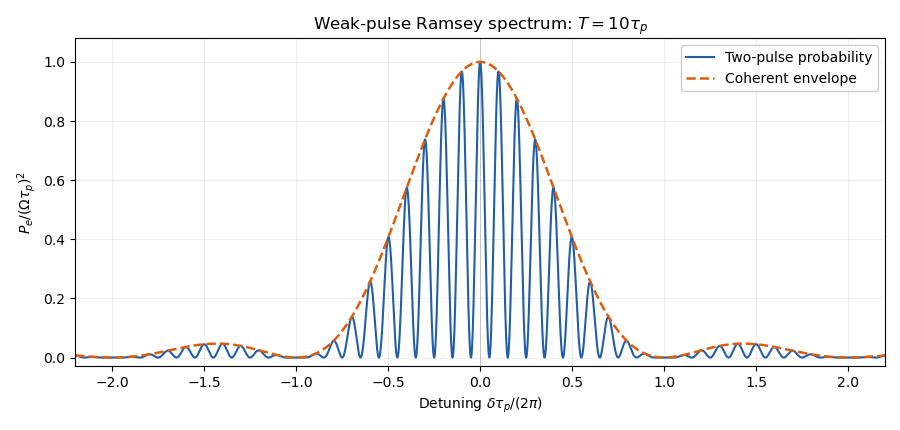

The first-order excitation amplitude is the Fourier transform of the temporal pulse envelope evaluated at the Rabi detuning. Two rectangular time windows therefore give exactly the mathematical structure of double-slit interference: each window gives a sinc function amplitude, and their separation gives a relative quantum phase . The transition probability is a sinc function squared envelope multiplied by .
Pulse duration corresponds to slit width, pulse-start separation to slit-center separation, and Rabi detuning to the transverse wavevector sampled on the screen. The narrow fringes measure the long separation, while the broad envelope measures the short interaction duration. As in spatial interference, adding probabilities instead of coherent probability amplitudes would lose the fringes. Randomizing the relative pulse phase averages the cosine squared to .
Differentiating the specified rotating-frame amplitudes gives the time-independent Schrödinger equationThe characteristic polynomial is , henceFor , corresponding normalized eigenvectors are proportional to . Their arbitrary complex coefficients evolve as ; this solves the amplitude equations for any initial quantum state.
Restoring the common energy origin , the two dressed state energy eigenvalues areThus their positive energy separation increases byEquivalently, the branches connected to and shift by and respectively. Their signed difference changes by , which is the printed expression with a signed convention. For negative Rabi detuning, an actual positive separation still increases; for example at it cannot have the negative change implied by reading the printed expression as an unsigned gap. These opposite AC Stark shifts describe level repulsion.
Articles by others on the same topic
There are currently no matching articles.