Fix the qubit polarization convention by , where the Pauli matrices are ordered in the basis and . Thus the ground state is the north pole of the Bloch sphere. In a rotating frame and within the rotating-wave approximation, choose the drive phase and detuning sign so thatFor example, with this ground-state convention one may take and choose the transverse coupling positive. The Bloch vector precesses around the effective field at angular frequency , tracing a circle at fixed projection on that axis. Its length is conserved under coherent unitary time evolution. On resonance the axis is transverse and the Rabi oscillation can fully invert an initially ground-state atom. Away from resonance the axis tilts, andThere is no relaxation towards an equilibrium Bloch vector in this ideal model. An inhomogeneous ensemble can nevertheless lose its averaged qubit polarization through dephasing even without spontaneous emission; the circle description assumes a common drive and detuning.
For , the stated quantum state givesThe diagonal elements are the two state populations. The off-diagonal elements are quantum coherences: they retain the relative quantum phase and determine interference under a subsequent pulse. This is a pure state, even if both populations are nonzero: , , and . A mixed state averages projectors over preparation probabilities and generally has . Equal populations alone do not distinguish an equal coherent superposition from an unpolarized mixture.
For use in all three cases, multiplication of the gates gives the Hadamard-phase-Hadamard qubit rotationThe global phase cancels in . Thus the Bloch vector map is
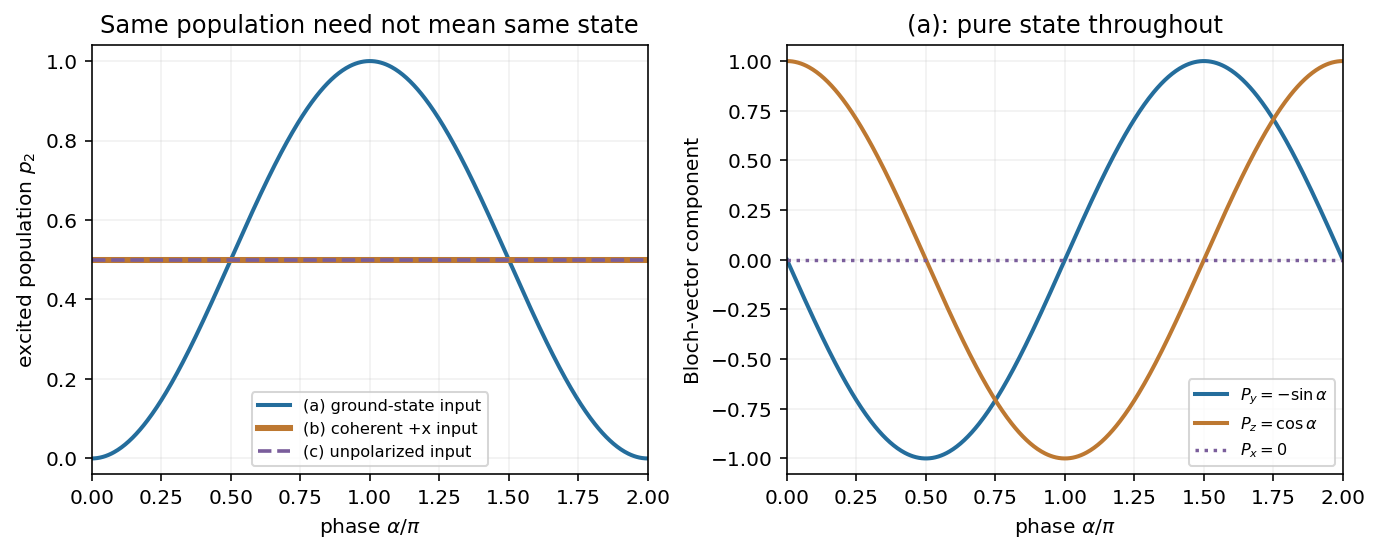
The final unlabelled Ramsey spectroscopy comparison applies to the three cases as follows. In an atomic clock, an initial coherent pulse prepares a superposition, a free interval accumulates a relative quantum phase proportional to detuning times , and a final coherent pulse converts that phase to a population. Here plays the role of that accumulated phase, with sign and fringe offset set by pulse conventions. In (a), the first Hadamard gate creates the needed superposition and the final gate reveals full-contrast Ramsey interferometry. In (b), the first Hadamard gate instead puts the state in , so the intervening phase gate has no relative quantum phase to imprint: the output is independent of . In (c), the unpolarized density matrix remains unchanged under every gate, so the ensemble has no Ramsey interferometry contrast. A coherent unitary gate alone cannot initialize a maximally mixed ensemble into a pure clock state.
The Ramsey interferometry analogy concerns preparation, phase accumulation, and readout; a Hadamard gate is not literally a transverse rotation on every input. In this basis , and its Bloch sphere action is a rotation about , up to a global phase. The phase conventions of physical Ramsey spectroscopy pulses must be specified to compare their outputs for arbitrary initial states.
Following the pure state through the first two gates gives . After the last Hadamard gate it isUsing the qubit polarization convention defined above,The output remains pure and has unit Bloch vector length. The population oscillation is the Ramsey interferometry fringe: the first gate supplies quantum coherence, and the last turns the acquired relative quantum phase into a measurable population difference.
The first Hadamard gate maps the prepared superposition to . The phase gate leaves that state unchanged, and the last Hadamard gate returns it to . ThereforeThis is a fully polarized pure state, not an unpolarized ensemble. Its Bloch vector lies along the rotation axis of the combined operation. There is no Ramsey interferometry fringe as varies, because the state during phase accumulation occupies only one basis level. Quantum coherence in the final state alone does not guarantee phase sensitivity to the specified sequence.
For an unpolarized ensemble . Every unitary gate satisfies , soThe purity remains . Equal populations here come with zero quantum coherence, unlike the state in (b). There is no Ramsey interferometry fringe: the two orthogonal components of any equal-weight ensemble decomposition give cancelling population responses. Quantum state preparation that reduces the ensemble entropy is needed for the usual polarized clock interrogation.
Gate sequence populations
. Details. 
The original plot compares the three excited-state populations. The constant lines coincide despite the very different purities in (b) and (c).
Articles by others on the same topic
There are currently no matching articles.