Original examination: Physical PDF pages 445–447; printed Paper 170, 18 January 2012. All three optional questions and all three optional notes are treated below.
Use the condensate wavefunction convention , so is the number density and is a normalized one-particle orbital. The contact interaction strength is for dilute atoms with s-wave scattering length . The chemical potential fixes the stationary time dependence and enforces normalization when minimizing the energy. The Gross–Pitaevskii equation follows from an energy functional that contains the pair-counting factor :Varying gives the stationary Gross–Pitaevskii equation; the interaction contribution to that equation is , without the factor .
For the broadening discussed here assume repulsive interactions, . The Thomas–Fermi approximation for a condensate neglects the gradient kinetic energy compared with the trapping and interaction energies. At fixed spatial scale, increasing increases the mean-field potential. Expansion then reduces the kinetic energy further: for a cloud radius , its scale per atom is , whereas the trap energy scale is . Their ratio decreases as . In the weak-interaction limit the kinetic energy instead balances confinement, giving the Gaussian wave packet ground state of the quantum harmonic oscillator.
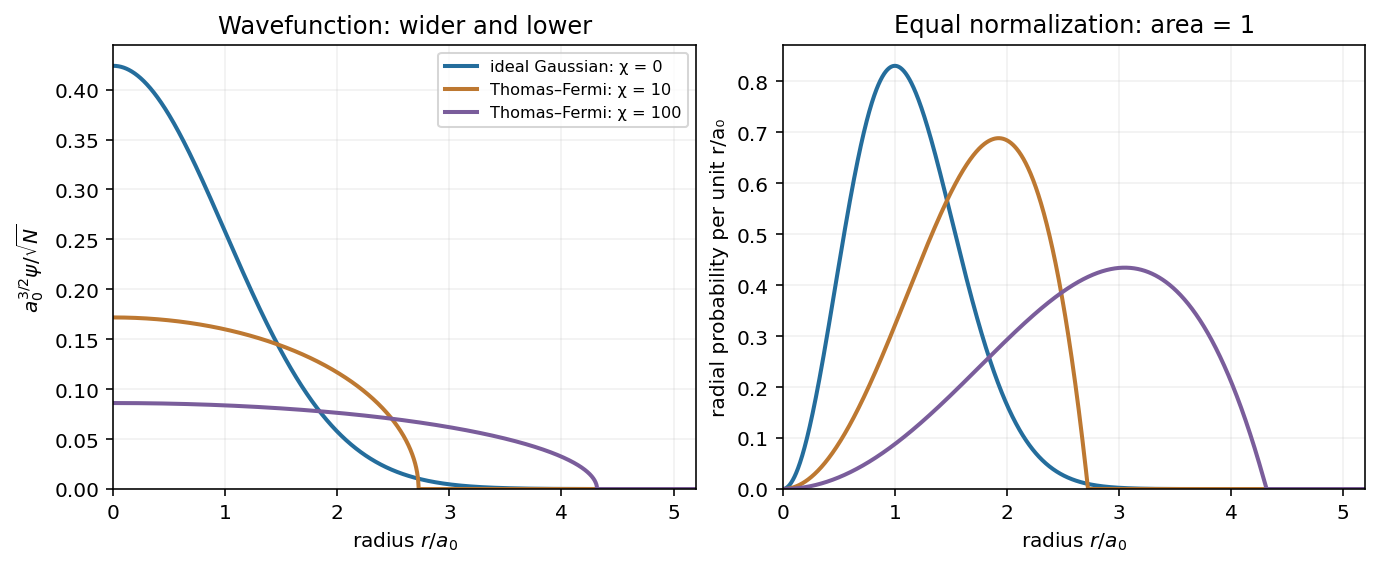
The spherical Thomas–Fermi condensate hasIntegrating this density gives . ThusAt fixed , stronger repulsion produces a wider, lower wavefunction: the Gaussian wave packet crosses over towards the square root of an inverted parabola, with an almost flat central region and a steeper outer drop. The density is the inverted parabola; the wavefunction is its square root. The exact wavefunction remains smooth and has a tail, since kinetic energy cannot be neglected near the Thomas–Fermi condensate edge rounding region. The healing length must be small compared with the cloud size in the bulk. Attractive interactions would not follow this large- expansion argument.
The original plot compares the noninteracting endpoint with two normalized repulsive spherical Thomas–Fermi condensate profiles. The latter are asymptotic shapes, rather than exact intermediate solutions of the Gross–Pitaevskii equation. Each has the same integrated atom number; labels the illustrative interaction strengths.

Choose real and positive. The Gaussian integral givesThe three zero-point energies add for each atom. The ideal-gas chemical potential is a one-atom energy; the total energy includes all atoms.
For weak interactions, the first-order correction in perturbation theory is the energy functional of the contact interaction evaluated on the unperturbed Gaussian wave packet. The integral needed isConsequently the Gaussian interaction energy of a trapped condensate isHere . These are the mean-field expressions consistent with the supplied equation and . Exact first-order perturbation theory for precisely atoms in one orbital replaces by through the number of distinct pairs; this distinction is negligible in the large- regime of the crossover estimate.
To judge the ideal-gas approximation, compare the interaction energy with the total ideal energy, or compare the interaction energy per atom with :Thus the crossover from Gaussian to Thomas–Fermi condensate is governed by : perturbation theory is reliable for , while the regime of the Thomas–Fermi approximation for a condensate requires . The characteristic crossover number is ; there is no sharp critical atom number here. If one specifically defines crossover by using the weak-interaction expression, it gives . That prefactor is a convention-dependent estimate extrapolated to the edge of perturbation theory, not a phase transition. Comparing itself to a single would incorrectly omit a factor of .
For the numerical estimate use and . ThenThe particular equality would instead give about atoms. These quantify different choices within a smooth crossover; a well-developed spherical Thomas–Fermi condensate profile requires going substantially beyond the characteristic scale.
Fix the qubit polarization convention by , where the Pauli matrices are ordered in the basis and . Thus the ground state is the north pole of the Bloch sphere. In a rotating frame and within the rotating-wave approximation, choose the drive phase and detuning sign so thatFor example, with this ground-state convention one may take and choose the transverse coupling positive. The Bloch vector precesses around the effective field at angular frequency , tracing a circle at fixed projection on that axis. Its length is conserved under coherent unitary time evolution. On resonance the axis is transverse and the Rabi oscillation can fully invert an initially ground-state atom. Away from resonance the axis tilts, andThere is no relaxation towards an equilibrium Bloch vector in this ideal model. An inhomogeneous ensemble can nevertheless lose its averaged qubit polarization through dephasing even without spontaneous emission; the circle description assumes a common drive and detuning.
For , the stated quantum state givesThe diagonal elements are the two state populations. The off-diagonal elements are quantum coherences: they retain the relative quantum phase and determine interference under a subsequent pulse. This is a pure state, even if both populations are nonzero: , , and . A mixed state averages projectors over preparation probabilities and generally has . Equal populations alone do not distinguish an equal coherent superposition from an unpolarized mixture.
For use in all three cases, multiplication of the gates gives the Hadamard-phase-Hadamard qubit rotationThe global phase cancels in . Thus the Bloch vector map is
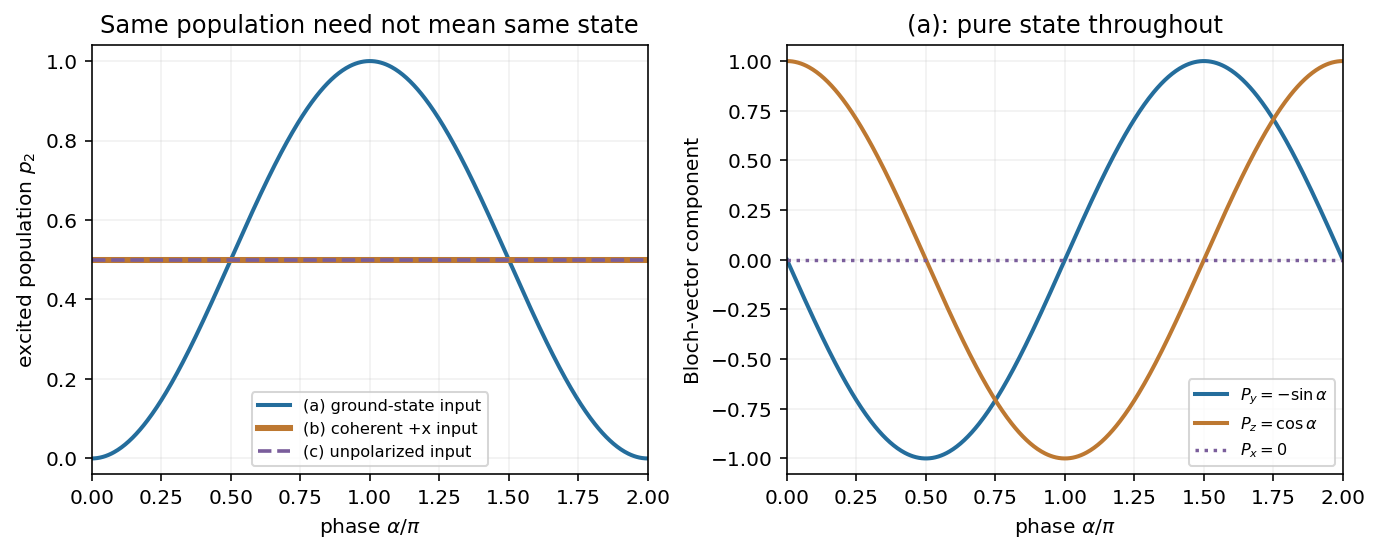
The final unlabelled Ramsey spectroscopy comparison applies to the three cases as follows. In an atomic clock, an initial coherent pulse prepares a superposition, a free interval accumulates a relative quantum phase proportional to detuning times , and a final coherent pulse converts that phase to a population. Here plays the role of that accumulated phase, with sign and fringe offset set by pulse conventions. In (a), the first Hadamard gate creates the needed superposition and the final gate reveals full-contrast Ramsey interferometry. In (b), the first Hadamard gate instead puts the state in , so the intervening phase gate has no relative quantum phase to imprint: the output is independent of . In (c), the unpolarized density matrix remains unchanged under every gate, so the ensemble has no Ramsey interferometry contrast. A coherent unitary gate alone cannot initialize a maximally mixed ensemble into a pure clock state.
The Ramsey interferometry analogy concerns preparation, phase accumulation, and readout; a Hadamard gate is not literally a transverse rotation on every input. In this basis , and its Bloch sphere action is a rotation about , up to a global phase. The phase conventions of physical Ramsey spectroscopy pulses must be specified to compare their outputs for arbitrary initial states.
Following the pure state through the first two gates gives . After the last Hadamard gate it isUsing the qubit polarization convention defined above,The output remains pure and has unit Bloch vector length. The population oscillation is the Ramsey interferometry fringe: the first gate supplies quantum coherence, and the last turns the acquired relative quantum phase into a measurable population difference.
The first Hadamard gate maps the prepared superposition to . The phase gate leaves that state unchanged, and the last Hadamard gate returns it to . ThereforeThis is a fully polarized pure state, not an unpolarized ensemble. Its Bloch vector lies along the rotation axis of the combined operation. There is no Ramsey interferometry fringe as varies, because the state during phase accumulation occupies only one basis level. Quantum coherence in the final state alone does not guarantee phase sensitivity to the specified sequence.
For an unpolarized ensemble . Every unitary gate satisfies , soThe purity remains . Equal populations here come with zero quantum coherence, unlike the state in (b). There is no Ramsey interferometry fringe: the two orthogonal components of any equal-weight ensemble decomposition give cancelling population responses. Quantum state preparation that reduces the ensemble entropy is needed for the usual polarized clock interrogation.
Gate sequence populations
. Details. 
The original plot compares the three excited-state populations. The constant lines coincide despite the very different purities in (b) and (c).
Laser cooling removes atomic kinetic energy through a velocity-dependent optical force, with scattered photons carrying away energy and entropy. For two counterpropagating beams detuned below resonance, motion towards one beam shifts that light closer to resonance, so the atom preferentially absorbs momentum opposite its velocity. At small velocity the net force is with . Three orthogonal beam pairs form optical molasses. Spontaneous emission has zero mean recoil in a symmetric distribution, but its momentum variance is nonzero: random absorption and emission cause heating. The cooling and heating balance sets a finite temperature.
For a weakly saturated two-level transition, write and let be the excited-state population decay rate. A useful one-axis Doppler cooling expression isThis limit belongs to the weak-intensity Doppler cooling model, with recoil energy small compared with . Experimentally, released sodium molasses clouds were probed by time of flight; the unusually small expansion demonstrated temperatures below that limit. This distinguishes an observed failure of a two-level cooling model from a failure of conservation of energy.[ref]
Nobel Lecture: Laser cooling and trapping of neutral atoms by William D. Phillips. pp. 729–732, Doppler limit, optical molasses, and release/time-of-flight thermometry
Multilevel atoms permit polarization-gradient cooling: spatially varying light polarization produces different light shifts of ground-state sublevels. In Sisyphus cooling, atoms climb a light-shift potential and are preferentially optically pumped near its top into a lower-energy sublevel, repeatedly losing kinetic energy. The optical pumping and emitted light supply dissipation. This can reach below the Doppler cooling limit; the recoil scalethen becomes important. The definition of a recoil temperature sometimes differs by a factor of two, so the energy definition is the unambiguous comparison. Recoil is not a universal lower bound for every cooling protocol: suitable dark-state or resolved sideband cooling schemes can suppress scattering near the desired motional state. Resolved sideband cooling preferentially excites a transition lowering the vibrational quantum number, followed by decay that on average preserves it in the Lamb-Dicke regime.[ref]
Nobel Lecture: Superposition, entanglement, and raising Schrödinger’s cat by David J. Wineland. Section IV, cooling of quantized ion motion
Optical molasses supplies damping rather than a position-restoring force. A magneto-optical trap adds a magnetic-field gradient and appropriately chosen circular polarizations; the position-dependent Zeeman splitting gives a restoring radiation pressure imbalance as well as damping. In real alkali atoms, repumping light returns population that would otherwise accumulate in an uncoupled hyperfine level. Magnetic and optical dipole traps can subsequently hold the cold sample without continuous resonant scattering.
Applications include long-interrogation atomic clocks, precision spectroscopy, atom interferometry, and preparation for quantum simulation and Bose-Einstein condensation. Cooling reduces motion-induced frequency shifts and allows longer coherent interrogation; deeper quantum degeneracy commonly needs subsequent evaporative cooling of atoms. Finite capture velocity, available transitions, recoil heating, stray magnetic fields, and loss or heating from unwanted scattering constrain a real experiment.
A quantum computing apparatus needs a scalable quantum register of controllable qubits, reproducible initialization, a universal quantum gate set, sufficiently long quantum coherence, and selective readout. A qubit is a two-dimensional state space; several qubits occupy a tensor product space and can develop entanglement. Quantum state preparation must establish a known low-entropy input and supply fresh ancillas during quantum error correction. A universal quantum gate set may use arbitrary single-qubit rotations with an entangling two-qubit gate such as controlled-NOT gate. Quantum coherence and control fidelity must suffice for the intended circuit, and measurement must recover chosen output probabilities without uncontrolled disturbance of other qubits. These are the five DiVincenzo criteria.[ref]
The Physical Implementation of Quantum Computation by David P. DiVincenzo. Section III, requirements 1–5
An atomic implementation can encode qubits in two long-lived internal levels, initialize them by optical pumping, drive coherent transitions with laser or microwave pulses, couple selected qubits through a shared interaction, and distinguish states by state-dependent fluorescence. For trapped ions, a shared vibrational mode can mediate entangling gates, so motional control and cooling are part of the computational apparatus. The motion is a resource only while uncontrolled heating does not erase the required quantum coherence.
The computational resource is coherent control of amplitudes and entanglement, with interference making useful outcomes likely. An -qubit pure state has basis amplitudes, but a single measurement does not reveal those amplitudes or all possible answers. Algorithms exploit structure rather than simply reading out parallel classical computations. The Shor algorithm gives factoring with polynomial resource scaling in the input bit length, compared with the best known classical algorithms' superpolynomial scaling; an exponential classical lower bound has not been proved.[ref]
Polynomial-Time Algorithms for Prime Factorization and Discrete Logarithms on a Quantum Computer by Peter W. Shor. Abstract, polynomial running time in the number of input digits
Grover's algorithm uses order oracle queries for unstructured search among possibilities, a quadratic query improvement.[ref]A fast quantum mechanical algorithm for database search by Lov Grover. Abstract and algorithmic query scaling
Quantum simulation is a further motivation because interacting quantum systems can require exponentially many classical amplitudes for a direct generic representation.The main challenges are quantum decoherence, fluctuating control fields, imperfect gates, leakage out of the qubit subspace, readout errors, crosstalk, and the difficulty of scaling connectivity and calibration. Faster control can introduce extra errors, while stronger isolation can make preparation and readout harder. Quantum error correction encodes logical information redundantly in several physical qubits and extracts error syndromes without measuring the unknown logical state itself. Fault-tolerant quantum computation prevents the correction apparatus and gates from spreading a few faults into uncorrectable logical errors. It requires error rates below an architecture- and noise-dependent threshold and substantial resources; there is no universal numerical threshold for all implementations. Advantages are task-dependent, while reliable scaling requires both coherent hardware and error control.
Evaporative cooling of atoms selectively removes atoms with unusually high total energy, then elastic collisions rethermalize those remaining. Loss of particles alone is insufficient: the lost atoms must carry more than the mean energy per particle if the temperature is to fall. The process is open and dissipative, so it can increase the phase-space density of an atomic gas in the remaining sample while reducing its atom number. As the temperature falls, the cutoff must be lowered to keep replenishing a useful escaping tail; a fixed high cutoff eventually gives negligible evaporation.
An experimental sequence first loads laser-cooled atoms into a conservative trap and suppresses resonant-light heating. In a trap using magnetic trapping of neutral atoms, a radiofrequency evaporation knife drives a Zeeman splitting transition from a trapped weak-field-seeking state to an untrapped state on a surface where the splitting matches the radiofrequency photon energy. Only atoms energetic enough to reach that surface escape. Lowering the radiofrequency cutoff progressively removes less energetic atoms. Alternatively, lowering an optical dipole trap's depth permits energetic atoms to spill out. This changes confinement as well as the escape cutoff, so it can reduce the collision rate. Radiofrequency-selective evaporation and the need for favourable elastic-collision and background-loss rates are documented in the original condensate experiments.[ref]
Nobel Lecture: Bose-Einstein condensation in a dilute gas, the first 70 years and some recent experiments by Eric A. Cornell and Carl Wieman. pp. 880–882, elastic/background collisions, magnetic confinement, and radiofrequency evaporation
The elastic collision rate must be large enough for elastic rethermalization of a trapped atomic gas throughout evaporation, and much faster than unwanted loss and heating. A clean vacuum reduces background collisions; suitable trapping states suppress inelastic spin-changing loss, and density must not make three-body recombination dominant. The cutoff ramp should allow equilibration without taking so long that background losses dominate. A large evaporation truncation parameter selects energetically valuable atoms, but an excessively large value suppresses their escape rate. A very small value discards too many useful low-energy atoms. If elastic collisions become more frequent as evaporation proceeds, the resulting runaway evaporative cooling can improve efficiency; it is not automatic in a weakening optical trap.
The energy selectivity for evaporation to increase phase-space density can be made precise in a classical three-dimensional harmonic trap with fixed frequencies. Equipartition gives . If each escaping atom removes mean energy , energy balance is with , soThe peak harmonic-trap phase-space density is . ThereforeCooling requires ; increasing despite atom loss requires the stronger condition . These inequalities assume rapid thermalization and no work from changing trap frequencies. They distinguish lower temperature from genuinely improved quantum degeneracy. Eventually quantum statistics and inelastic processes require a refinement of this classical estimate. Efficient evaporation combines energy-selective loss, rapid elastic redistribution, and low unwanted loss; it can bring a precooled gas to Bose-Einstein condensation.
Articles by others on the same topic
There are currently no matching articles.