In the ideal point-nucleus Dirac-Coulomb problem, hydrogen levels depend on and , so and are degenerate despite their different orbital angular momenta. The Lamb shift removes this degeneracy: the level lies about above , an energy of roughly . This is distinct from the much larger fine-structure splitting.
quantum electrodynamics changes the electron's interaction with the Coulomb field. electron self-energy and vacuum polarization give state-dependent radiative corrections; a complete prediction also keeps specified recoil and nuclear-size contributions. An wave samples the nucleus differently from a wave, so equal no longer ensures equal energy. A leading-log estimate for an radiative contribution scales as , with a numerical prefactor and further state-dependent terms. This is a scale estimate, not a replacement for renormalized bound-state QED. The measurable shift is a difference relative to a specified reference Hamiltonian, rather than an unregulated absolute vacuum energy.[ref]
Theory of the Lamb shift in hydrogen and light hydrogen-like ions by Vladimir Yerokhin and others. §II, definition of level contributions relative to the point-nucleus Dirac value and bound-state QED expansion
The original microwave experiment used a tungsten oven to dissociate hydrogen, an electron beam to populate metastable atoms, and electron ejection from a metal target to measure surviving metastable atoms. Microwaves transferred population to rapidly decaying , reducing detector current. At a fixed microwave frequency, interruption of the radiation and a scan of static magnetic field revealed Zeeman-tuned resonances. Comparing resonance locations with the Dirac-level prediction showed the level shifted upward. Field calibration and homogeneity, excessive microwave intensity, unresolved hyperfine structure and stray-electric-field quenching limit the measurement; the signal is not direct absorption by a large equilibrium excited population.[ref]
Fine Structure of the Hydrogen Atom by a Microwave Method by Willis Eugene Lamb Jr. and Robert Curtis Retherford. pp. 241–243, apparatus, Fig. 1 caption and resonance-field comparison
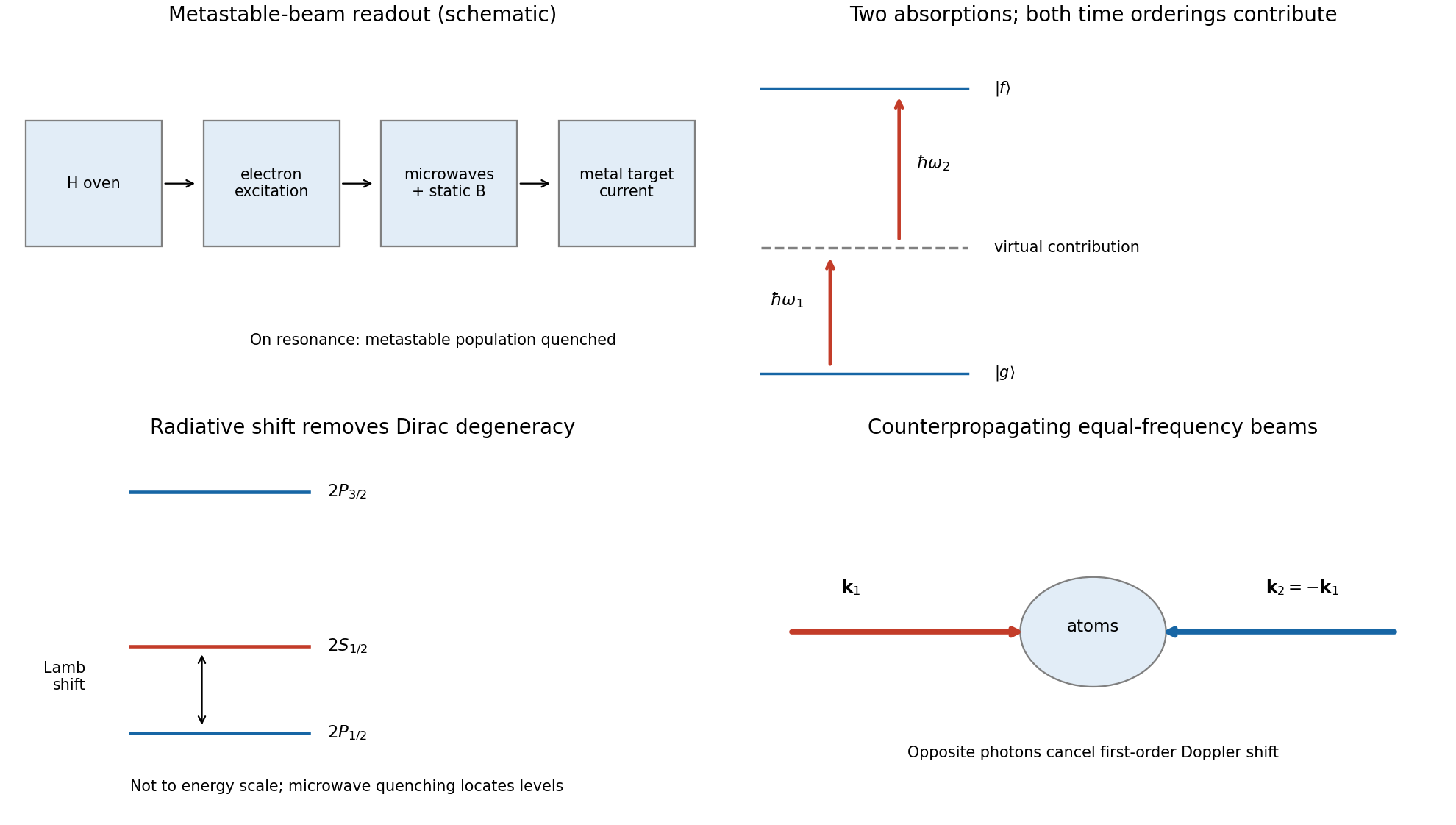
A two-photon transition is a second-order atom-field process. For two-photon absorption, energy conservation requires . A virtual intermediate state in two-photon absorption need not be populated as a real stationary state. In the electric dipole approximation, the two time orderings give an amplitude proportional toThe electric-field amplitudes multiply this expression. Far from intermediate resonance, the denominators are large relative to linewidths and one-photon couplings, keeping real intermediate occupation small. Near an intermediate resonance, sequential absorption, linewidths and saturation require a fuller treatment. For weak unsaturated absorption the rate scales as , or when both photons come from one field. Absorption followed by stimulated emission instead gives a difference-frequency Raman transition; it is not two-photon absorption at the sum frequency.
Two electric dipole interactions change parity twice, so initial and final states have the same parity. For a one-electron orbital, the usual changes are , subject to angular-momentum and polarization constraints. For identical equal-frequency photons, exchange symmetry removes the antisymmetric rank-one tensor: ranks zero and two survive. Thus is possible, whereas is forbidden in this degenerate electric-dipole approximation. It would be too strong to prohibit every transition between nonzero angular momenta, since a rank-two tensor can connect some such pairs. Spin remains unchanged to leading electric-dipole order.
A central example is hydrogen , forbidden as a one-photon electric dipole transition but accessible with two photons near . Absorption of one photon from each of equal-frequency counterpropagating beams makes the first-order Doppler shift vanish and suppresses net recoil. The two same-direction absorption paths can still give a broad Doppler background. A primary demonstration used a frequency-doubled pulsed dye laser near this wavelength and compared with a simultaneously recorded Balmer reference.[ref]
Doppler-Free Two-Photon Spectroscopy of Hydrogen by Theodor W. Hänsch and others. Phys. Rev. Lett. 34, 307 (1975), abstract: 2430-angstrom source and simultaneous Balmer-beta reference
Experimentally, scan the sum frequency and detect the excited state, its subsequent fluorescence or its ionization. Counterpropagating and single-beam spectra distinguish the narrow Doppler-free contribution from its background. Varying intensity tests weak-field scaling and extrapolates AC Stark shifts and power broadening; frequency calibration, beam overlap, residual angle and second-order Doppler shifts still matter. “Doppler free” here cancels the leading velocity term, not every systematic shift.
Two complementary signatures are suppressed low-speed dissipation and quantized circulation. Condensation alone establishes macroscopic occupation, not all of these flow properties. In a uniform weakly interacting condensate, the Landau criterion givesfor the Bogoliubov spectrum. Creating an excitation in a flow changes energy by ; a negative value allows energy transfer. Boundaries and vortex nucleation can make an actual measured threshold lower than this ideal bulk sound speed.
In the moving-obstacle test of atomic superfluidity, a blue-detuned focused laser repelled atoms in a sodium condensate and was scanned at different speeds. After a fixed exposure, time-of-flight absorption imaging measured the reduction of condensate fraction as a heating indicator. Low-speed heating was small, with a pronounced onset near , below the peak-density sound speed near . A stationary-beam control showed no heating; above-transition clouds constrained heating through the noncondensed fraction. Changing scan frequency and amplitude at common obstacle velocity helped separate a flow threshold from a particular trap resonance. Density inhomogeneity, obstacle geometry and vortex nucleation limit identification of the observed onset with a unique homogeneous Landau velocity.[ref]
Evidence for a Critical Velocity in a Bose-Einstein Condensed Gas by C. Raman and others. pp. 2502–2504, Figs. 1–3, stationary-beam and above-transition controls
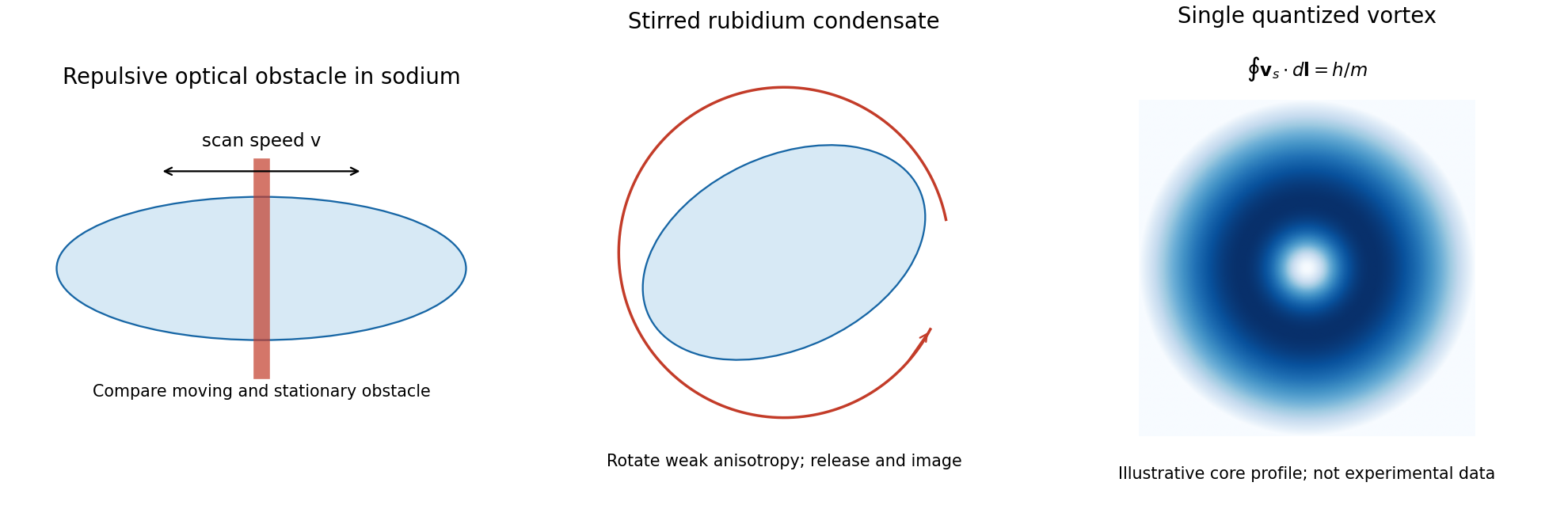


A second experiment stirred rubidium-87 in a magnetic trap by rotating a small transverse anisotropy generated with a far-detuned attractive laser. After stirring, the cloud expanded for and absorption imaging along the rotation axis revealed vortex cores. Below a threshold no cores appeared; faster rotation produced one or several. Ramping the stirrer down before release reduced additional excitation, and waiting after removing it tested vortex survival. Beam-centre stability and residual trap anisotropy are important controls; an isolated density dip without the rotation and persistence evidence would be less conclusive. This stirred-condensate vortex experiment is a response to rotation, distinct from merely imaging the appearance of a condensate.[ref]
Vortex Formation in a Stirred Bose-Einstein Condensate by K. W. Madison and others. preprint pp. 1–3, rotating dipole anisotropy, time-of-flight imaging and single-vortex lifetime
The superfluid velocity is . A closed loop avoiding a core must return a single-valued order parameter, soA singly quantized vortex therefore has phase winding and circulation , with depleted density in a core of order the healing length. This quantized rotational response differs from ordinary rigid-body flow. The experiment supports that interpretation through controlled stirring and vortex formation; imaging cores alone does not independently measure every phase winding or an absolute zero dissipative rate.
Articles by others on the same topic
There are currently no matching articles.