A Jablonski diagram distinguishes electronic excitation from subsequent relaxation. Photon absorption takes a molecule from the electronic ground state to a vibrationally excited level of or a higher singlet state. Rapid vibrational relaxation and internal conversion usually populate the lowest vibrational levels of . Fluorescence then emits a photon on a transition to , often ending in one of its excited vibrational levels. Nonradiative relaxation competes with emission; intersystem crossing can also populate triplet states. Energy lost to relaxation and solvent reorganization commonly makes the fluorescence maximum occur at lower photon energy, hence longer wavelength, than the photon absorption maximum: the Stokes shift.
The intrinsic fluorescence quantum yield is the number of photons emitted by fluorescence per absorbed excitation. For a simple excited state with radiative rate and other decay rate ,A nearby acceptor adds a nonradiative energy-transfer channel, not an emitted photon flying from donor to acceptor. The electric dipole-dipole interaction transfers the donor excitation while returning the donor toward its ground state and exciting the acceptor. The acceptor then relaxes and may fluoresce. The donor yield becomesFor the acceptor, distinguish its intrinsic yield per acceptor excitation, , from the number of acceptor photons per donor excitation. Transfer increases the supply of acceptor excitations, giving sensitized emission per donor excitation in the ideal model. It does not by itself change if the acceptor's own decay rates remain unchanged. Environmental changes, saturation or additional quenching can change those rates, but increased acceptor intensity alone does not establish an increased intrinsic fluorescence quantum yield.
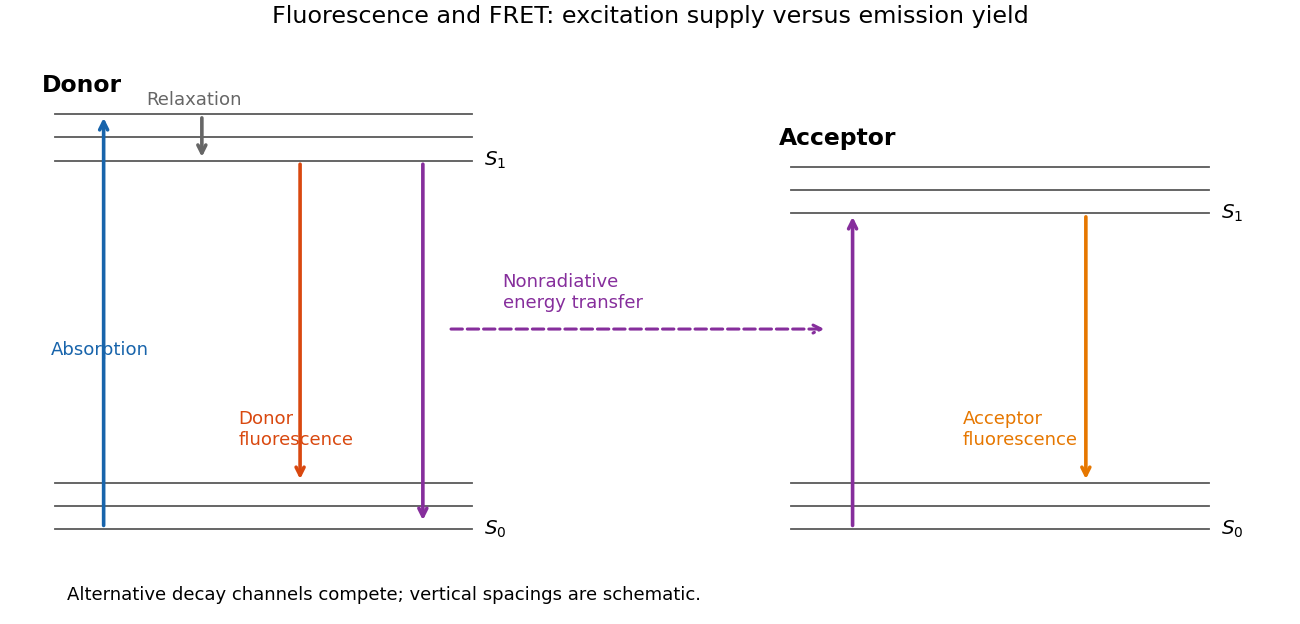
Relaxation, fluorescence and donor–acceptor energy transfer
. Original schematic electronic and vibrational levels. Transfer supplies an acceptor excitation without a photon between the molecules; the acceptor quantum yield and the excitation supply are separate quantities. Details.
Let , so the lifetime without transfer is . For a fixed isolated donor–acceptor pair, the specified transfer rate is . Inserting this rate into the definition of FRET efficiency givesThe donor population in the presence of the acceptor obeys , so its fluorescence decays exponentially with lifetime . ThereforeBoth relations assume the donor's nontransfer rates are unchanged by adding the acceptor, a single approximately fixed separation during each excited-state lifetime, and an available acceptor. The transfer law also presumes the usual weak-coupling dipole approximation and the spectral and orientation conditions contained in . If the reference donor is differently quenched, the lifetime difference cannot all be attributed to transfer. Heterogeneous mixtures or a fluctuating separation can produce multiexponential decay, in which case blindly substituting an arbitrary fitted average lifetime into the single-pair formula need not give the ensemble's mean efficiency.
For independent available acceptors at equal distance, the multiple-acceptor FRET efficiency follows by adding the parallel exit rates. Each contributes the same rate , so the total rate is , rather than times the single-pair transfer probability. HenceEquivalently, . Inverting givesWith and , the bracket is exactly one and nm. Each isolated pair would have efficiency ; the three transfer rates together give . Multiplying by three would violate the probability bound and is not a valid calculation.
This model assumes one donor excitation, identical pairwise transfer rates, no coherent coupling between acceptors, no acceptor saturation and no change in donor photophysics or orientation on adding labels. Different separations instead require summing individually. Acceptor-to-acceptor transfer can alter which acceptor emits; it does not automatically change the donor's first-transfer probability when the donor exit rates remain those specified.
Assume distinct positive separations, and first label them so . Let , and . The positive contrast isIts derivative has a particularly simple sign:It is positive below and negative above, so this is the global maximum. Both end limits and give zero contrast. ThusTo recover the printed expression, factor its sixth-power radicand:Its sixth root is indeed . The cancellation requires . If , every choice gives zero contrast and there is no unique optimum; the printed expression then has a removable algebraic without a unique maximization conclusion. For unordered , maximize absolute contrast and replace the numerator of the maximum by . A negative signed difference for is minimized, not maximized, by the same interior point. These qualifications are needed to make the statement precise.
Articles by others on the same topic
There are currently no matching articles.