Use the logic approximation for gene regulation: production is either or zero, and every species has linear removal rate . Put and assume zero basal expression, inactive X before time zero, and all required thresholds strictly between and . The input is for and zero otherwise. The common ordinary differential equation is , with Boolean production gate . Both networks therefore havewhere the latter uses the stipulated attained steady state. Define the threshold-crossing delayBecause , . In both networks, stays zero until and then follows until the OFF response. Write for the activation threshold of on Z in diagram (a), and for the level of that blocks Y's repression in diagram (b); these thresholds were not supplied numerically.
Diagram (a). All three inputs X, Y and must permit Z production. Since Y has already crossed its Z threshold before starts, the final permission arrives atThus until and subsequently. Solving givesFor the frequently adopted but extra convention that both required thresholds are , this is . At the OFF step, X's direct AND input disappears, so immediately. Y also decays immediately. remains at while Y remains above ; it starts decaying at . This is a coherent feed-forward loop persistence response: activation is delayed, while removal of the direct required input switches production off promptly.
Diagram (b). The production gate is . Z initially rises, Y switches Z production off at , and restores production at . The continuous solution during the ON phase isThe derivative changes from positive to negative at , and from negative to positive at . Consequently the first temporary minimum following the initial pulse occurs atIts value is . At the OFF step Z again decays immediately because X is required for production, with Y and behaving as above. If a required threshold is unattainable, these late switching events do not occur; equal production and removal rates alone do not fix threshold values.
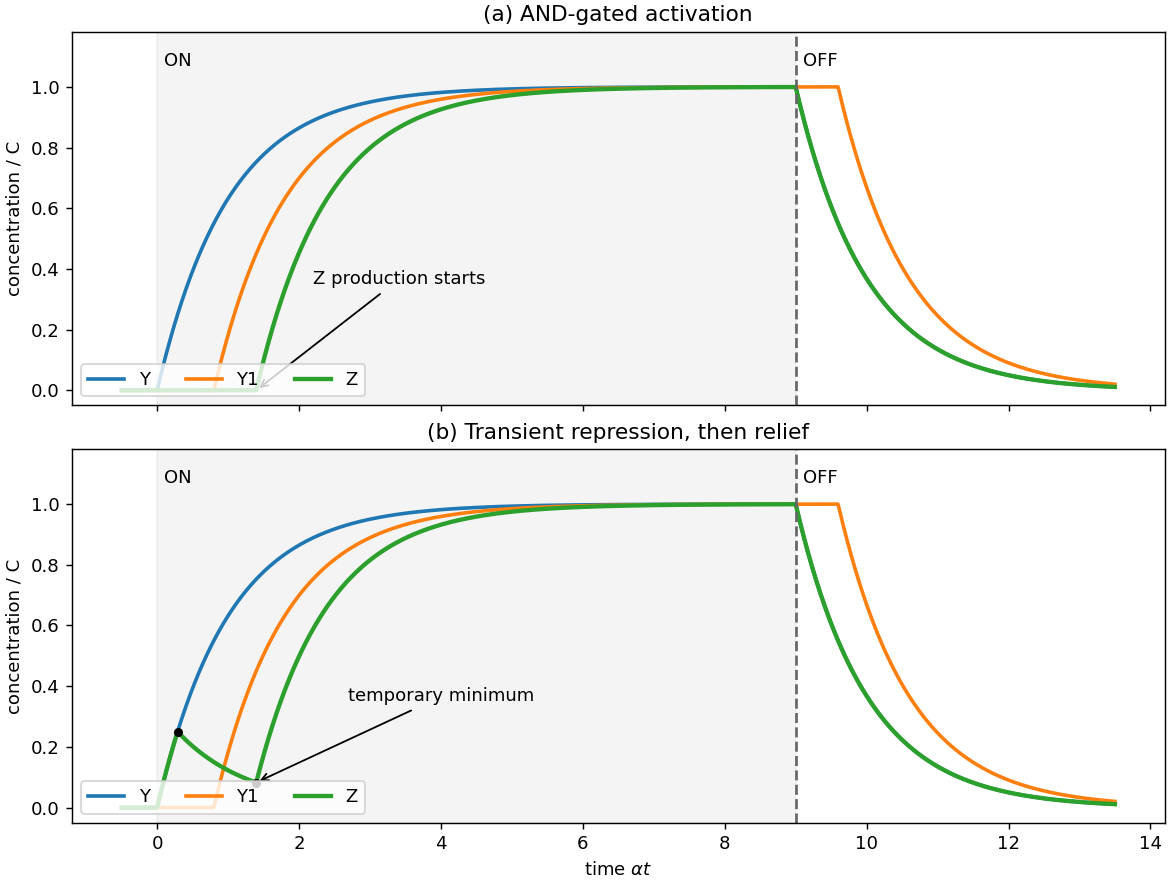

The plotted thresholds are explicitly illustrative, with , and .
The protein production rate is proportional to the current messenger RNA concentration, not an independently constant : . Setting the two coupled rate equations to zero givesWith first-order removal, a messenger RNA molecule has mean lifetime . At biological translation rate per molecule, it produces an expected proteins before its removal. Thus the translational burst size is a dimensionless mean number of offspring proteins per messenger RNA, not a concentration and not a fixed number produced in every event. When production and removal are independent Poisson events, mixing a Poisson number of biological translation events over an exponentially distributed lifetime makes the burst count geometrically distributed on the nonnegative integers. Its mean is and its variance is .
Convert number density into molecule count: . For the explicitly assumed representative cell volume , the two densities correspond to and . The concentrations alone do not fix fluctuation sizes without a volume.
For activation from zero messenger RNA and protein, solving the two mean rate equations givesThus all three normalized mean curves are almost identical. Sample paths differ. For Poisson transcription with biological translation bursts, the stationary Fano factor and squared coefficient of variation areOne way to obtain the fast-messenger RNA limit is to use burst arrivals at rate , a geometrically distributed burst with and , and independent unit protein degradation at rate . The first stationary moment gives ; the second gives .
At , typical relative fluctuations are and many small bursts make the trajectory smooth. At , they are ; individual bursts have mean normalized height , with only about bursts per protein lifetime. At , the relative fluctuations are again , but the typical burst height is and about bursts occur per lifetime. The latter two examples can look similarly noisy after normalization even though their mean molecule counts differ by two orders of magnitude. Burst arrival times and sizes fluctuate: a high-burst trace is not a periodic sawtooth.
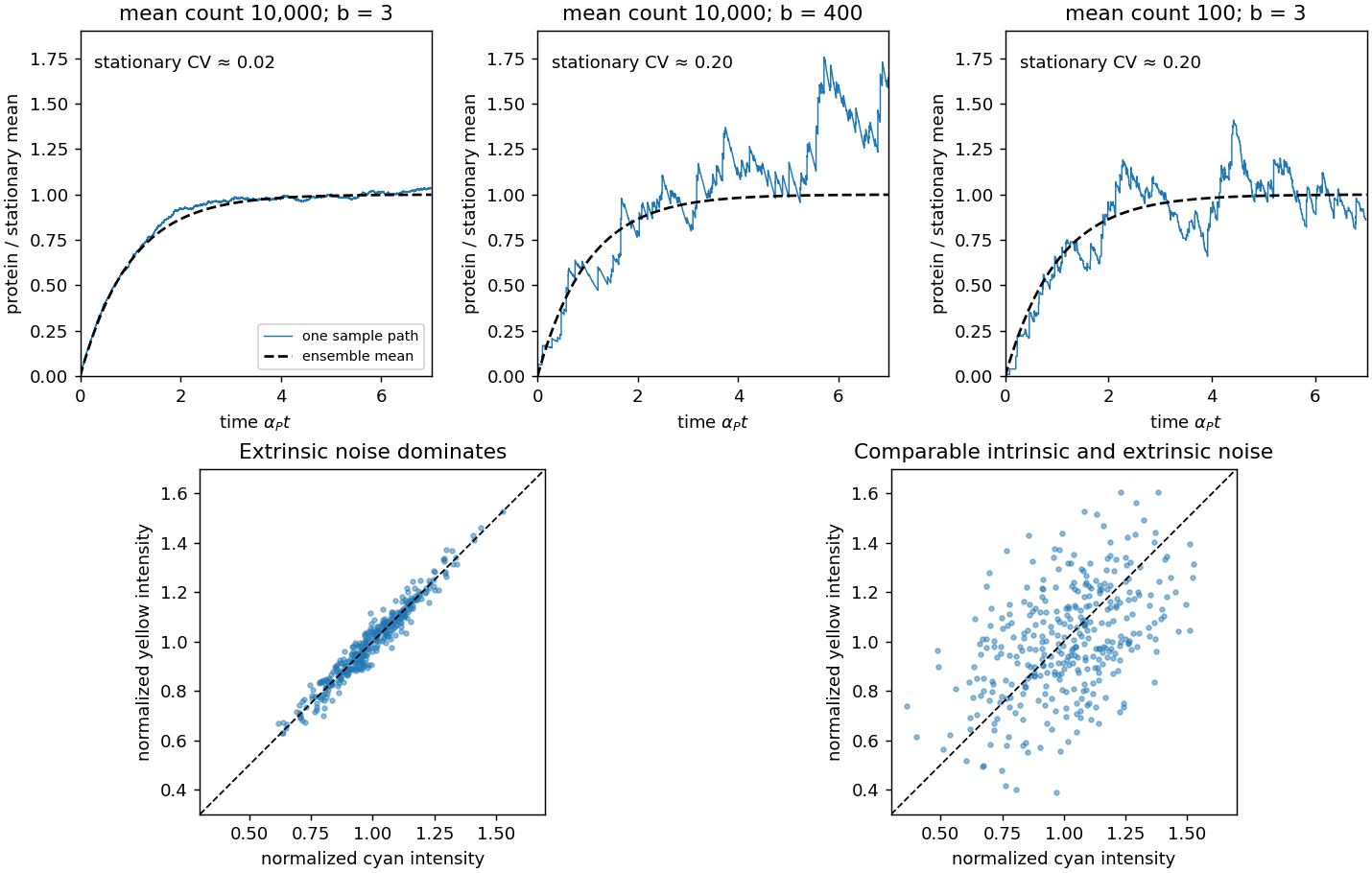
Stochastic gene expression trajectories and dual-reporter intrinsic gene-expression noise and extrinsic gene-expression noise
. Details. 
The upper panels are independently simulated burst-arrival and unit-removal processes, shown alongside the common mean. The lower panels illustrate d; their point clouds are schematic, not experimental data.
Normalize each reporter by its mean intensity, after correcting background and unequal brightness, so equal expression lies on . Write , , where the common fluctuation is extrinsic gene-expression noise and the independent reporter-specific fluctuations are intrinsic gene-expression noise. The extrinsic gene-expression noise includes shared variation in cell size, expression machinery and growth state; intrinsic gene-expression noise includes independent molecular production and removal events at each reporter.
If intrinsic gene-expression noise is much smaller, points form a narrow elongated cloud along : a cell that is bright in cyan is usually bright in yellow. If the two contributions have comparable magnitude, the cloud is still positively correlated but has substantial width perpendicular to , because the two reporters can differ within the same cell. With variance in and equal variance in each independent intrinsic term,Equal intrinsic and extrinsic variances therefore give correlation coefficient , rather than an uncorrelated circular cloud. For mean-normalized reporters, and . Measurement noise must be separately estimated before assigning perpendicular scatter to expression itself. These are the geometric diagnostics of the original dual-reporter experiment.[ref]
Stochastic Gene Expression in a Single Cell by Michael B. Elowitz and others. Figure 1 and definition of intrinsic and extrinsic noise: within-cell reporter differences versus correlated cell-to-cell variation
The lower panels of c show these two cases. Repeated observations of one cell can move both along and across the diagonal; a static population cloud alone does not determine the time scales of the fluctuations.
Articles by others on the same topic
There are currently no matching articles.