Take the energy of an isolated, field-free gas atom as zero, and let be the field-independent binding energy at one adsorption site. The two adsorbed spin energies areHere is the Bohr magneton. The lower state is stabilized by increasing ; the assignment of the two signs to names for the spin projections is a convention.
Put . Summing the two Boltzmann factors gives the occupied-site internal partition functionIf the single atom can occupy any of the identical sites, its complete surface partition function isOne also commonly calls the one-site factor itself . Both conventions are valid, but the combinatorial factor in part (c) must use the same convention. We use the complete one-atom surface function below and give the equivalent one-site expression.
Use the ideal Langmuir adsorption model: identical independent sites, at most one atom per site, no lateral interactions, and no additional thermally active adsorbed degrees of freedom beyond the two spin states. Treat the atoms as indistinguishable and localized after adsorption; only site occupancy and spin choices distinguish configurations.
There are ways to select occupied sites. For any such selection, independent spin sums contribute . ThusWith as defined in part (b), this isEquivalently, starting from labelled particles gives distinct assignments to different sites; division by removes particle relabellings. The removes the site multiplicity already included in each full one-particle function.
If denotes the one-site internal factor instead, and . These are identical physical results, not different counting models. In particular, the complete-function convention gives and hence .
For the adsorbed lattice gas, the Helmholtz free energy isUse Stirling's approximation with large, then differentiate at fixed . Writing surface coverage as gives the adsorption chemical potentialThe occupation ratio comes from site-mixing entropy; it is essential near saturation.
Let be the number of free atoms and . In the field-free gas, both spin states have zero energy, so the one-atom partition function is , where is the thermal de Broglie wavelength. For a dilute ideal gas,ThereforeThe last equality uses . The bulk spin degeneracy is two even though the bulk magnetic field vanishes: degeneracy is not the absence of spin states.
At adsorption equilibrium, . The expressions from part (d) giveDefineSolving the occupation ratio yieldsThe coefficient has units of inverse pressure, so is dimensionless. The two spin states contribute a factor two on both sides of the adsorption equilibrium and cancel; retaining the surface factor but dropping the bulk degeneracy would incorrectly double .
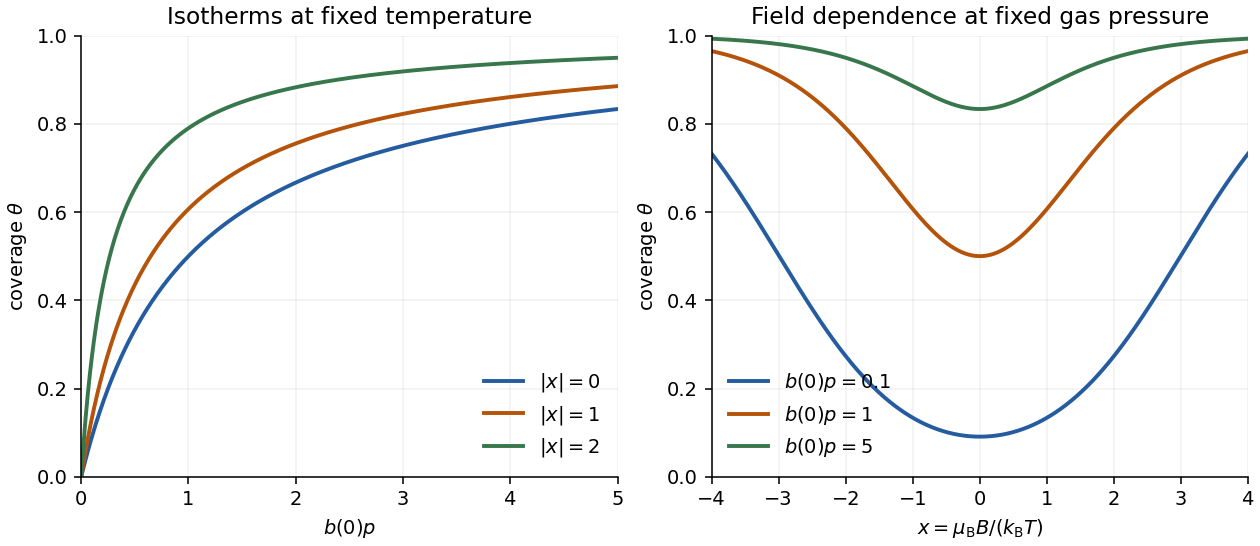
At fixed temperature,Thus magnetic-field-dependent Langmuir adsorption is even in and increases with . At fixed nonzero gas pressure, stronger field increases surface coverage; in an isotherm plot, the half-coverage pressure moves to lower pressure. The saturation coverage remains one because the number of sites is unchanged.
For weak fields, with ,There is no linear small-field change. At large , , and at fixed the coverage approaches one. The field lowers the free energy of the surface spin ensemble relative to the unsplit bulk; simply averaging the two surface energies to would miss this equilibrium effect.

Articles by others on the same topic
There are currently no matching articles.