Wavefunction normalization requires . For the normalized probability weight proportional to , the Gaussian integral and its derivatives giveSince , the kinetic energy and potential energy expectations areThusThe second derivative is positive, and the energy diverges at both ends of , so this is the global minimum within the Gaussian function family. The best Gaussian function upper bound isThis is an upper bound, not the exact quartic ground energy.
A gives the same optimum: replacing by merely reparameterizes the same set of positive-width Gaussian functions, so its best bound is unchanged.
B is worse as a ground-energy estimate: it has odd parity and a node at the origin, whereas the ground state of this even confining one-dimensional potential is even and nodeless. It is therefore orthogonal to the exact ground state and belongs to the odd sector, whose lowest energy is already above the ground energy; the extra factor cannot be removed by varying its width. A separate numerical minimization gives a best value about for B, well above the original Gaussian function bound.
C can improve the bound: setting recovers every original Gaussian function, while nonzero adds shape freedom. Minimizing over this larger family can never give a worse optimum, and the additional freedom does lower the quartic-oscillator estimate. Inclusion of a family alone proves “no worse”; improvement is not guaranteed for every conceivable potential, for example one already solved exactly by a Gaussian function.
For any , the Gaussian function is the exact nodeless ground wavefunction of a quantum harmonic oscillator withDirect substitution cancels the terms. An additive constant in the potential would simply shift the eigenvalue.
A natural comparison uses the same optimized width as part (i), . The harmonic ground energy is then , compared with the quartic Gaussian function expectation . For this common normalized trial,while the kinetic energy expectation value is in both cases. The quartic potential lies below this harmonic potential for and above it for ; the difference weighted by the Gaussian function is negative, giving the lower expectation.
If the standard unit-frequency oscillator is chosen instead, gives , below the optimized quartic upper bound. These are different harmonic comparison potentials, not contradictory answers. Crossing potential curves cannot be ordered globally; the comparison must specify the frequency or Gaussian function width used.
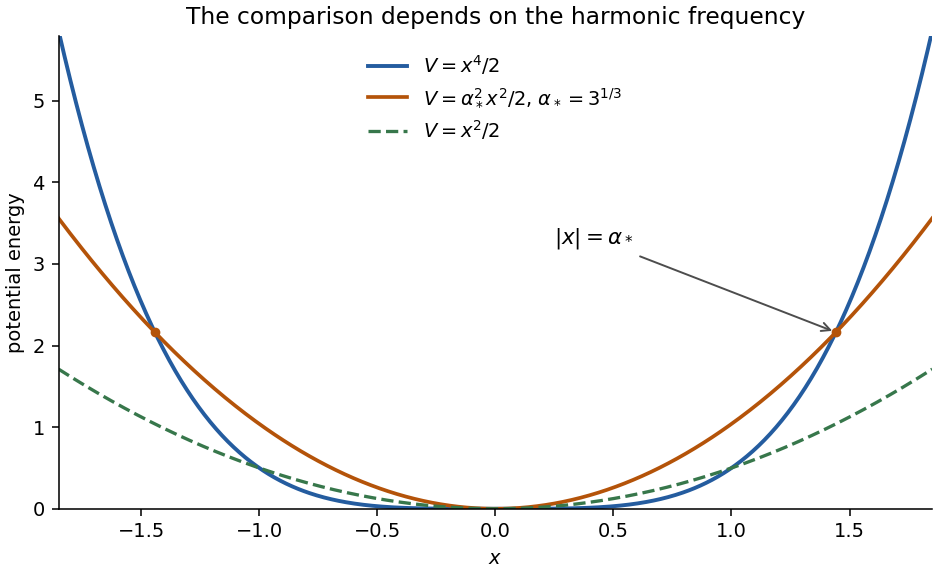
Original comparison of the quartic potential with harmonic potentials at unit frequency and at the optimized Gaussian width
. Details. 
Articles by others on the same topic
There are currently no matching articles.