Use C1 for the carbonyl carbon, C2 for the adjacent carbon, and C3 for the beta carbon of the reactive enone fragment . water adds conjugately at C3, giving a beta-hydroxy ketone. The oxygen lone pair of neutral water attacks C3; move the C2=C3 pi pair toward C1–C2 and the carbonyl pi pair onto oxygen. This produces the charge-separated enolate–oxonium intermediateA second water molecule can relay a proton from the newly attached oxonium oxygen to the enolate system. Using the carbon-centered resonance structure, reform C1=O and protonate C2 while the donating O–H bond returns its pair to the added oxygen. Equivalently, oxygen protonation first gives an enol, followed by water-mediated keto-enol tautomerism. Either path yields a neutral beta-hydroxy ketone and regenerates the relay water. There is no need to introduce externally supplied H or OH; solvent molecules perform the proton transfers. The uncatalyzed charge separation has a large barrier, so this mechanism describes a slow formal pathway, not a claim of rapid hydration in pure water.
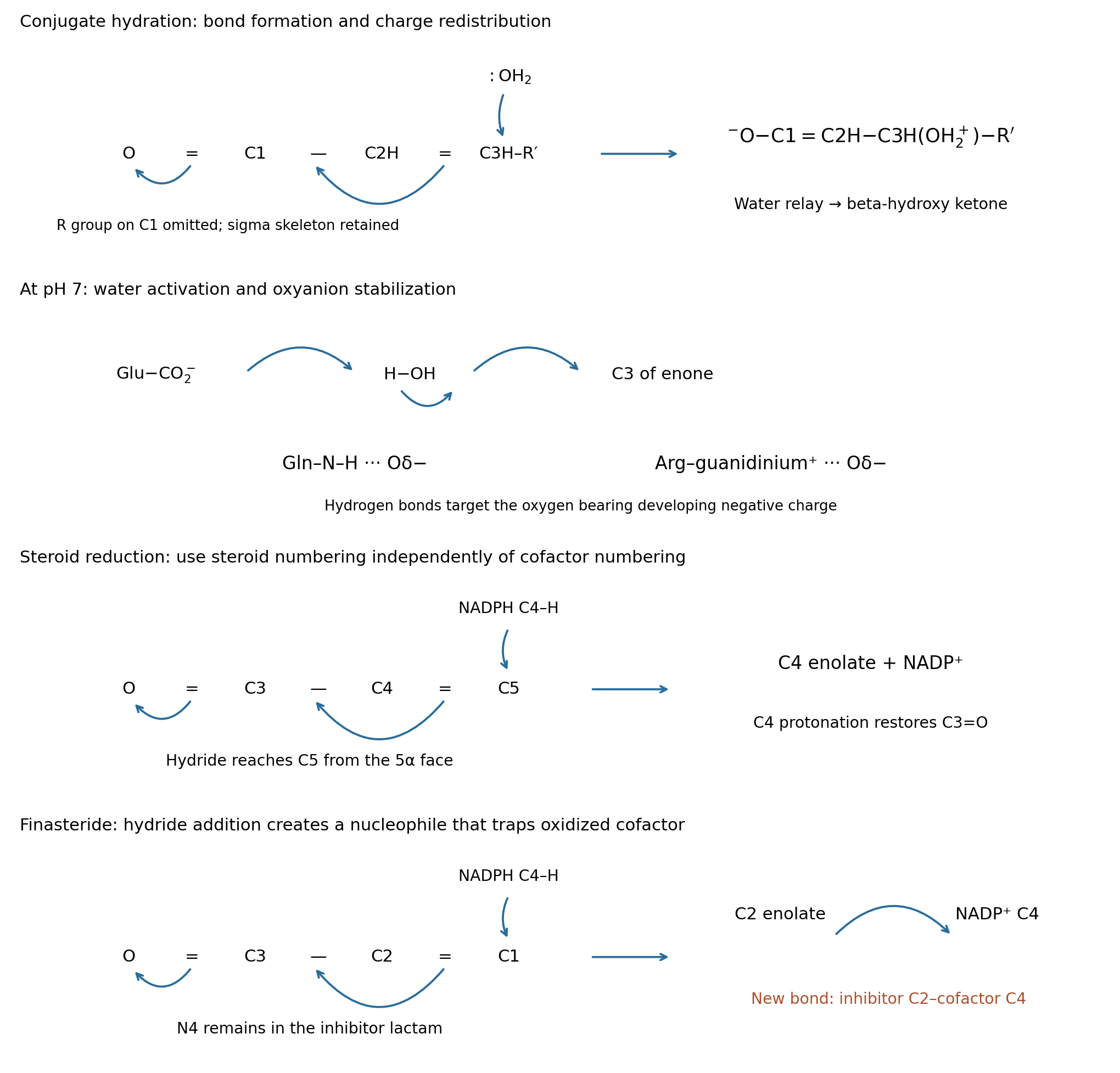
Reactive-fragment mechanisms for conjugate hydration, steroid reduction and finasteride trapping
. Details. 
The C–O-forming transition state has a partial bond from water oxygen to C3, positive charge developing on that oxygen, and negative charge delocalizing toward the carbonyl oxygen. A compact drawing isHere the two C–C dotted connections denote redistribution of pi bonding, not cleavage of either carbon–carbon sigma bond. In a bond-order drawing retain the full sigma skeleton: C1–O is changing from double toward single, C1–C2 from single toward double, C2–C3 from double toward single, and C3–O from absent toward single. The incoming water approaches a face of the approximately planar conjugated unit and C3 begins to become tetrahedral. The total electric charge remains zero. If proton transfer to another water occurs concertedly, include a partially broken incoming-water O–H bond and a partially formed relay O–H bond; that is a solvent-assisted variant, not a different regioselectivity. The original mechanism schematic identifies these bond changes without depicting a falsely isolated free hydroxide reagent.
At pH 7, a glutamate residue is normally carboxylate. Its most natural role is general-base activation of the attacking water. Draw the carboxylate oxygen lone pair toward a water H, the water O–H pair toward its oxygen, and that oxygen's lone pair toward C3 while the conjugated pi system moves toward the carbonyl oxygen:This can be concerted, avoiding a freely diffusing hydroxide intermediate. The protonated glutamate subsequently returns its proton to the enolate system, directly or through solvent, regenerating carboxylate. A favorable arrangement is needed; ordinary carboxylate does not quantitatively deprotonate bulk water in a prior equilibrium.
The side-chain amide of glutamine is neutral. Its N–H can donate a hydrogen bond to the carbonyl oxygen and stabilize developing enolate charge, while its amide oxygen can accept a hydrogen bond to orient attacking water. Draw , with the dotted interaction from amide N–H to substrate oxygen. This assists polarization and transition state stabilization; the amide nitrogen is not an ordinary amine base because its lone pair is delocalized into its own carbonyl.
The guanidinium group of arginine is positively charged. It can stabilize developing negative charge by hydrogen bonding and electrostatic attraction, drawn . Its delocalized cation is not the preferred neutral general base at pH 7. Productive catalysis requires stronger stabilization of the reacting arrangement than of the unreactive ground-state complex.
Phenylalanine and leucine have hydrocarbon side chains and provide no conventional acid/base or hydrogen-bond donor/acceptor group here. They can position the enone, exclude unproductive solvent and select the attacked face through hydrophobic effect and steric hindrance. Those binding effects can assist catalysis but should not be drawn as an imaginary side-chain proton relay. The original schematic depicts the Glu water relay and the Gln/Arg oxyanion-stabilizing contacts.
The beta-carbon bond-forming transition state retains the same basic connectivity across this pH range, but the predominant proton-transfer route and enzyme protonation change. Near the acidic end, protonated glutamate can act as a general acid, donating a proton or a strong hydrogen bond to carbonyl oxygen and making C3 more electrophilic; it is less available as the carboxylate general base that activates water. Above its local , carboxylate-mediated water activation is favored. Acid catalysis therefore shifts positive-charge stabilization toward a protonated carbonyl, whereas base-assisted attack reduces positive-charge buildup on incoming water. Neither a unique transition-state geometry nor a numerical pH optimum follows from pH alone.
Using a free-solution glutamate side-chain only as an illustration, the deprotonated fraction is : about 0.059 at pH 3 and 0.998 at pH 7. An enzyme environment can shift that substantially. The glutamine amide and the hydrocarbon side chains remain in their ordinary forms from pH 3 to 10; arginine guanidinium, with a typical free side-chain around 12.5, remains predominantly positive even at pH 10. Thus the major side-chain switch among those listed is glutamate. At the alkaline end, bulk hydroxide can also contribute to nonenzymatic conjugate addition. A measured pH-rate profile must control substrate stability and enzyme folding before assigning every loss of activity to an active-site titration.
Articles by others on the same topic
There are currently no matching articles.