Choose x along O–O. The valence orbital order appropriate to O is approximatelyIts twelve valence electrons occupyThe two degenerate pi-antibonding orbitals are singly occupied with parallel spins according to Hund's rules. Thus , multiplicity , with three possible values. A triplet is a many-electron spin classification, not three electrons in one orbital. The resulting ground term is . Exchange stabilization favours this triplet over the singlets formed within the same frontier-orbital manifold.
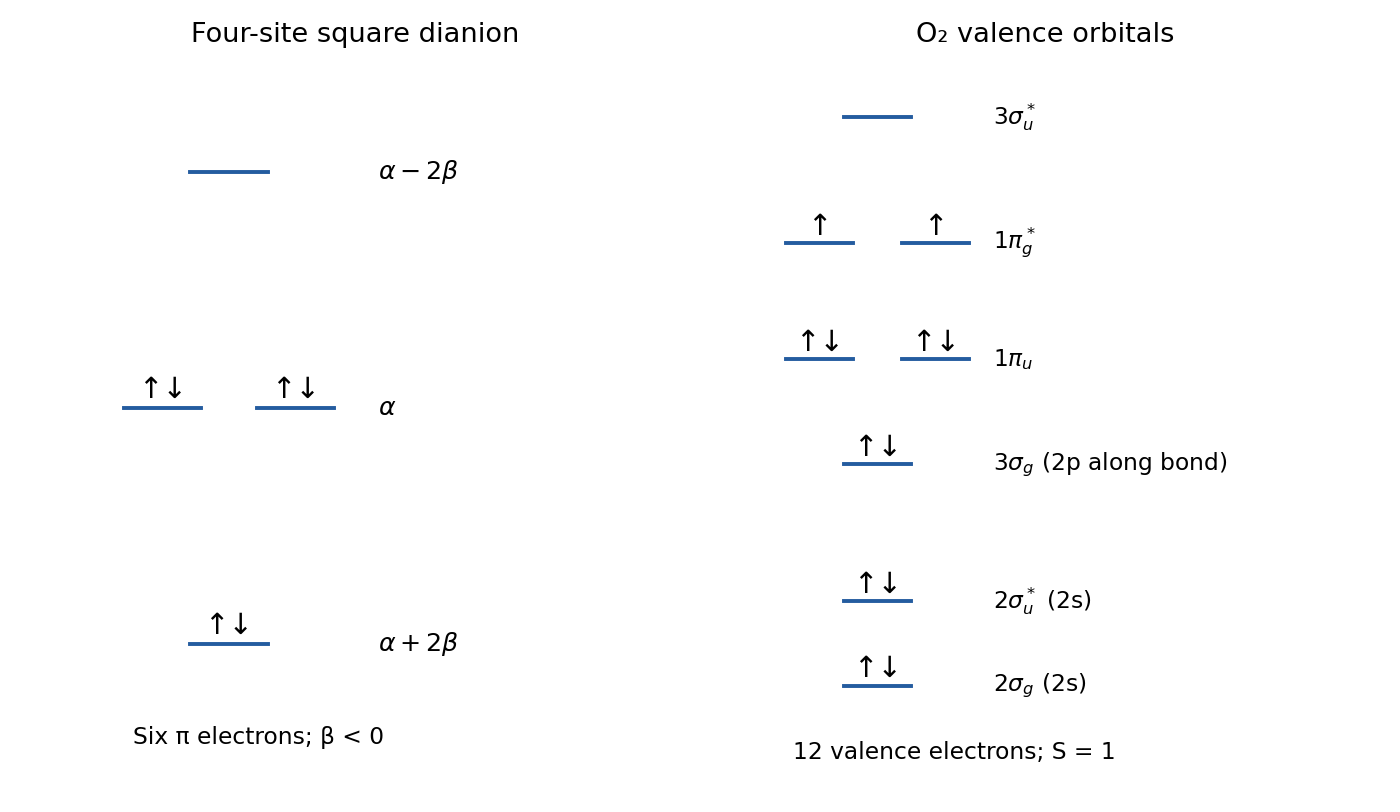
Original valence-O2 diagram with the two singly occupied pi-antibonding orbitals
. Details. The active set contains four oxygen pi orbitals and two carbon pi orbitals, with eight electrons in six orbitals. The noninteracting levels, using the parameters inferred below, areEach bonding oxygen orbital has equal-phase coefficients on its two O atoms; its antibonding partner reverses one coefficient. The two pi directions are z in the prospective ring plane and y perpendicular to it. carbon pi and pi-star use z-directed p orbitals with equal and opposite coefficient signs. In this separated-fragment comparison the occupations are those of neutral triplet O plus neutral ethene. Do not refill the combined list solely by energy, which would move an electron between infinitely separated fragments and describe a charge-transfer state instead.
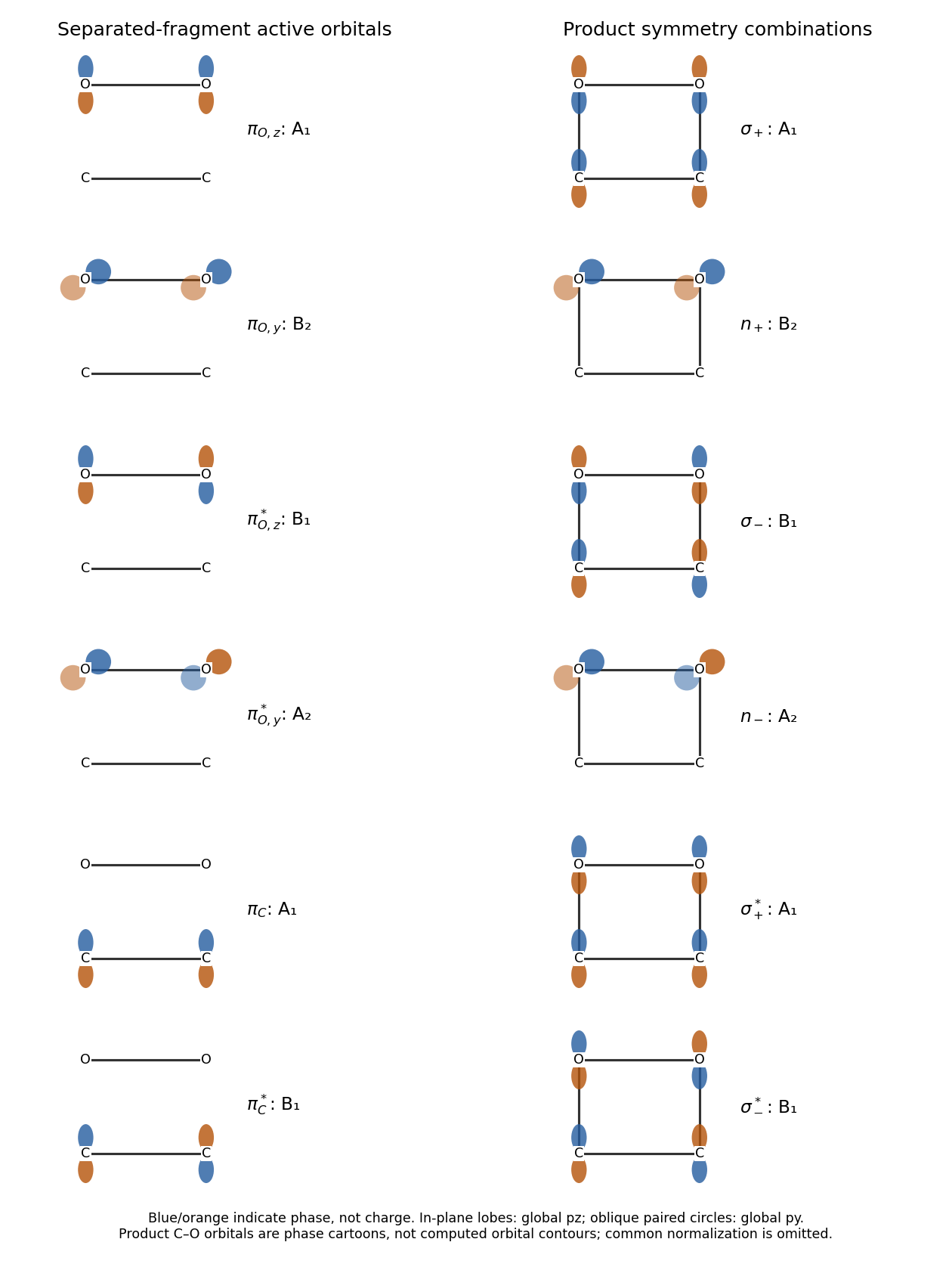
Original signed-orbital sketches for the six reactant and six product active orbitals
. Details. Use negative bonding Hückel resonance integrals, and . The oxygen HOMO is pi-antibonding, whereas the ethene HOMO is pi-bonding. The frozen-orbital Koopmans estimate therefore givesConsequently and . These Hückel Coulomb parameters are effective parameters of this spectroscopically calibrated model. Real ionization energies include relaxation and correlation, so they are not exact matrix elements of an isolated-atom Hamiltonian.
Let be localized bonding orbitals of the two new C–O bonds, and let be their antibonding partners. Their symmetry combinations areThe two remaining active orbitals are out-of-ring oxygen lone-pair combinations, . The opposite-phase combination is the HOMO in the supplied ordering and is HOMO−1. Both are filled, as are the two C–O bonding combinations, givingThe original active-orbital sketches show these phase relations, while the correlation diagram gives a qualitative energy ordering. Precise splittings between unrelated symmetry blocks are not determined by the fragment ionization energies. The retained O–O sigma bond, the C–C sigma bond and the other framework orbitals lie outside this six-orbital active comparison; the eight-electron count does not describe all valence electrons of the product.
The symmetric approach preserves the C2v molecular point group with its twofold axis z and mirror planes xz and yz. The molecular ring lies in xz. Classify orbitals by reflection signs : , , , . With globally defined p-orbital phases the molecular orbital correlation diagram givesWithin either two-orbital symmetry block the lower member remains correlated with the lower product member; the non-crossing rule prevents swapping their order through an ordinary same-symmetry crossing. Crossings between different irreducible representations are allowed. The crucial consequence is that the occupied carbon pi orbital correlates to a C–O-antibonding combination, rather than both initially occupied orbitals becoming the two product bonding orbitals.
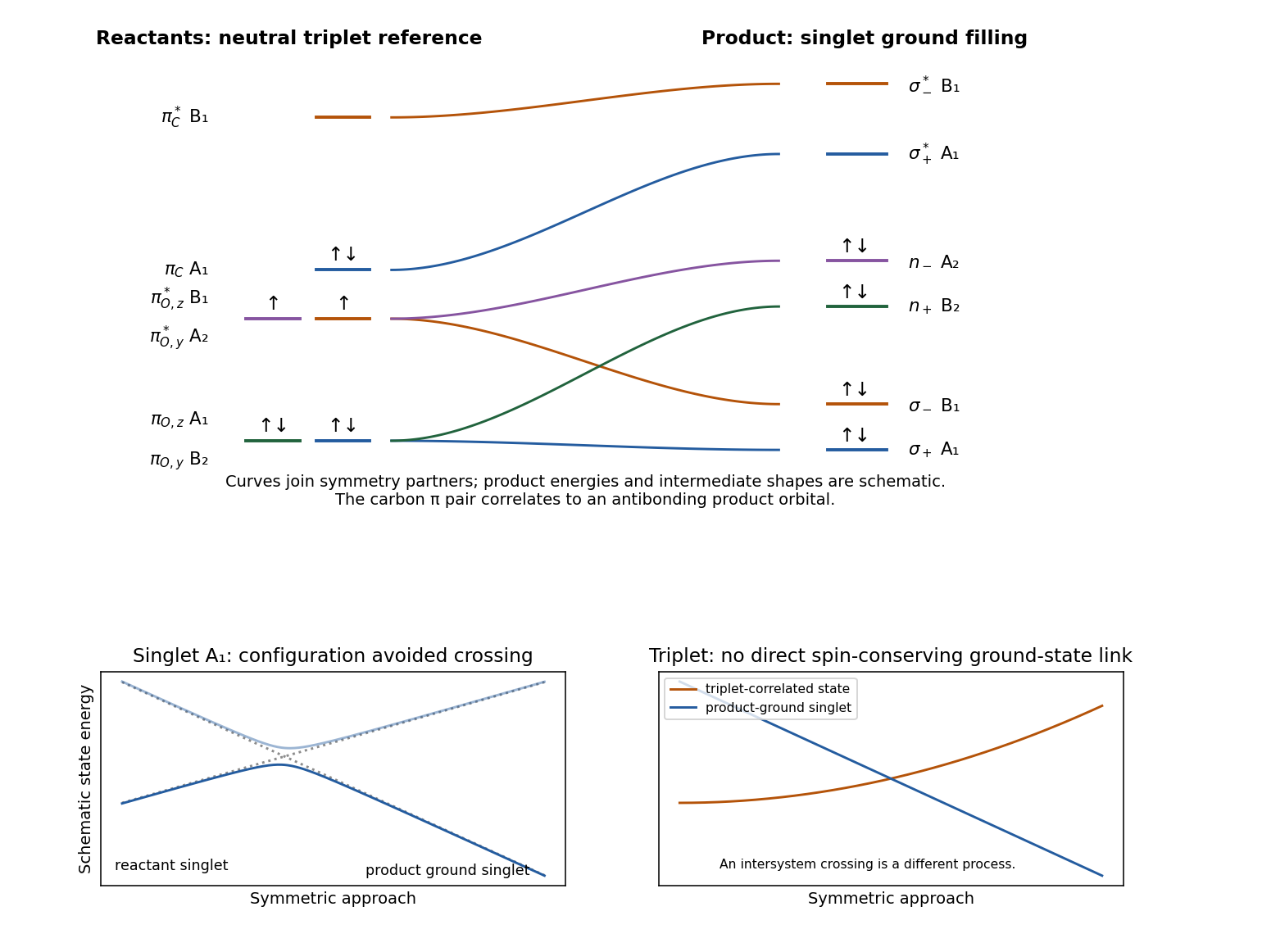


Endpoint energies, endpoint phase patterns and a conserved symmetry fix the qualitative connectivity. Each initial orbital must end in the appropriate product symmetry block, and the ordering within a generic block is preserved by avoided crossings. The two singleton blocks and have unique partners. No numerical calculation at each intermediate separation is required to draw those connections.
This conclusion is limited to a correlation diagram: it does not determine intermediate orbital energies, interaction strengths, the location or height of a reaction energy barrier, or the lowest route on a multidimensional potential energy surface. If the reaction breaks the assumed symmetry, previously distinct symmetry blocks can mix and the diagram must be reconsidered.
In the electronic state correlation diagram, the singly occupied reactant orbitals for triplet oxygen have symmetries and , so their spatial product is . The reactant state is therefore a triplet , whereas the closed-shell product is . A strictly spin-conserving path cannot correlate triplet reactants directly to the ground-state product. It correlates to an excited triplet product configuration or requires intersystem crossing; the symmetric direct reaction consequently has a substantial electronic obstacle.
Simply changing the oxygen spin does not repair the occupied carbon-orbital correlation. The lowest oxygen singlet manifold has spatial components of and symmetry in this subgroup. The singlet can have an avoided crossing with another configuration and reach the product singlet; the singlet cannot mix directly with the product while is maintained. Following either closed-shell oxygen singlet component in the orbital diagram still leaves the carbon-pi electron pair in the rising orbital. Its redistribution into the final occupied orbitals requires configuration mixing at an avoided crossing. A barrier is therefore expected even for the symmetry-constrained concerted singlet addition; singlet does not imply barrierless. The state curves in the original diagram are schematic, illustrating this avoided-crossing argument rather than computed energies.[ref]
Selection rules for singlet-oxygen reactions. Concerted addition reactions by David R. Kearns. 1969, orbital and state correlation for concerted olefin additions
The real singlet reaction can lower this obstacle through asymmetric or stepwise pathways that are absent from the stipulated direct approach. A primary multireference study explicitly distinguishes singlet and triplet addition through biradical intermediates, supporting that limitation of a one-coordinate symmetry argument.[ref]
Singlet and triplet potential surfaces for the O2+C2H4 reaction by Kyoyeon Park and others. 2010, abstract and calculated addition/isomerization surfaces
Neither correlation alone nor a spin label supplies a numerical activation energy. Articles by others on the same topic
There are currently no matching articles.