The missing kinetic contribution is . Both atoms contribute independent translational kinetic energy before the coordinates are changed.
Substituting givesThe shifted equilibrium coordinates satisfy . Expanding about them replaces q by displacements without changing the kinetic metric or the Hessian.
Taking the Hessian of the potential with respect to mass-weighted displacements givesThe equations of motion are , so eigenvalues are squared angular frequencies. Normalized eigenvectors and frequencies areBoth vectors are in the q basis, and . The translation corresponds to equal physical displacements . The stretch has and opposite physical displacements with magnitude ratio . Ordinary frequencies are ; spectroscopic wavenumbers are .
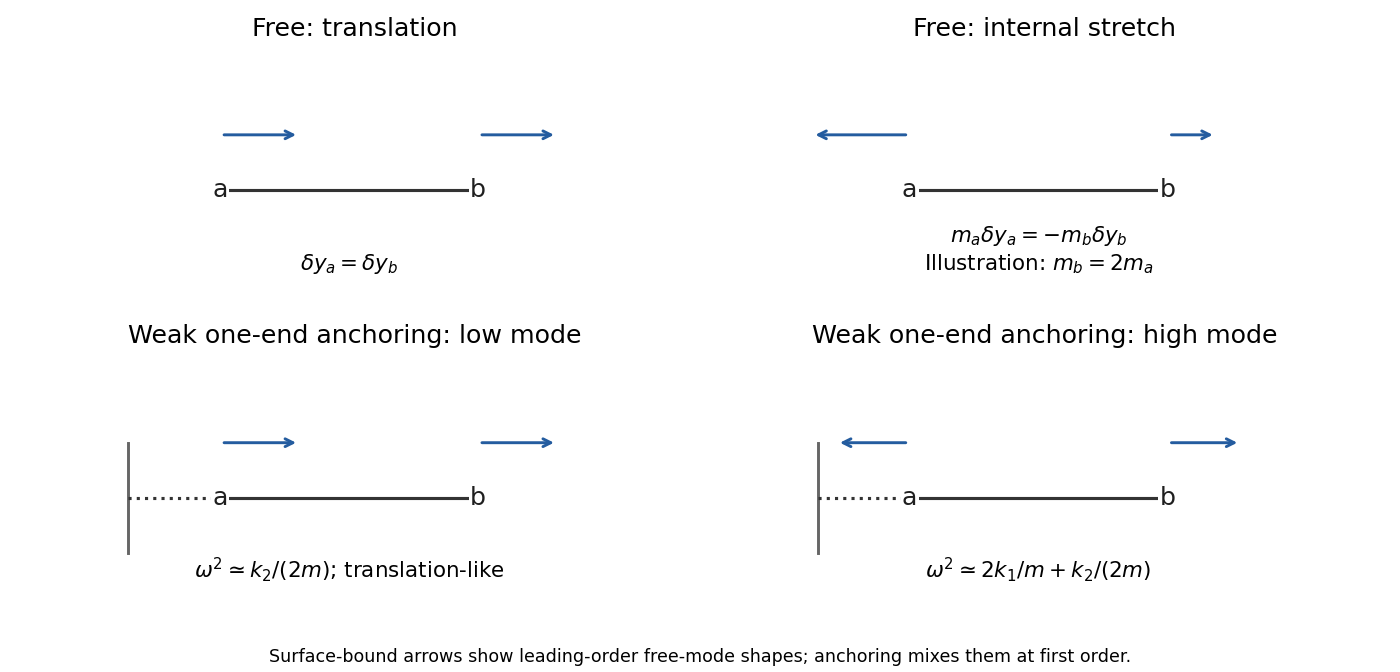

With equal masses m, the two mass-weighted Hessians areFor a uniform displacement vector ,Therefore uniform translation is not a normal mode in orientation (1) when : anchoring only one atom mixes translation with internal stretching. It is an exact normal mode displacement in orientation (2) because both atoms have identical restoring terms. Its frequency is nevertheless nonzero, ; the antisymmetric stretch has . The rigid surface breaks free translational invariance in both orientations. A vector resembling a uniform translation need not be a zero-frequency mode when the molecule is anchored.
For weak anchoring, , use the normalized free-molecule eigenvectors and . The perturbation isIts diagonal matrix elements in this basis are both . First-order time-independent perturbation theory for the eigenvalues therefore givesHence and . The zero free translation requires taking a square root of its new eigenvalue, rather than Taylor-expanding the frequency about zero. It is not a degenerate eigenvalue in the stipulated one-dimensional two-coordinate model.
As a check, the exact squared frequencies areExpansion gives the same first-order results; the next lower-mode correction is . The perturbed eigenvectors contain small translation/stretch admixtures of order , consistent with the failure of uniform translation to remain an exact mode in orientation (1).
Articles by others on the same topic
There are currently no matching articles.