Peroxyacetyl nitrate forms reversibly from a peroxyacetyl radical and NO. It stores reactive nitrogen while intact, then thermal dissociation can release it again. It can therefore transport nitrogen through colder free-tropospheric air and recycle it more rapidly in a warmer planetary boundary layer. Deposition or further chemistry can compete, but reversible storage is its reservoir role.
Dinitrogen pentoxide is likewise a reservoir because can return reactive species. Conversion to nitric acid makes it a sink from the active nitrogen oxides family, especially through heterogeneous uptake on wet aerosol or cloud particles, followed by deposition or washout. Water vapour alone and wet-particle uptake are different mechanisms; they should not be assigned the same rate constant. Temperature, particle surface area and removal are often very different between the boundary layer and the free troposphere, so a reservoir can be transported in one environment and chemically removed in another.
For the stated total number density, multiply the number atmospheric mixing ratio by . With NO defined as NO plus NO,The water partial pressure is of the total pressure. It is a 3% number fraction, not 30 ppm.
The fast family is NO plus NO. Put , , and freeze the supplied parent concentrations while definingThe two equations are and . Their stationary solution isHere , , and in inverse seconds; . Reversible storage must not be counted as permanent family loss: only the term represents the association route followed by hydrolysis.
Closed-family interconversion has . Including the supplied losses, the two linear relaxation times are approximately and , from the eigenvalues of . Fast exchange is therefore well separated from the slower total-family adjustment. However, NO is consumed by ozone on , comparable to and shorter than the family relaxation. Thus the quoted stationary concentration is justified for a maintained background or a sufficiently slowly varying quasi-stationary environment; it is not automatically reached in an isolated parcel initialized with the supplied composition. NO auto-oxidation is negligible at this concentration. Additional organic losses of NO, if present, would need to be added to the model.
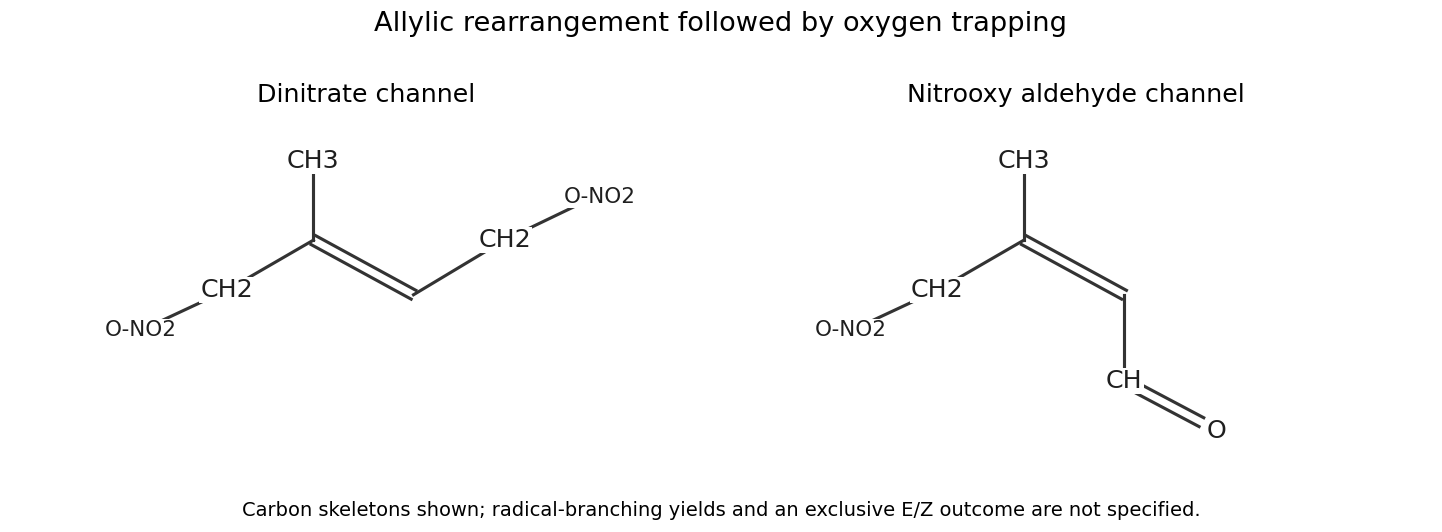
At night, nitrate radical addition and ozone attack are relevant oxidations of isoprene; direct daytime photochemistry is absent, though small OH sources can still exist. The nitrate-containing products identify the NO-addition route. Add NO to the terminal carbon next to the methyl-substituted alkene carbon, producing a nitrooxy substituent and an allylic radical. Resonance moves the radical to the far terminal carbon while shifting the double bond. Oxygen trapping gives a peroxy radical with the carbon skeletonA nitrate-forming termination branch, for example the organic-nitrate branch of reaction with NO, replaces the terminal peroxyl group by a nitrate ester, giving . An alternative branch forms an alkoxy radical, such as peroxy-radical reaction with NO producing RO, NO and O. Reaction of the terminal CHO group with O then gives an aldehyde plus HO, producing . These are covalent O–NO ester groups, not C–NO nitro groups. The delocalized radical can be trapped after conformational change, so this mechanism does not require one universal alkene geometry for both product channels. Product structures alone do not fix a unique branching ratio.

Articles by others on the same topic
There are currently no matching articles.