For an action functional , vary a path while fixing its endpoint coordinates. Integration by parts givesThe endpoint term vanishes. Since the interior variations are arbitrary, stationarity givesDefine canonical momentum . For a regular velocity Hessian, these relations can be inverted for , and the Legendre transform definesIts differential is . Inserting the Euler-Lagrange equations already suggests the canonical equations.
To derive them directly from an principle of stationary action, vary the first-order action with independent and fixed endpoint . Integrating by parts givesThereforeThe endpoint momenta need not be fixed. A singular velocity Hessian instead requires a constrained Hamiltonian formulation; the ordinary Legendre inversion is an assumption, not an identity valid for every Lagrangian.
For degrees of freedom, phase space is the -dimensional space of canonical coordinates . Initial data at one point determine a trajectory under the Hamilton equations.
Liouville's theorem in Hamiltonian mechanics states that this flow preserves the canonical volume element . Its divergence isIf is the Jacobian determinant of the flow from initial data, the determinant evolution formula gives . Since , it remains one, proving preservation of every advected phase volume. The proof also applies to smooth explicitly time-dependent Hamiltonians.
For an ensemble density , probability conservation and the same vanishing divergence giveThus the fine-grained density is constant along the Hamiltonian trajectories, although the ensemble may shear, stretch and develop fine structure. This is not a claim that coordinate-space volume or every lower-dimensional projection is conserved.
Solving , gives the linear phase flowIts Jacobian determinant isHence every patch keeps its area , directly verifying Liouville's theorem. The energy ellipses are also invariant, but area preservation applies to arbitrary patches, not just whole energy shells.
In scaled canonical coordinates , the flow is a rigid clockwise rotation, . The following original plot follows an off-center patch and shows equal areas at successive times.
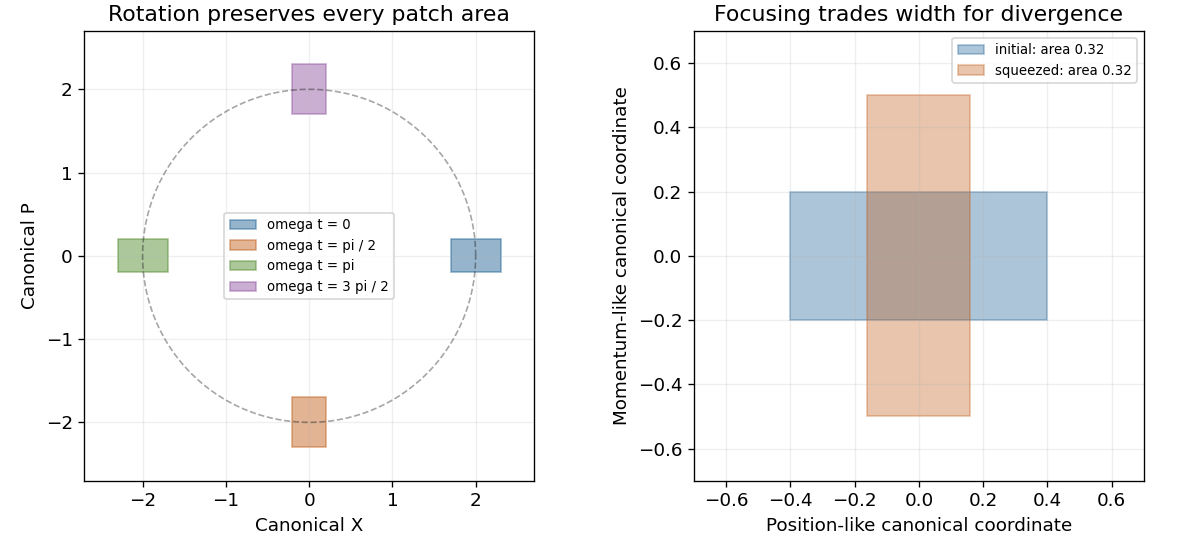
Area-preserving harmonic-oscillator flow: the same phase-space patch at four times, with a focusing squeeze that trades position width against momentum width
. Details. 
For a truly isolated Hamiltonian bunch, Liouville's theorem preserves the fine-grained volume in its full -dimensional phase space. Hamiltonian manipulation cannot increase its full phase-space density by compressing all canonical position and momentum directions simultaneously. Merely focusing the beam to a smaller transverse spot generally increases angular or momentum divergence; it does not by itself reduce beam emittance.
The distinction between full volume and projected spreads matters. Coupling transverse and longitudinal degrees of freedom can exchange emittance or move spread into other coordinates and correlations, so a projected transverse quantity may decrease without reducing the complete phase volume. That is redistribution, not cooling of every degree of freedom. In linear uncoupled optics, preservation of each transverse canonical area makes the spot-size/divergence tradeoff particularly direct.
Actual cooling allows the beam to exchange energy and entropy with other systems. In electron cooling, a colder comoving electron population receives the protons' random kinetic energy and is subsequently renewed or cooled. In stochastic cooling, a pickup measures deviations and a downstream kicker applies feedback corrections; the electronics, measurement noise and environment belong to the enlarged system. CERN's description identifies exactly this pickup-and-kicker arrangement.[ref]
Stochastic cooling by CERN. Feedback and corrections: pickup measurement of sample motion and downstream electric-field correction
Thus these methods relax the idealization that the proton bunch alone is isolated. Including the cooling apparatus does not require the complete closed dynamics to violate Liouville's theorem. For protons, direct radiative damping is much weaker than for electrons, so stochastic or electron cooling is a more relevant practical suggestion than relying on strong synchrotron damping.
Articles by others on the same topic
There are currently no matching articles.