The Debye model treats a three-dimensional solid as an isotropic elastic continuum with three independent acoustic phonon polarizations. It assumes harmonic normal modes, a linear dispersion relation , and equilibrium Bose-Einstein statistics with zero phonon chemical potential. Real anisotropy and nonlinear dispersion are replaced by one effective Debye sound speed. A cutoff restores the finite number of atomic vibrational degrees of freedom; the continuum itself would otherwise have infinitely many modes.
For sample volume , the wavevector state density is per polarization. Counting a sphere givesThere are modes for atoms. HenceThe associated phonon density of states isIf longitudinal and transverse sound speeds differ, use for the low-frequency count. The Debye frequency is an effective mode-counting cutoff, not a claim that every actual branch terminates at exactly that frequency.
The FCC conventional unit cell has four atoms, so the cube containsatoms, neglecting surface corrections. A phonon is one excitation quantum of a vibrational normal mode; there can be many quanta per mode, and zero-point motion does not add half a phonon to the thermal population.
For the low-temperature thermal phonon number, integrate the Bose-Einstein distribution against the Debye model phonon density of states:At , , so extending the upper limit to infinity has negligible effect at the precision required. The supplied integral yieldsThis is the thermally excited phonon number, not the number of available modes.
The continuum approximation fails when the thermally occupied wavelengths become comparable with the cube size . From the Debye temperature,A lowest nontrivial acoustic frequency is of order ; a standing-wave estimate corresponds to . Periodic boundary conditions instead give and . The precise spectrum depends on mechanical boundary conditions and branch speeds, neither of which is specified.
This finite-crystal phonon freeze-out requires summing discrete normal modes. For a finite positive lowest frequency, , rather than extrapolating the bulk law indefinitely. Rigid translations and rotations of an isolated crystallite are not internal thermal phonons. Surface acoustic modes can modify the intermediate crossover, but do not justify inventing a unique boundary spectrum.
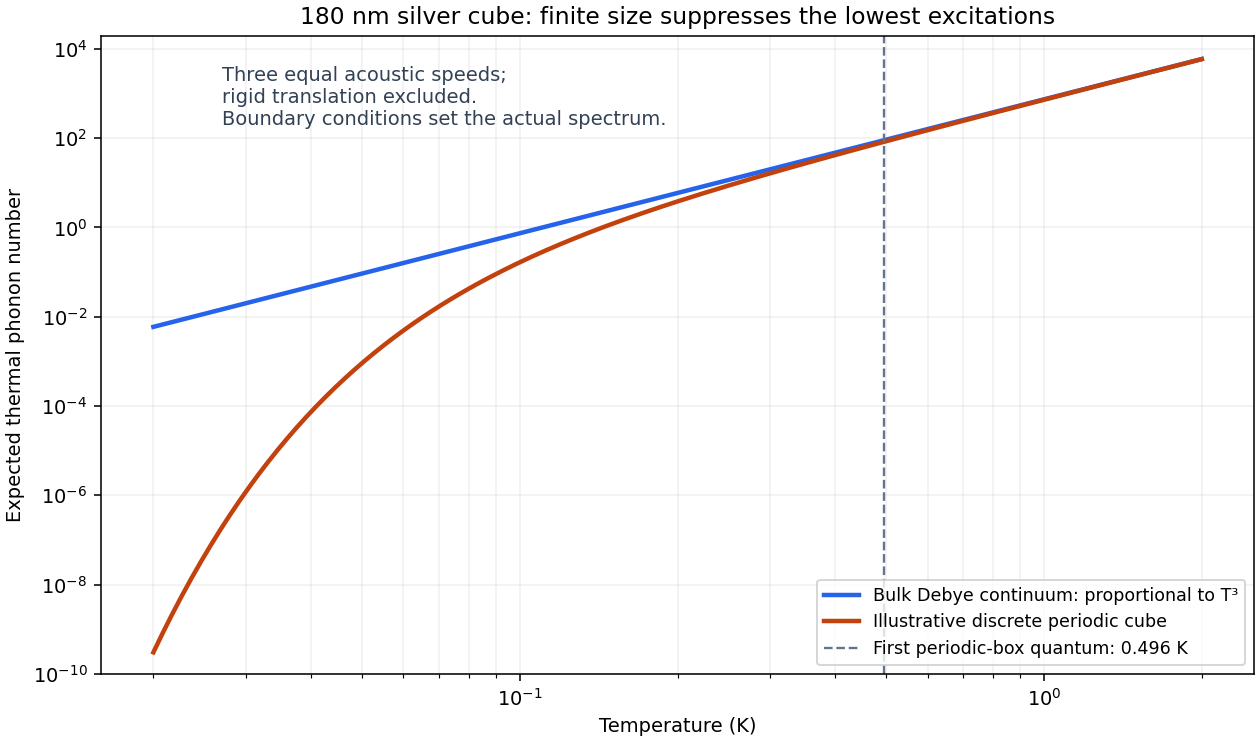
Bulk and finite-box thermal phonon populations
. The discrete curve uses an illustrative periodic cube and three equal acoustic speeds; its low-temperature suppression is not a fitted free-surface spectrum. Details.
The harmonic phonon contribution to the internal energy isFor , every retained mode has . Expanding cancels the explicit half quantum and gives per mode to leading order. ThereforeEquivalently, differentiating before integrating givesThe integrand tends to , and its integral is , producing the same Dulong-Petit law. In classical language, the equipartition theorem assigns each to the kinetic and elastic parts of every harmonic normal mode. Fixed zero-point energy does not contribute to the heat capacity.
Articles by others on the same topic
There are currently no matching articles.