Take one conduction electron per atom and a three-dimensional free electron gas, with spin degeneracy two and electron mass . State counting inside the occupied Fermi sphere givesThe highest occupied energy at zero temperature is , soThis relates the atomic number density to the Fermi temperature only because monovalency and the free-electron dispersion have been assumed. A real energy band can require a different density of states and band effective mass.
For the isotropic Debye model, count three acoustic polarizations up to one spherical wavevector cutoff . The number of vibrational modes per volume isWith and ,The effective is the Debye sound speed: matching the low-frequency mode density of one longitudinal and two transverse branches requires . It is not generally the arithmetic average of their speeds. The cutoff preserves the mode count; it need not coincide with the actual nonspherical Brillouin zone boundary.
Pauli exclusion principle prevents most filled electronic states from changing occupation at . Only a shell of width of order around the Fermi energy participates. Since the density of states near that energy is of order per volume and energy, the fraction of active electrons is of order . Their typical change of energy is of order , so the thermal energy increment per volume scales asDifferentiating with respect to temperature gives the electronic heat capacityThe simple shell argument fixes the linear law, not its coefficient. A Sommerfeld expansion using the spin-summed free-electron density of states gives , hence , consistent with the supplied value. The result excludes strong band-structure or interaction corrections and requires a degenerate electron population.
The Debye model treats the crystal as an isotropic elastic continuum with independent harmonic vibrational modes. There are three acoustic polarizations, approximated by linear dispersions and a common effective speed. A cutoff is chosen to retain modes for atoms. The model neglects anharmonic interactions and the detailed high-wavevector dispersion. In a multi-atom primitive cell, optical branches require additional treatment; copper has one atom per primitive cell even though its conventional cubic cell contains four atoms.
A frequency interval contains, per volume,Each phonon mode has Bose-Einstein distribution occupation . The fixed zero-point energy contributes no heat capacity. Its thermal energy density isFor , extending the upper limit to infinity gives . ThereforeThe cubic law reflects the three-dimensional acoustic mode density proportional to . It is a low-temperature limit, not a valid extrapolation through the classical high-temperature regime.
The conventional face-centered cubic lattice cell contains four atoms, soThe preceding free-electron and Debye expressions giveAt low temperature the electronic and lattice heat-capacity crossover in a monovalent metal is found fromThus the electronic term dominates for K within the normal-metal model. Both low-temperature approximations are well controlled at that crossover. At exactly zero temperature both heat capacities vanish; below sufficiently small finite-size energy scales a continuum model also needs revision.
Room temperature is not : using the cubic formula at 300 K would incorrectly predict , far above the harmonic high-temperature limit . Instead use the Dulong-Petit law as an estimate:Keeping the finite cutoff in the Debye heat capacity givesAt 300 K this is , whereas , giving . Either appropriate room-temperature estimate shows that the lattice contribution dominates. The electronic approximation remains excellent because .
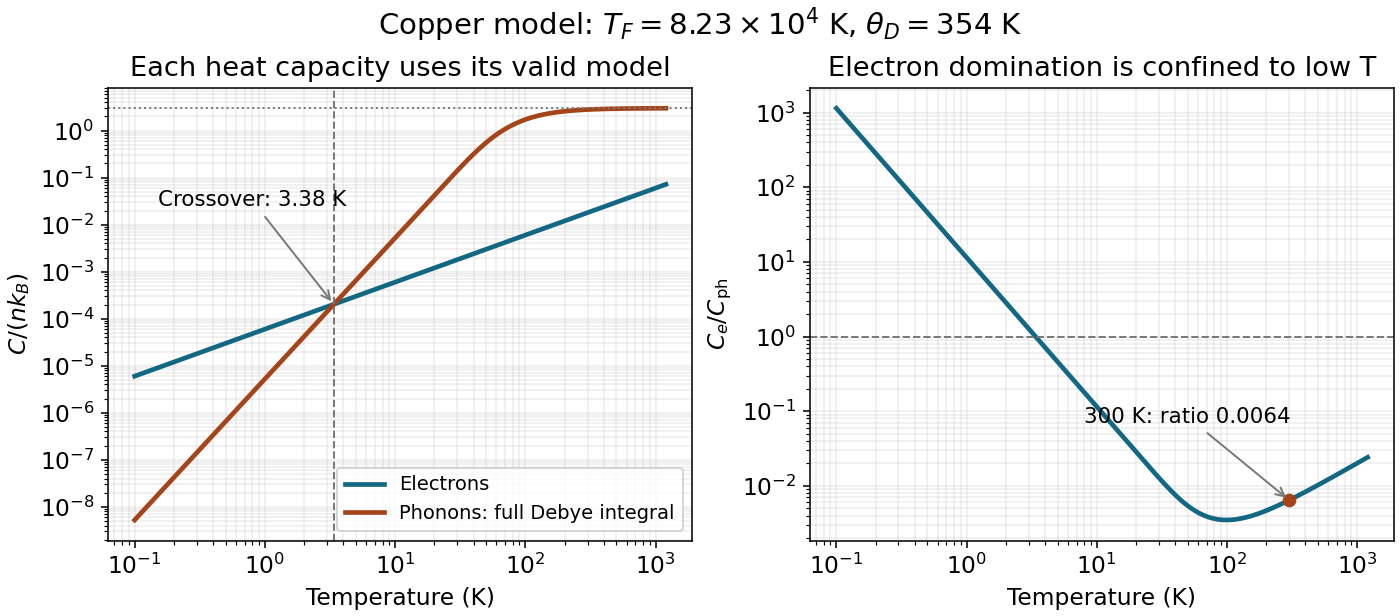
Electronic and full Debye lattice heat capacities of the stated copper model, with the low-temperature crossover and room temperature marked
. Details. 
Articles by others on the same topic
There are currently no matching articles.