Isothermal compressibility is the compressibility measured at fixed temperature, particle number and composition. A slowly compressed sealed piston in contact with a thermal reservoir can approach this constraint. For an ideal gas, differentiating at fixed temperature gives , hence . A small pressure increase therefore gives . For a finite change, use the whole isothermal process curve instead.
Take one mole of classical monatomic gas, with stipulated molar gas constant , initially at and . The initial volume is . Compressing to givesThe isothermal compression releases heat to the thermal reservoir; the reversible adiabatic compression retains the input work as internal energy. Reversing either curve gives the corresponding expansion, with adiabatic expansion cooling the gas.
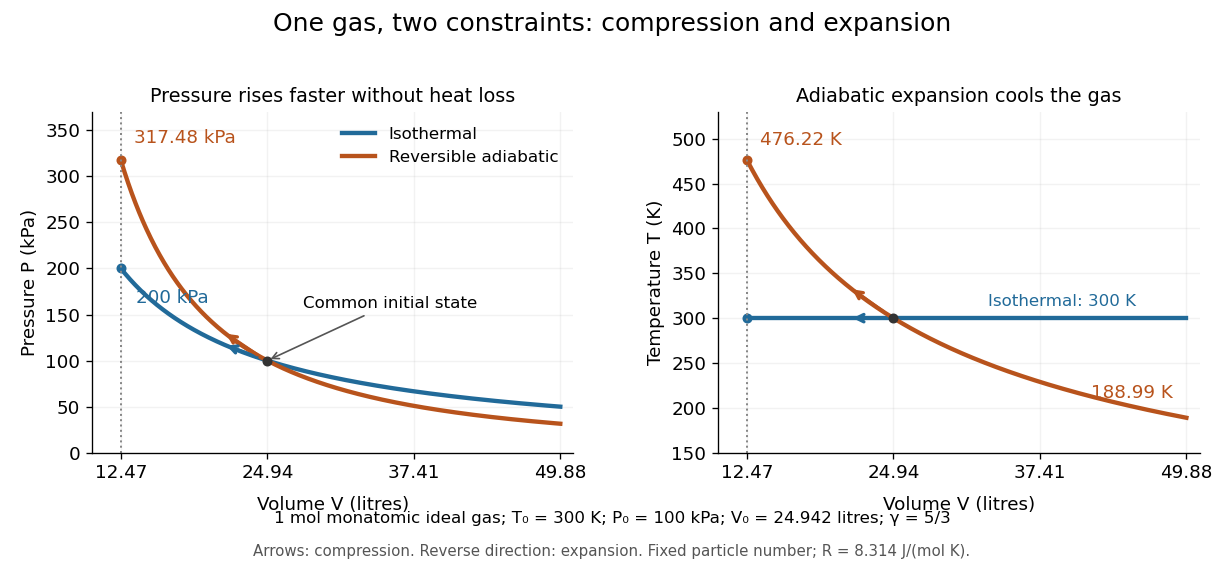

The equilibrium curvature of Gibbs free energy provides another measurement of isothermal compressibility:This follows from , with denoting Gibbs free energy. Within a stable single thermodynamic phase, increasing pressure reduces volume and makes this curvature negative. At phase coexistence, changing the phase fraction can change the volume at constant temperature and pressure; the usual finite single-phase isothermal compressibility then need not exist. Near a critical point, it can diverge. [ref]
https://www.feynmanlectures.caltech.edu/I_45.html#Ch45-S3. Feynman, Leighton and Sands, section 45-3: compression and phase coexistence
Articles by others on the same topic
There are currently no matching articles.