A phonon is a quantum of a normal mode of Bravais lattice vibration. A harmonic mode of angular frequency has energy , and adding one phonon increases its energy by . The phonon carries crystal momentum , defined modulo a reciprocal lattice vector.
The first Brillouin zone is the Wigner-Seitz cell of the reciprocal lattice about the origin: the set of wavevectors at least as close to the origin as to any other reciprocal lattice point. Its boundaries are reciprocal-space perpendicular bisectors. It gives one representative of each wavevector modulo reciprocal lattice translations.
Put . Differentiating the Morse potential givesThe finite-separation minimum has . ThusThe positive bond-dissociation energy is , measured relative to the separated-atom value . This distinguishes the well's negative potential energy from the positive energy required to break the bond.
For the displacement , the Taylor expansion isConsequentlyThe restoring force is to leading order, identifying the bond's Hooke's law spring constant.
The mass per lead atom isLet be its longitudinal displacement. Newton's second law gives the harmonic chain equationInsert the normal mode to obtainAt long wavelength, . The sound speed is the corresponding low-frequency group velocity:The relevant inertia in this chain equation is one atomic mass. The reduced mass belongs to the relative vibration of an isolated pair and should not be substituted for in the chain's dispersion relation.
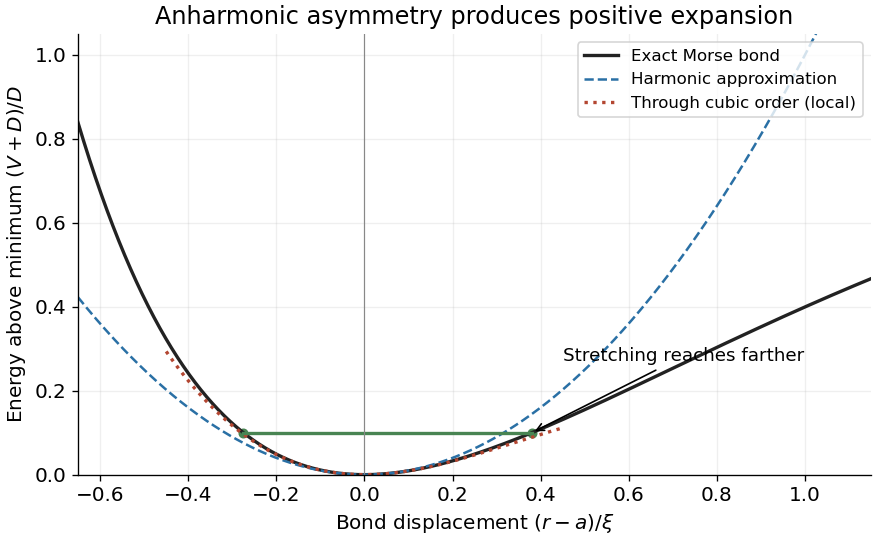
Write the Morse potential relative to its minimum as . Expanding one order beyond the harmonic term givesThe negative cubic coefficient means that stretching is softer than compression. Thermal motion therefore has positive mean displacement even though the most probable minimum is at .
For thermal expansion of a weakly anharmonic bond, classical equipartition gives . Vanishing mean restoring force, to first anharmonic order, requiresFor a bond free to expand under negligible applied tension, . Its linear thermal expansion coefficient is thereforeKeeping the leading perturbative numerical factor gives . The question only requires the scale, not that factor. The thermal expansion is positive; a purely harmonic approximation would give zero mean displacement and zero thermal expansion. The local Taylor expansion describes a bound bond and is not a globally stable cubic potential.

The small parameter controlling the local Taylor expansion is the typical bond displacement divided by . In the classical regime, the root-mean-square displacement is . ThusFor example, the magnitude of the cubic term divided by the quadratic term is , and subsequent terms carry further powers of this ratio. A physically safe bound-bond regime also has , or . These are the same parametric scale, differing only by a factor two. The inequalities are strong: they do not imply that a truncated local expansion is accurate close to several thousand kelvin.
At very low temperature, replace the classical fluctuation estimate by the zero-point motion as discussed in part ii. Its bond displacement is small compared with for the supplied parameters, so low temperature does not itself invalidate the local expansion. Actual melting, other neighbours and bond breaking are outside this one-dimensional bond model.
Quantum statistics matter when thermal energy is comparable with a characteristic vibrational level spacing. The chain's natural angular frequency is , givingFactors of order unity depend on which vibrational scale is used. The largest chain phonon angular frequency is , corresponding to . An isolated two-atom bond has reduced mass and angular frequency , corresponding to . Thus quantum corrections become appreciable on the scale of several tens of kelvin, and all modes are classical only when is comfortably above the largest relevant vibrational scale. Below it, high-frequency phonons are progressively frozen out and equipartition fails.
For the isolated bond, the zero-temperature root-mean-square relative displacement isIt is small enough for a local bond expansion. The classical weakly anharmonic estimate in part d therefore has a useful parametric windowwhere the lower condition means comfortably above the vibrational scale, rather than a sharp threshold. The model's upper bound concerns local anharmonicity and binding, not a prediction of the melting temperature.
Articles by others on the same topic
There are currently no matching articles.