The function is an odd function, passes through , and has the horizontal asymptote at both infinities. Its derivative isIt decreases for and increases for , with its lowest value and highest value . These features determine the graph of a function shown below.
For , the equation is the quadratic equation . The quadratic formula gives exactly two real equation roots:The binomial series gives , hence the two requested asymptotic expansions areTheir product is exactly one. Both are positive, with ; there are no negative equation roots because for . At the two real equation roots coincide at one, and for there are none. In the stated limit , these two branches are therefore exhaustive.
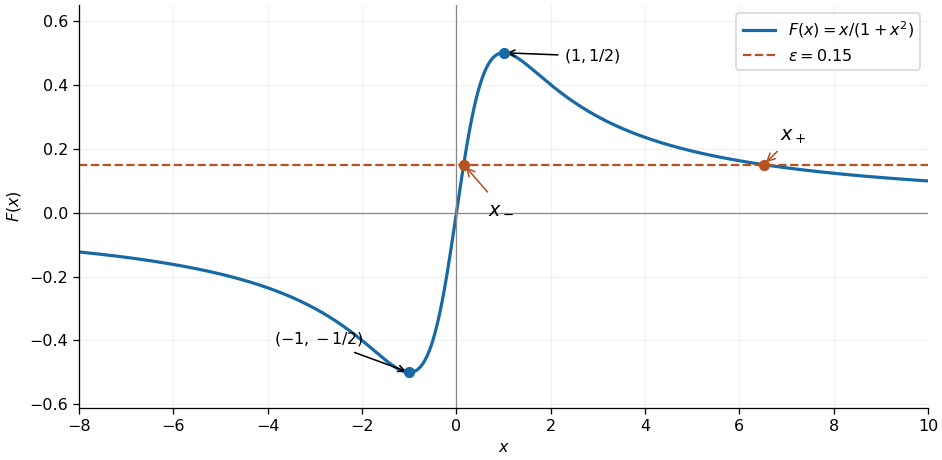
Two positive intersections of the rational function with a small positive level
. Original sketch of with the two real equation roots marked for . The curve also shows its negative lowest point and positive highest point. Details.
Articles by others on the same topic
There are currently no matching articles.