Write the planar velocity field as , with . Expanding the curl givesConsequently, for a piecewise smooth path from the origin to ,The arbitrary additive constant may be set to zero. The integrand is exactly , so the fundamental theorem for line integrals proves path independence immediately: the difference between two paths is the line integral of a gradient around a closed curve, which is zero.
One can also see the local integrability condition from Green's theorem:because the given representation enforces incompressibility. This second proof applies whenever the region between the paths lies in the regular fluid domain. The question already assumes a globally defined streamfunction; without that assumption, incompressibility alone would guarantee a global streamfunction on a simply connected domain, but a hole carrying nonzero volume flux could obstruct it.
Substitute the given Stokes streamfunction representation into the divergence in spherical coordinates. The mixed derivatives cancel:Thus incompressibility is automatic for a smooth Stokes streamfunction. Since this is an axisymmetric flow with no azimuthal velocity, the only possibly nonzero component of its vorticity isDefine the differential operator in the Stokes streamfunction equation for irrotational flowThe stated equation is , and thereforeThe irrotational flow has a velocity potential locally, and globally on a regular simply connected domain. Regularity of the physical velocity field supplies the limiting interpretation on the polar axis, where the coordinate expressions contain in the denominator.
Put and define the image term . The key step is to verify that inversion preserves the Stokes streamfunction equation for irrotational flow. Direct differentiation giveswhere the quantities on the right are evaluated at . HenceBy linearity, obeys the same equation and describes an incompressible flow and an irrotational flow wherever the original exterior flow is regular.
On the sphere, and the two terms cancel identically:Thus the sphere is a stream surface and satisfies the no-penetration boundary condition. Tangential slip is allowed in this potential flow model. For every finite , the image argument satisfies , where has no singularities. The prefactor is regular there. Therefore the construction creates no new finite exterior singularities; any original exterior singularities remain those of the prescribed incident flow. This is the sphere theorem for a Stokes streamfunction.
For the far-field claim, the stated bound givesOne must compare velocities, rather than require the correction to the Stokes streamfunction to tend to zero. Smoothness at the original origin, together with , gives and there. Thus and , and the correction hasThese estimates hold away from the coordinate poles, with the regular-axis limits supplied by the original smooth physical flow. ConsequentlyThe far-field velocity field is unchanged. For a fully smooth incident velocity field at the origin, the usual regular expansion is stronger and makes the sphere disturbance decay as .
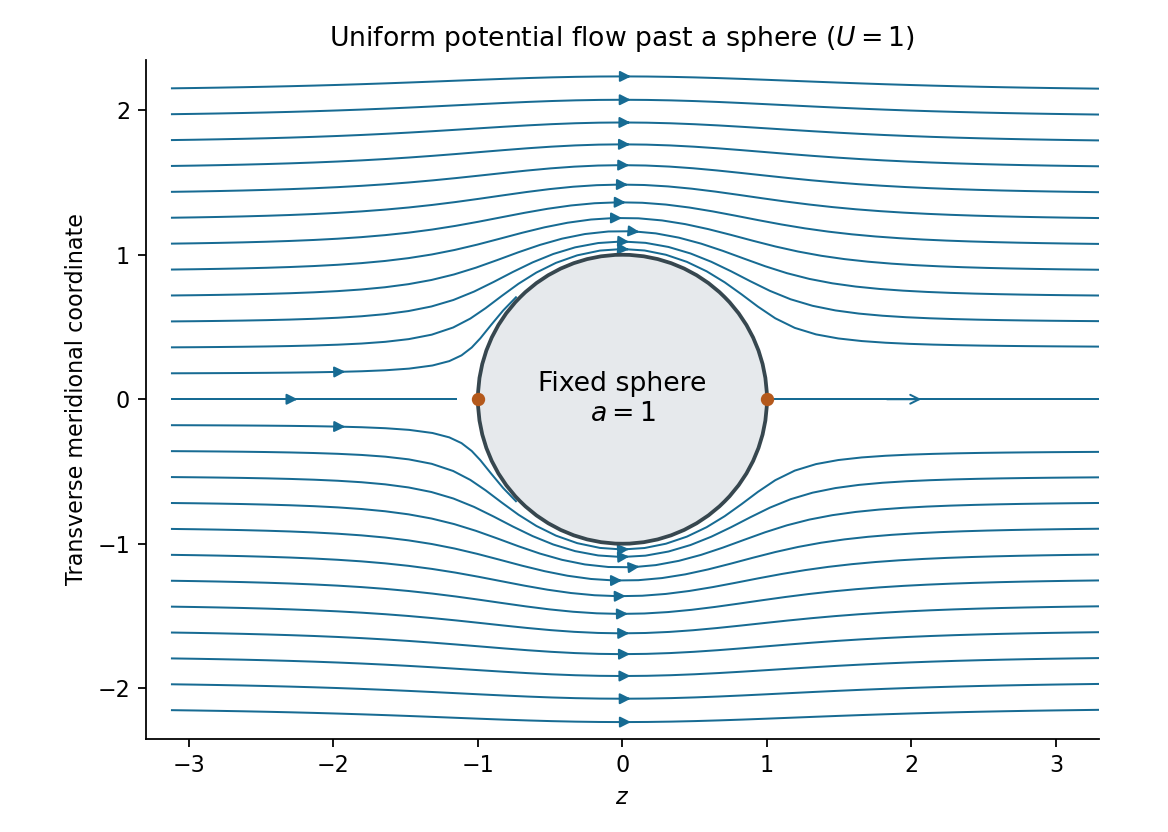
The incident uniform flow has spherical components , . Integrating the Stokes streamfunction formulas, with the additive constant chosen to vanish on the axis, givesIt is regular at the origin. Applying the sphere theorem for a Stokes streamfunction yieldsThe resulting velocity components areTo find the velocity potential, integrate and verify . This givesThe first term is the incident uniform flow, and the second is a potential dipole located inside the excluded sphere. At , the radial velocity vanishes, while the far-field velocity tends to . The poles are stagnation points; the surface tangential speed reaches at the equator. These formulas describe uniform potential flow around a fixed sphere.

Articles by others on the same topic
There are currently no matching articles.