Let . The end-wall forcing has transverse factor , which already satisfies both fixed-wall Neumann boundary conditions. By linearity and separation of variables, seek its periodic response asSubstitution into the wave equation and the moving-wall condition givesThe acoustic waveguide cutoff is thereforeIt is the lowest nonzero transverse-mode frequency. The uniform transverse mode has no cutoff, but is not excited here because .
For , put . The axial equation has solutions . Boundedness removes the growing exponential, and fixes the coefficient. ThusThis evanescent wave oscillates in time but decays with penetration length . Its axial velocity is proportional to , while its excess pressure is proportional to . They are in phase quadrature, so their mean product, the axial acoustic energy flux, is zero.
For , put . The axial solutions are . The outgoing condition selects for the chosen time convention, andTaking the real part givesIts axial velocity is , so the moving-wall condition is satisfied with the correct sign. This is a traveling acoustic waveguide mode carrying energy toward positive . Its dispersion relation isThe larger axial phase velocity does not imply faster energy transport: the group velocity controls that transport.
At , the axial equation becomes . The imposed nonzero derivative forces a constant, which is unbounded. Thus there is no bounded periodic response at exact cutoff for this infinite, undamped, velocity-driven model. The divergent coefficients as or also show why the assumed small perturbations fail sufficiently close to cutoff at fixed forcing. Initial conditions can add free transients; the displayed formulas give the selected periodic forced response.
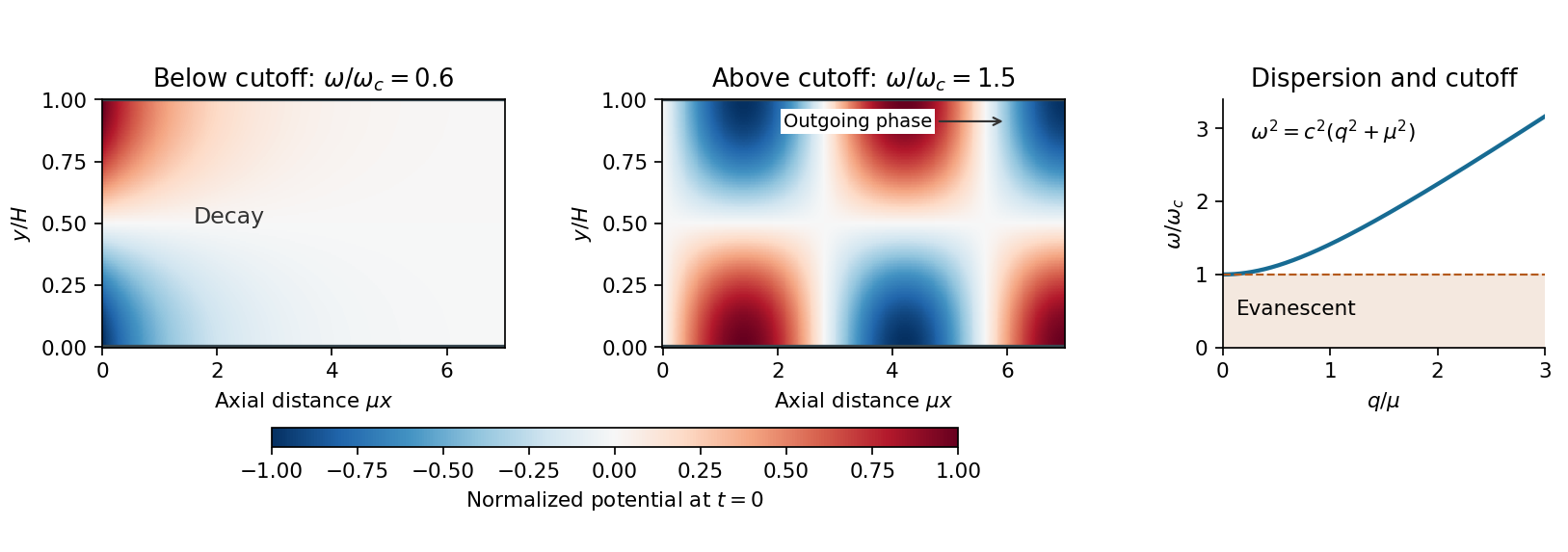
An oscillating end wall excites either an evanescent disturbance or an outgoing acoustic wave
. The transverse shape is . Below cutoff, the normalized axial potential decays exponentially; above cutoff it oscillates downstream with an outgoing phase. The right panel shows the common cutoff and the propagating dispersion branch. Details.
Articles by others on the same topic
There are currently no matching articles.