Let be any material volume, moving with the velocity field . The Reynolds transport theorem in the required form isapplied componentwise when is vector-valued. Mass conservation givesSince the material volume is arbitrary, the local continuity equation follows:For an inviscid fluid with no body force, the balance of linear momentum equates the rate of change of total momentum to the boundary pressure force:using the divergence theorem. The integrand on the left expands asThe bracket vanishes by mass conservation, leaving the Euler momentum equationUnlike the incompressible flow case, the mass density need not be constant along a fluid element.
The rest state is , , . At linear order in the perturbations, the continuity equation, Euler momentum equation and the given equation of state becomeFor the acoustic component take . This is consistent with initially zero vorticity, since taking the curl of the linear momentum equation gives . Any pre-existing linear vortical component is time independent and is separate from the potential oscillations being sought.
Spatial integration of gives . Adding a function of time to the velocity potential removes without altering the velocity field. HenceSubstitute the first relation into mass conservation:Thus the velocity potential satisfies the wave equationDifferentiating that equation in time and using the same density-potential relation givesAlternatively, differentiate the linear continuity equation in time and take the divergence of the linear momentum equation. The coefficient is the sound speed, since .
The fixed upper and lower walls have zero normal velocity. Since , their no-penetration boundary conditions areFor the moving end wall, use its level-set equation . The kinematic boundary condition gives the exact impermeability relationBoth and are first order, so their product is second order. A Taylor expansion from to changes the first-order perturbation velocity only at second order as well. ThusAt infinity, select a bounded response with no waves incident from . A propagating acoustic waveguide mode must satisfy the outgoing radiation condition for a waveguide mode, while a nonpropagating mode must decay. For a time dependence , a propagating axial factor has the form , , and obeys . An evanescent factor is , .
Requiring for all frequencies would incorrectly exclude the radiated traveling waves. In this lossless channel they retain finite amplitude arbitrarily far downstream.
Let . The end-wall forcing has transverse factor , which already satisfies both fixed-wall Neumann boundary conditions. By linearity and separation of variables, seek its periodic response asSubstitution into the wave equation and the moving-wall condition givesThe acoustic waveguide cutoff is thereforeIt is the lowest nonzero transverse-mode frequency. The uniform transverse mode has no cutoff, but is not excited here because .
For , put . The axial equation has solutions . Boundedness removes the growing exponential, and fixes the coefficient. ThusThis evanescent wave oscillates in time but decays with penetration length . Its axial velocity is proportional to , while its excess pressure is proportional to . They are in phase quadrature, so their mean product, the axial acoustic energy flux, is zero.
For , put . The axial solutions are . The outgoing condition selects for the chosen time convention, andTaking the real part givesIts axial velocity is , so the moving-wall condition is satisfied with the correct sign. This is a traveling acoustic waveguide mode carrying energy toward positive . Its dispersion relation isThe larger axial phase velocity does not imply faster energy transport: the group velocity controls that transport.
At , the axial equation becomes . The imposed nonzero derivative forces a constant, which is unbounded. Thus there is no bounded periodic response at exact cutoff for this infinite, undamped, velocity-driven model. The divergent coefficients as or also show why the assumed small perturbations fail sufficiently close to cutoff at fixed forcing. Initial conditions can add free transients; the displayed formulas give the selected periodic forced response.
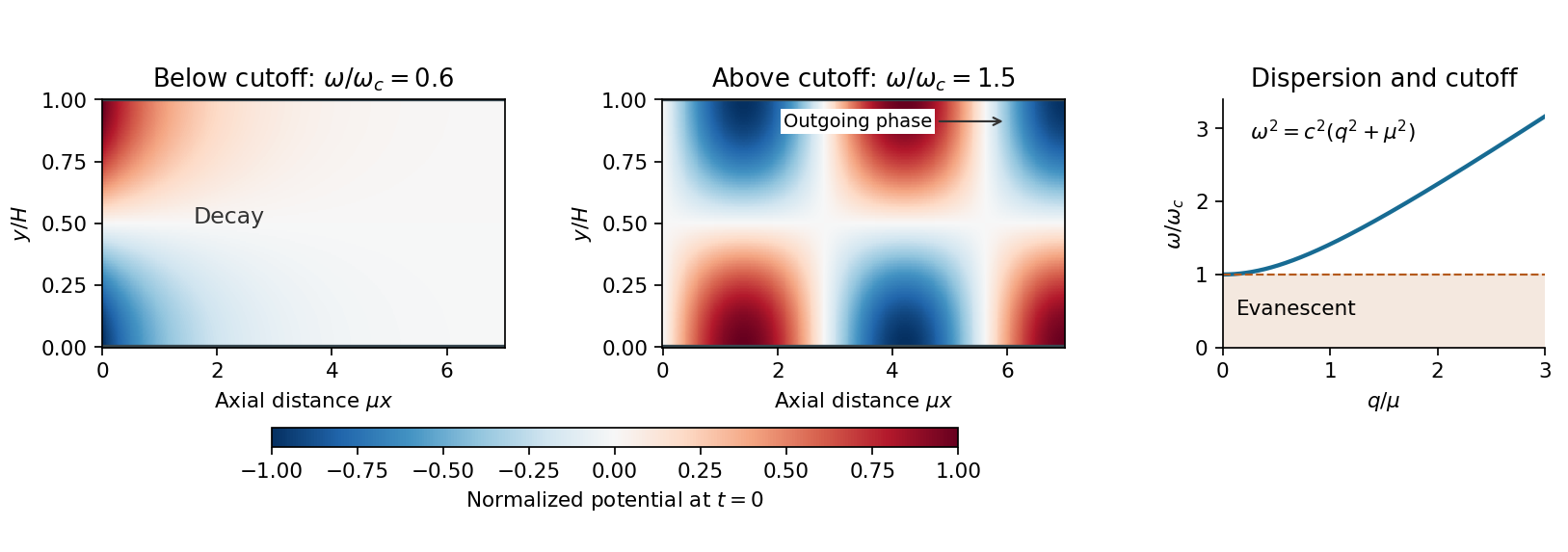
An oscillating end wall excites either an evanescent disturbance or an outgoing acoustic wave
. The transverse shape is . Below cutoff, the normalized axial potential decays exponentially; above cutoff it oscillates downstream with an outgoing phase. The right panel shows the common cutoff and the propagating dispersion branch. Details.
Articles by others on the same topic
There are currently no matching articles.