Put , and . For an affinely parametrized geodesic, use the unhalved quadratic Lagrangian . Its Euler-Lagrange equations are unchanged by this overall normalization. Since is a cyclic coordinate, , equivalentlyThe spatial derivatives give and , where . Therefore
For the connection coefficients, take , so and . Substituting the diagonal inverse metric into the Christoffel symbol formula gives all nonzero component types, including lower-index symmetry:All other component types vanish. If the time coordinate is rather than , replace by ; the displayed time–space mixed coefficients are unchanged. Spatial indices in these formulas are raised with the background Euclidean metric.
For the circular orbit let and . Both and are constant along it. The radial spatial equation gives , so, treating the displayed metric coefficients algebraically, . The weak-field approximation securely determines the leading Keplerian orbit resultThe time normalization is , yielding and . One must distinguish the proper-time angular frequency in the supplied path from the coordinate-time angular frequency. The formal factor in the frequency equation comes from treating the truncated metric as exact; a complete relative post-Newtonian correction to the orbital period would also require the omitted higher-order temporal metric terms.
Use the curvature sign conventionwhich has the derivative ordering printed in the source for . A Christoffel symbol is of order , so its derivative is of order , whereas a product of two connections is of order . Their ratio is . The metric is stationary, hence the temporal derivative term vanishes. ConsequentlyHere , and . The weak-field tidal curvature in a stationary metric is
Printed sign inconsistency. The source's positive half-Hessian and its final negative-prefactor expression are the opposites of this result. A concrete check at is , giving , while the printed final expression gives . Thus both printed equalities cannot hold with its stated derivative ordering. Reversing the definition of the Riemann curvature tensor would give the printed final sign, but would also require reversing the curvature term in the geodesic deviation equation. The convention used here and in the next part gives the physical radial stretching and transverse compression.
Geodesic deviation compares neighboring members of a family of freely falling trajectories. Subtracting their geodesic equations to first order in the connecting vector gives a covariant relative-acceleration equation governed by the Riemann curvature tensor. For a slowly moving satellite, dominates the spatial components. Choose simultaneous spatial separation in a locally transported frame, take the weak-field approximation, and neglect terms quadratic in the small separation and higher velocity corrections. The leading spatial equation becomesReplacing the transported covariant derivatives by ordinary derivatives is a leading local or Newtonian approximation; a rotating orbital frame would introduce additional inertial terms. In the convention established above, the instantaneous tidal acceleration stretches radial separations and compresses transverse ones.
The growth expected for nearby different-radius circular orbits is especially transparent from Kepler's third law. If the radii are and , their coordinate angular frequencies differ by . Initially aligned orbits therefore acquire an along-track separation . Over the interval in which the nearby-orbit approximation remains valid, this produces a growing separation without needing to solve the deviation equation.
This growth is not universal or indefinitely unbounded. Equal-radius co-orbiting geodesics with a fixed phase offset have constant separation, and slightly inclined equal-radius circular orbits have bounded, periodically varying separation. Even different-radius circular orbits have bounded exact positions; their relative angle eventually wraps around. The secular drift statement assumes distinct radii and describes the local differential-orbit regime.
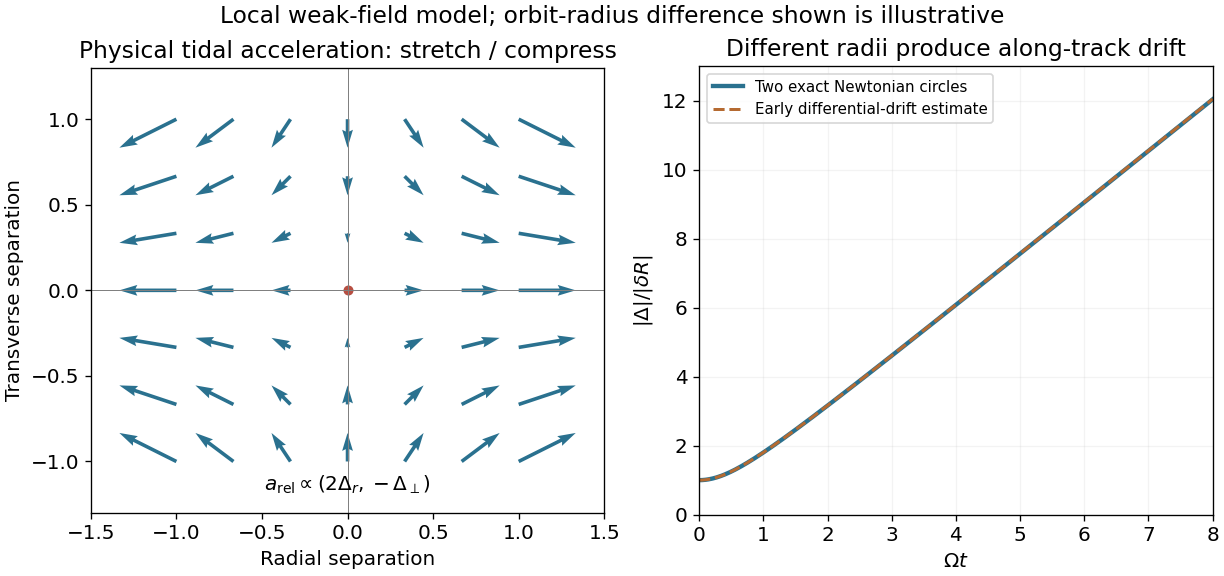
Physical tidal stretching and the early differential drift of neighboring circular orbits
. Details. 
Articles by others on the same topic
There are currently no matching articles.