Work consistently to first order in the metric perturbation, with of the same small order. Under the passive change ,Applying this to the full metric tensor and writing with the same fixed numerical Minkowski metric givesIndices on are lowered with . This is the gauge transformation of the perturbation relative to a fixed background. If the background were transformed as a tensor as well, the difference of those two fully transformed metrics would instead obey the homogeneous tensor transformation law. The inhomogeneous terms arise from retaining the fixed-background identification used in linearized gravity.
The trace changes by , so the trace-reversed metric perturbation changes asLet . Commuting partial derivatives givesThus choose a solution of the inhomogeneous wave equationSuch a solution exists locally with suitable initial data, and can be selected with appropriate wave-equation boundary conditions. This imposes the Lorenz gauge in linearized gravity, . All the divergence terms in the supplied vacuum equation then vanish, leavingThe remaining freedom is the residual gauge symmetry of linearized gravity.
Using the old coordinates in these derivatives is consistent at the retained order. IndeedActing on a first-order perturbation, the correction is a product of two first-order quantities and is discarded. Similarly replacing the argument by changes by under the same perturbative ordering. This does not assert an exact equality of the two coordinate differential operators; it is the linear approximation about the fixed flat background.
For a nonzero plane-wave trace-reversed metric perturbation,The wave equation therefore requires a null wave vector. The Lorenz gauge in linearized gravity supplies transversality:The amplitude is symmetric because it represents a metric perturbation; its real part is the physical wave. The two displayed conditions do not by themselves make it spatially transverse and traceless: the additional reduction to transverse-traceless gauge uses the remaining residual gauge symmetry of linearized gravity.
Take the real physical wave and write . The specified amplitude has zero trace, so its metric perturbation equals its trace-reversed metric perturbation. It is in transverse-traceless gauge:to first order. Assume the freely falling particles are initially at rest in these coordinates. Since and in coordinates ,The geodesic equations therefore admitUniqueness preserves these initial conditions. Thus the coordinate locations remain fixed; this conclusion does not apply to arbitrary initially moving particles.
Coordinate position is not measured separation. In the central observer's local orthonormal frame in spacetime, and in the long-wavelength limit appropriate to a small detector, the transverse physical separations areto first order. In particular the two principal semiaxes of the ring areFor a point at angular position the radial displacement isThe freely falling ring in transverse-traceless gauge alternates between ellipses elongated in the and directions. Its area is unchanged to first order. This is the plus gravitational wave polarization; the axes exchange their roles after half a period.
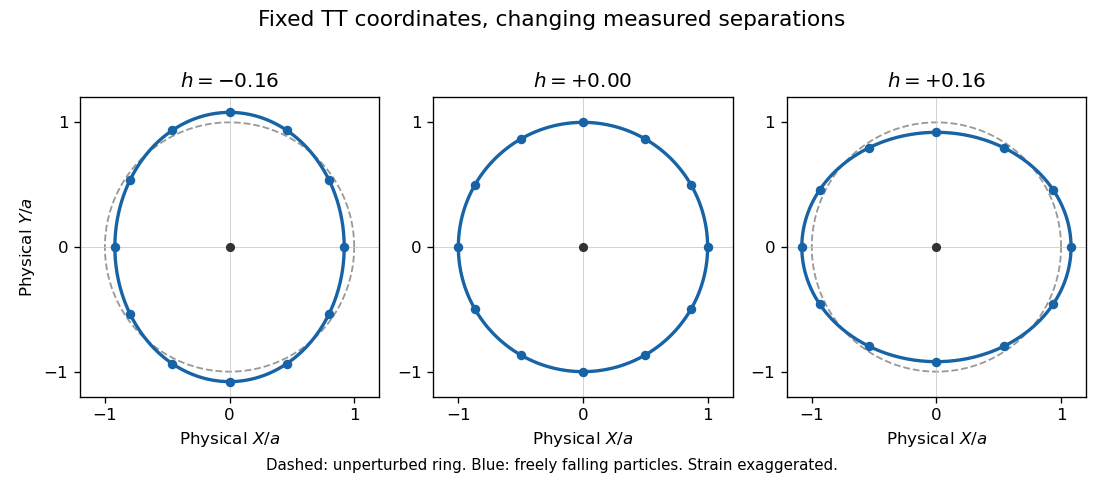

An observer at the center detects these changing distances, for example by exchanging light signals with the particles. Equivalently geodesic deviation gives the local tidal accelerationto the same order. There is physical relative motion and nonzero Riemann curvature tensor, even though the selected coordinate positions are constant. For a detector comparable to a wavelength, its light-travel-time response must be included rather than treating all distances as simultaneously measured local lengths.
Using the source's rounded solar mass, each hole has . Its Schwarzschild radius isThus at order-of-magnitude accuracy. Using the more accurate solar mass would give about .
The stated orbit is not a consistent separated-hole weak-field binary. Its nominal center-to-center separation is only , below even the above single-hole radius. Applying two isolated Schwarzschild spacetime descriptions and a circular Newtonian orbit at that separation is not controlled. Likewise an estimate at is of order one or larger, contradicting the small-perturbation assumption. The intended near-source statement is therefore a strong-field scale,not a reliable prediction from linearized gravity at the specified orbit. The exact radiative component is also gauge dependent near the source.
One can still estimate the intended distant gravitational wave strain scale. A radiative amplitude decreases as in the wave zone. A compact strong-field source has a characteristic length of order , giving a dimensional strain estimate , up to mass, orientation and efficiency factors of order unity. This is also the strong-field dimensional scale suggested by far-zone quadrupole strain; it is not an application of the slow-motion formula to the inconsistent orbit.
With the supplied conversion,For a ring radius , part (c) gives a single principal semiaxis displacement amplitudeThe difference of the two principal semiaxes has twice this amplitude. This is a conditional dimensional estimate of a physically plausible merger signal at that distance; the supplied close circular orbit does not define a self-consistent waveform or a precise amplitude.
Articles by others on the same topic
There are currently no matching articles.