The annual, zonal-mean absorbed sunlight falls from the tropics towards the poles much more strongly than outgoing thermal radiation. Thus Earth's top-of-atmosphere radiation budget has a tropical surplus and a polar deficit, with changes of sign around latitude in a basic sketch. The curves below are illustrative, rather than measured data; their area-weighted global means agree.
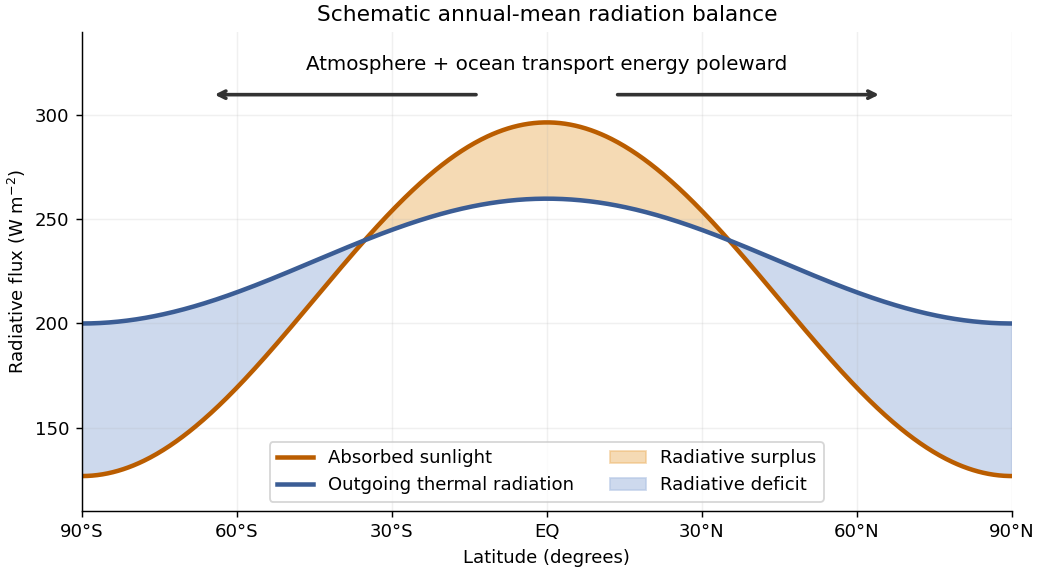

In a statistically stationary climate, local conservation of energy requires the surplus to be exported. If is the net downward radiative heat flux and the northward total power carried across the latitude circle, thenHere is Earth's radius. The terrestrial atmosphere and ocean circulation carry this energy poleward by moving warm and cold fluid, including atmospheric transport of latent heat. Without this transport the assumed steady radiation budget could not persist: the tropics would warm and polar regions cool until the budget changed. The tropical atmospheric contribution includes the Hadley cell: rising warm air near the equator, poleward flow aloft, subtropical descent, and an equatorward lower return.
For a parcel moving without an axial torque, conservation of angular momentum applies in an inertial frame. The specific axial angular momentum at latitude is“Initially at rest” means relative to the rotating surface at the equator, so . Neglecting atmospheric height compared with givesWith and , the eastward velocity at isThis is the ideal angular-momentum-conserving upper branch of the Hadley cell. Real jet streams exchange angular momentum through eddies and friction, so this estimate is not an observational claim about the actual wind speed.
Articles by others on the same topic
There are currently no matching articles.