The annual, zonal-mean absorbed sunlight falls from the tropics towards the poles much more strongly than outgoing thermal radiation. Thus Earth's top-of-atmosphere radiation budget has a tropical surplus and a polar deficit, with changes of sign around latitude in a basic sketch. The curves below are illustrative, rather than measured data; their area-weighted global means agree.
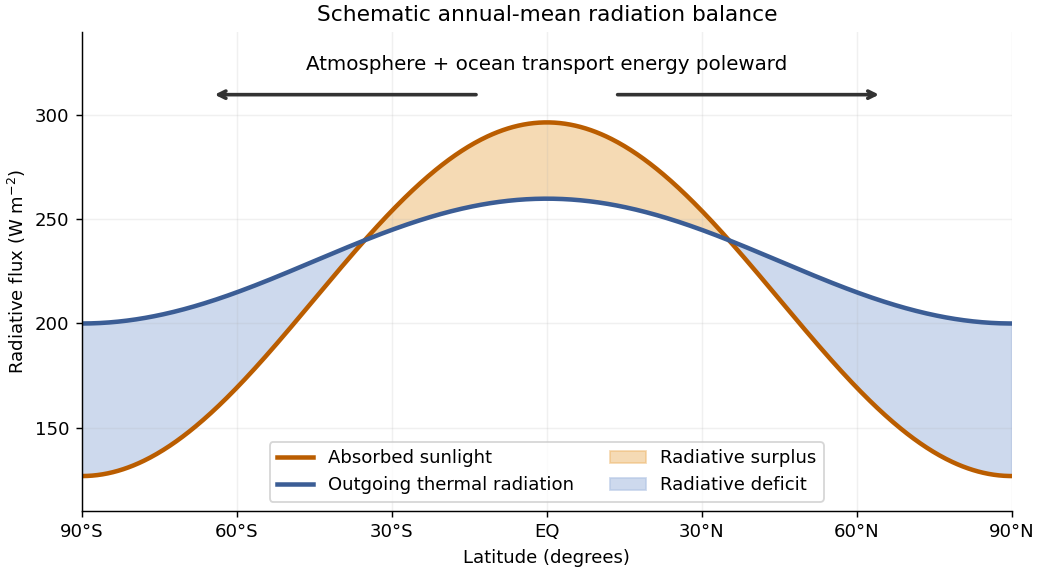

In a statistically stationary climate, local conservation of energy requires the surplus to be exported. If is the net downward radiative heat flux and the northward total power carried across the latitude circle, thenHere is Earth's radius. The terrestrial atmosphere and ocean circulation carry this energy poleward by moving warm and cold fluid, including atmospheric transport of latent heat. Without this transport the assumed steady radiation budget could not persist: the tropics would warm and polar regions cool until the budget changed. The tropical atmospheric contribution includes the Hadley cell: rising warm air near the equator, poleward flow aloft, subtropical descent, and an equatorward lower return.
For a parcel moving without an axial torque, conservation of angular momentum applies in an inertial frame. The specific axial angular momentum at latitude is“Initially at rest” means relative to the rotating surface at the equator, so . Neglecting atmospheric height compared with givesWith and , the eastward velocity at isThis is the ideal angular-momentum-conserving upper branch of the Hadley cell. Real jet streams exchange angular momentum through eddies and friction, so this estimate is not an observational claim about the actual wind speed.
Take eastward, northward and upward, and let be the eastward geostrophic wind. With Coriolis parameter independent of , geostrophic balance, hydrostatic balance, and the ideal gas law giveHere is the specific gas constant for dry air. Taking a vertical derivative of the first equation and interchanging mixed partial derivatives givesIt matters that is not constant in the pressure gradient force. Substitutingcancels the two terms proportional to and yields the height-coordinate thermal wind relationIf , this reduces toThe discarded term has relative scale when . Taking , and a atmospheric lapse rate of gives about . Thus this height-coordinate formula is a useful estimate, with potentially tens-of-percent compressibility-related correction through the vertical temperature gradient; it is not an exact consequence of the two balances. If the temperature gradient vanishes vertically, the displayed approximation is exact within those balances.
The hydrostatic approximation is very good on the broad, shallow atmospheric scales considered. The geostrophic balance is normally justified by a small Rossby number and fails as a general approximation near the equator. At , . With the ideal wind and a -- horizontal scale, --: quantitative accuracy is limited for this especially strong ideal jet. Small vertical aspect ratio alone does not ensure geostrophic balance, although a straight, steady zonal flow can satisfy it even when this scale estimate of the Rossby number is not small.
For the requested estimate, suppose the upper jet stream is above a weak surface wind, has temperature , and spans a meridional width . Integrating the approximate thermal wind relation in scale form givesThe northward temperature gradient is negative because the eastward wind strengthens upward. A -- jet width gives roughly --. No unique numerical difference follows without specifying the jet width, height and representative temperature; these are explicitly estimated quantities.
Write the velocity field as , . The uniform background has zero relative vorticity, and the perturbation has . Keeping only terms linear in the perturbations givesThe incompressibility condition permits a streamfunction with , , hence . Thus the Linear Rossby-wave equation here isChoose a plane wave , with . Substitution givesand therefore the local Rossby-wave dispersion relation in a zonal jetThe term is the background Doppler shift; the intrinsic phase velocity is westward. A real physical wave can always be represented using the conjugate wavevector if necessary to choose .
The relevant ground-frame zonal phase velocity and group velocity areTime increases downward in the source diagram. The individual phase contours lean towards increasing longitude as time increases, so their phase velocity is eastward. The envelope moves eastward faster: successive crests grow at the downstream edge and decay upstream. This illustrates Rossby-wave downstream development.
For the intended purely zonal wave packet, , andConsequently, with and the positive-frequency choice ,There is a small interpretation qualification: if “zonally propagating” specified only the plotted direction while allowing an unknown nonzero meridional wavenumber, eastward phase velocity alone would imply , not the stronger bound on alone. In this uniform model a strictly zonal group velocity with does imply , which supplies the intended interpretation.
For a zonal background , its relative vorticity is . The meridional absolute vorticity gradient is thereforeAt ,A localized jet stream of velocity scale and width hasFor -- this is about -- times the planetary contribution, so wind curvature cannot generally be neglected. The coefficient in this scaling depends on the chosen jet profile and width convention.
Linearizing the vorticity equation now gives the Rossby-wave equation for a sheared zonal currentFor a qualitative estimate at the jet core, freeze the local coefficients. At a smooth maximum , so : the restoring absolute vorticity gradient is stronger. The local Rossby-wave dispersion relation in a zonal jet gives, for the same local and zonal wavenumber with ,soThe envelope in the diagram would advance eastward faster, while individual phase contours would advance more slowly eastward, become stationary if , or move westward if . The separation between envelope and phase speeds increases. On a plot with time downward, compare horizontal displacement at fixed time: the envelope moves farther right, while a given phase moves less far right, or left after reversal. If the frequency changes sign for a fixed signed , conjugate the mode to restore the convention ; the physical propagation is unchanged.
This conclusion concerns the concave-down jet core. On a flank with the correction has the opposite sign; the value at the edge of the Hadley cell alone does not specify the curvature everywhere. Indeed the angular-momentum-conserving profile in 1(a) is a rising inner branch, not a complete smooth jet maximum. A global sheared-current normal mode requires its meridional structure and boundary conditions; the local calculation is the qualitative estimate requested.
Articles by others on the same topic
There are currently no matching articles.