Source extract: users.physics.ox.ac.uk/~Foot/C2/pdf/C22008Q5.pdf
The year is attributed from the preserved Oxford support-page record; it is not printed on the held page.
For a normalized pure state, expand in an orthonormal basis of eigenvectors of the measured Hermitian operator. The Born rule assigns outcome the probability . Under the ideal projective measurement update, a nondegenerate outcome leaves , up to a global phase. The sum of the outcome probabilities is one, and the expectation value is ; a single trial reports one eigenvalue, not that average.
If , thensince . A nonzero eigenvector has positive squared norm, so is real. For two eigenvectors,Thus : distinct eigenvalues have orthogonal eigenvectors.
The overlap is nonzero, whereas perfect discrimination of pure states requires orthogonality. Consequently no single-copy quantum measurement can identify both preparations with certainty. After a nondegenerate projective measurement, the loss of preparation information after a nondegenerate projective measurement prevents further measurements from recovering the missing label: conditional on the first outcome, the post-measurement state is the same for every compatible initial hypothesis. Repeating the same basis gives that outcome again; changing basis probes the collapsed state. Fresh, independently prepared copies would be additional resources.
In the computational basis, input always gives zero and remains . Input gives zero or one with probability , leaving the corresponding basis state. Combining these likelihoods with equal prior probabilities, the Bayesian update after a projective measurement givesFor example, Bayes' theorem gives . Outcome one certifies input ; outcome zero is ambiguous. Both inputs that give outcome zero leave exactly the same post-measurement state .
In the Hadamard basis, input always gives , while input gives or equally. ThereforeOutcome minus certifies input ; outcome plus is ambiguous. Guessing the more likely input after the ambiguous outcome gives success probability for either of these two fixed-basis measurements.
Put and . In the computational basis, input has outcome probabilities , while has . The marginal outcomes are equally likely; the Bayesian posterior probabilities areGuess after zero and after one. Each guess is correct with probability and wrong with probability . Neither outcome is certain evidence for one input.
For a real state , the Born rule in the Hadamard basis gives . Both angles and have . Thus both preparations give and . By Bayes' theorem, either outcome leaves the two input hypotheses equally likely. The biased outcome frequencies carry no information about which state was prepared; the best success probability with this measurement is .
The Bloch vectors of and areThey share the same component and differ along . The equal-prior discrimination of qubit states therefore selects the axis: it maximizes the separation of their projected outcome probabilities. This also explains why the measurement in part 3 is uninformative.
For and , the Bloch vectors are and . Their difference points along . Hence Carl W. Helstrom's Helstrom measurement for the zero and plus states measuresGuess after and after . An explicit orthonormal basis for these projectors isThe positive measurement axis is tilted by from towards on the Bloch sphere; the corresponding state-vector rotation angle is .
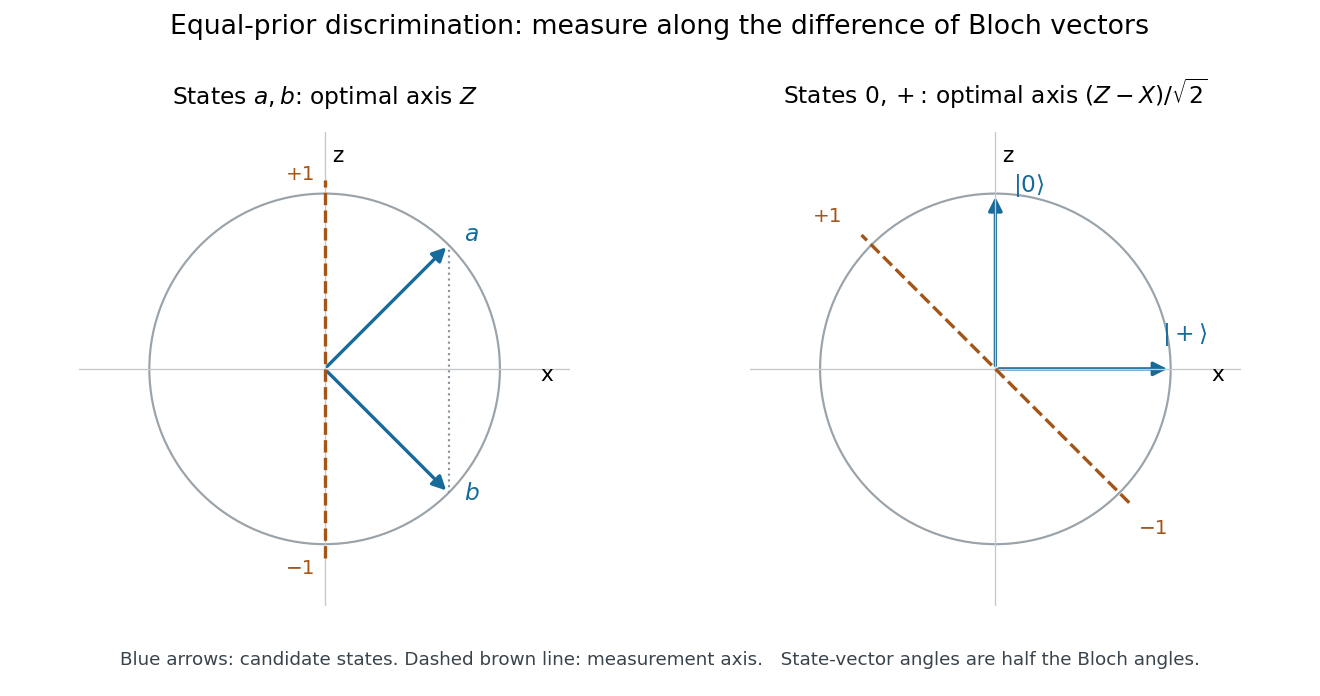
Bloch-sphere cross-sections for the two equal-prior discrimination problems
. Solid arrows are the candidate-state Bloch vectors. Dashed lines show the optimal measurement axes. The first pair has identical projections; the second is separated most strongly along . Details.
For completeness, if a projective measurement guesses along a unit Bloch axis , its average success is . The Cauchy-Schwarz inequality bounds , with equality at the axis above. The Holevo–Helstrom theorem shows this optimum also holds among general POVMs. Thus
Articles by others on the same topic
There are currently no matching articles.