Only supplied question extracts are held. The Oxford C2 support-page records attribute them to 2008; they do not establish the historical stage or sitting date.
Source extract: users.physics.ox.ac.uk/~Foot/C2/pdf/C22008Q5.pdf
The year is attributed from the preserved Oxford support-page record; it is not printed on the held page.
For a normalized pure state, expand in an orthonormal basis of eigenvectors of the measured Hermitian operator. The Born rule assigns outcome the probability . Under the ideal projective measurement update, a nondegenerate outcome leaves , up to a global phase. The sum of the outcome probabilities is one, and the expectation value is ; a single trial reports one eigenvalue, not that average.
If , thensince . A nonzero eigenvector has positive squared norm, so is real. For two eigenvectors,Thus : distinct eigenvalues have orthogonal eigenvectors.
The overlap is nonzero, whereas perfect discrimination of pure states requires orthogonality. Consequently no single-copy quantum measurement can identify both preparations with certainty. After a nondegenerate projective measurement, the loss of preparation information after a nondegenerate projective measurement prevents further measurements from recovering the missing label: conditional on the first outcome, the post-measurement state is the same for every compatible initial hypothesis. Repeating the same basis gives that outcome again; changing basis probes the collapsed state. Fresh, independently prepared copies would be additional resources.
In the computational basis, input always gives zero and remains . Input gives zero or one with probability , leaving the corresponding basis state. Combining these likelihoods with equal prior probabilities, the Bayesian update after a projective measurement givesFor example, Bayes' theorem gives . Outcome one certifies input ; outcome zero is ambiguous. Both inputs that give outcome zero leave exactly the same post-measurement state .
In the Hadamard basis, input always gives , while input gives or equally. ThereforeOutcome minus certifies input ; outcome plus is ambiguous. Guessing the more likely input after the ambiguous outcome gives success probability for either of these two fixed-basis measurements.
Put and . In the computational basis, input has outcome probabilities , while has . The marginal outcomes are equally likely; the Bayesian posterior probabilities areGuess after zero and after one. Each guess is correct with probability and wrong with probability . Neither outcome is certain evidence for one input.
For a real state , the Born rule in the Hadamard basis gives . Both angles and have . Thus both preparations give and . By Bayes' theorem, either outcome leaves the two input hypotheses equally likely. The biased outcome frequencies carry no information about which state was prepared; the best success probability with this measurement is .
The Bloch vectors of and areThey share the same component and differ along . The equal-prior discrimination of qubit states therefore selects the axis: it maximizes the separation of their projected outcome probabilities. This also explains why the measurement in part 3 is uninformative.
For and , the Bloch vectors are and . Their difference points along . Hence Carl W. Helstrom's Helstrom measurement for the zero and plus states measuresGuess after and after . An explicit orthonormal basis for these projectors isThe positive measurement axis is tilted by from towards on the Bloch sphere; the corresponding state-vector rotation angle is .
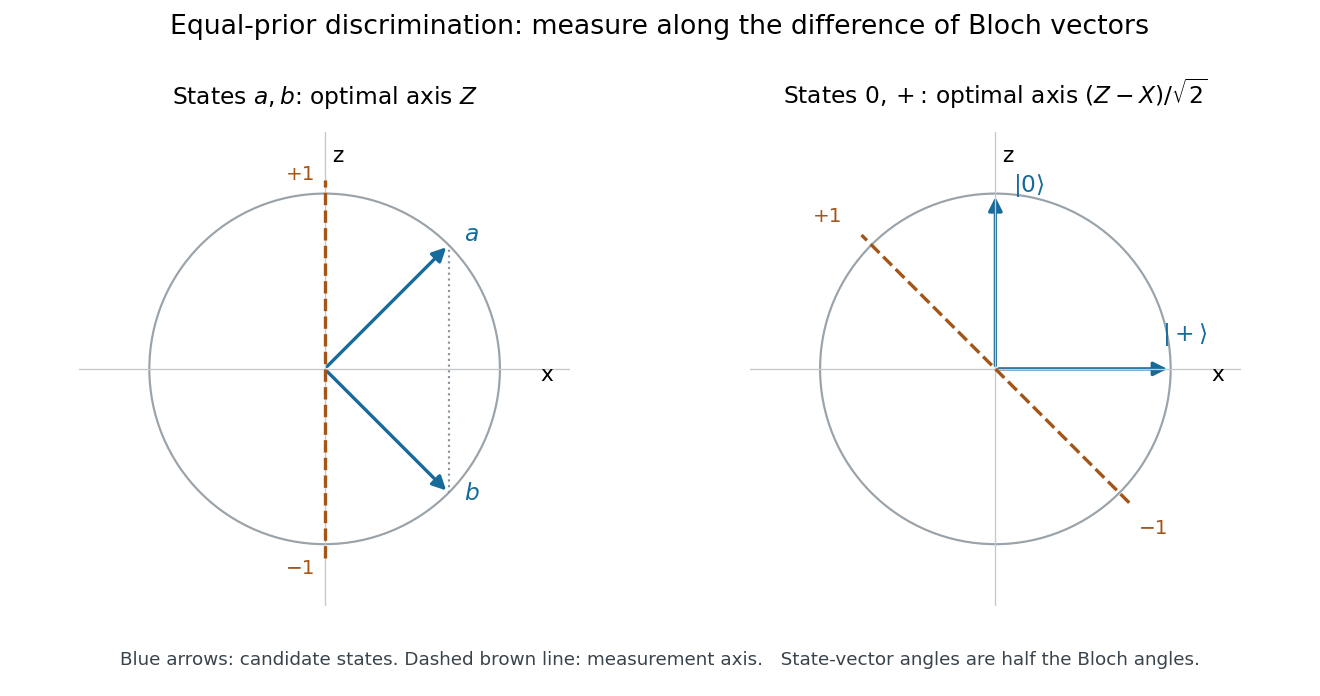
Bloch-sphere cross-sections for the two equal-prior discrimination problems
. Solid arrows are the candidate-state Bloch vectors. Dashed lines show the optimal measurement axes. The first pair has identical projections; the second is separated most strongly along . Details.
For completeness, if a projective measurement guesses along a unit Bloch axis , its average success is . The Cauchy-Schwarz inequality bounds , with equality at the axis above. The Holevo–Helstrom theorem shows this optimum also holds among general POVMs. Thus
Source extract: users.physics.ox.ac.uk/~Foot/C2/pdf/C22008Q6.pdf
The year is attributed from the saved Oxford support-page question-anchor label; it is not printed on the held page.
Use the ordered computational basis , with and . Write for the Pauli matrices, for the identity operator, , , and . As in the question, the Hamiltonian operators have angular frequency units, so the time-evolution operator is . The Heisenberg coupling matrix for two spins isConsequently the full Heisenberg model Hamiltonian operator and its proposed Ising coupling approximation are
For nondegenerate perturbation theory, choose as the unperturbed Hamiltonian operator andas the perturbation. Only and are coupled, and their unperturbed energy levels differ by . All first-order energy corrections vanish. The first-order eigenvectors and second-order energy corrections areThe states are exact eigenvectors throughout. Hence the weak coupling condition for two NMR spins isA large common Zeeman energy alone does not ensure this condition. Crossings involving the uncoupled parallel-spin states do not invalidate the argument: the relevant denominator is the separation of the two states connected by .
As an exact check, the middle matrix has eigenvaluesFor , labeling by the limiting computational basis states reproduces the shifts above. The quantum transition probability from to isThus unwanted exchange has a uniformly small amplitude when . If accumulated phases must also be approximated over a duration , neglecting the second-order shifts additionally requires , or those shifts must be retained in an improved effective Hamiltonian operator.
The same result is the secular approximation for scalar-coupled spins. In the interaction picture of the Zeeman energy terms,These terms average rapidly on the coupling timescale when , while survives.
For fixed nuclei and electronic environments, the individual NMR angular frequencies scale with the static magnetic field : schematically , where includes the gyromagnetic ratio and magnetic shielding. The NMR scalar coupling in angular frequency units is approximately independent of . Therefore a nonzero separation increases with magnetic field, improving the approximation. In particular, a fixed difference of chemical shifts gives a larger separation in hertz at higher magnetic field. If the two resonances remain exactly equal, increasing their common frequency does not suppress their exchange.
Set . Define the quantum rotating frame byThe isotropic Heisenberg model coupling commutes with the total spin angular momentum, so . The transformed Hamiltonian operator is thereforeHere removal of the common Zeeman energy is exact; the exchange is resonant and cannot be discarded using the weak coupling condition for two NMR spins.
Put , , and . Exponentiating the parallel-spin entries and the middle matrix gives the time-evolution operatorFor example, at this equals the SWAP gate times , which checks both the exchange angle and the overall phase.
The printed network reads from left to right as , a Pauli Z gate on the upper spin only, , and another upper-spin Pauli Z gate. LetIts total time-evolution operator, with the first operation on the right, is . For this Heisenberg exchange echo,The three paired Pauli operators , , commute pairwise: for example both products and equal . Thus commutes with , andThe spin echo cancels the exchange terms and retains the Ising coupling. Equivalently, over the total free-evolution time it produces the effective Hamiltonian operator exactly for ideal instantaneous gates. It is generally not the identity. A physical rotation about is ; using two such pulses instead of the ideal gates changes only by a physically irrelevant global phase of minus one.
The implementation requires frequency-selective spin control. Under the usual common-radio frequency NMR assumptions, equal resonance frequencies give no way to apply a pulse to the first spin while leaving the second untouched. For equally coupled spins in a spatially uniform control field, the transverse control Hamiltonian operator has the formBoth this control and the drift Hamiltonian operator commute with the SWAP gate . Every reachable time-evolution operator consequently commutes with . But : the individual pulse required by the diagram fails this symmetry test. This is the exchange symmetry obstruction to individual spin control. Applying simultaneous gates gives , which commutes with and instead yields ; it does not refocus the exchange. A common change of the RF phase reference also supplies only a collective rotation.
This obstruction assumes the usual common-RF control with no extra handle distinguishing the spins. Equal resonance frequencies do not universally forbid individual addressing: a spatially selective field, unequal control couplings, or another symmetry-breaking interaction could alter controllability. Such resources are absent from the specified equivalent-spin NMR model.
Quantum error correction encodes a logical qubit redundantly, obtains an error syndrome without measuring its unknown logical amplitudes, and applies a recovery that reverses the specified errors. A decoherence-free subspace instead uses a symmetry of a specified noise model: each noise operator acts as a scalar on the entire encoded space, so no syndrome-dependent recovery is required. This is passive protection and can also be viewed as a special case of quantum error correction.
For the two-spin decoherence-free encoding, chooseSimultaneous Pauli Z gates givesoBoth logical components acquire the same global phase; their relative phase and amplitudes survive. The density matrix is exactly unchanged, so even an unknown random choice between applying and causes no logical dephasing.
More strongly, the encoding protects against arbitrary collective dephasing:because both basis states have total eigenvalue zero. At , , consistent with the previous overall phase. The protection relies on correlated noise: independent rotations generally change the logical relative phase, and this two-spin code does not protect a whole logical qubit against arbitrary collective rotations about all three axes or against arbitrary single-spin errors.
Source extract: users.physics.ox.ac.uk/~Foot/C2/pdf/C22008Q8.pdf
The saved Oxford C2 support-page question-anchor label attributes this extract to 2008. The held page prints question 8 and the identifiers above, but no year, examination stage or sitting date.
A good atomic qubit needs two reproducible, orthogonal internal states whose populations and relative quantum phase survive for many gate times. Both should be long lived, with weak spontaneous emission and little decoherence from fluctuating fields or atomic motion. Their transition must nevertheless permit fast, selective, coherent control with little leakage to other states. Reliable initialization and state-selective quantum measurement are also required; optical pumping and fluorescence readout can supply these functions.
For rubidium-87, use the two ground state hyperfine levels in the electronic configuration. The electronic angular momentum is , and addition of angular momentum to the given nuclear spin gives . A suitable Rubidium-87 clock qubit isThese are coupled electron-nucleus angular momentum eigenstates, rather than two bare nuclear-spin projections. Their hyperfine structure supplies a resolvable splitting . Both belong to the electronic ground state, avoiding a short optical excited-state lifetime. Since the weak-field Zeeman shift is proportional to , both have zero linear shift at : their rubidium-87 clock transition suppresses first-order magnetic-field dephasing near zero field. A quadratic Zeeman shift of a clock transition and differential optical shifts remain. A small stable bias field can define the quantization axis and help resolve unwanted transitions, at the cost of some residual magnetic sensitivity.[ref]
Drive the magnetic dipole transition with a resonant microwave field of suitable polarization, here , or use two phase-coherent optical fields for a far-detuned stimulated Raman transition with their frequency difference resonant with . The optical excited state is then only virtually populated, reducing spontaneous emission. In the rotating frame and rotating-wave approximation, define the drive phase by the effective HamiltonianHere are the Pauli matrices on the chosen qubit, and is the Rabi angular frequency. Pulse duration controls the rotation gate angle, while phase selects the axis in the equatorial plane of the Bloch sphere. A pulse exchanges the populations; a pulse makes an equal quantum superposition from either basis state. Controlled Rabi detuning, a differential energy shift, or compositions of these pulses give rotations. For example, realizes any one-qubit unitary operator up to a global phase. Thus the atomic encoding admits arbitrary single-qubit quantum gates.
Let and be normalized qubit states. By linearity, the SWAP gate givesThe output remains a product state. Single-qubit unitary operators also preserve product states, so an induction over any quantum circuit made from these operations shows that it cannot create quantum entanglement from a product state. Equivalently, moves every exchange through the local operations, leaving only local gates and a permutation of wires. This is the product-state obstruction to SWAP universality.
Consequently SWAP gates and arbitrary single-qubit gates do not form a universal quantum gate set. For example, they cannot map to the Bell state , whereas a Hadamard gate followed by a CNOT gate does so.
Use the ordered computational basis , with qubit 1 written first. The half-time gate requires a branch convention. Even stationary Hamiltonian evolution with does not uniquely specify : different accumulated eigenstate phases can agree at and differ at . In particular, both and below square to SWAP gate and leave unchanged. Adopt the conventional continuous isotropic exchange interaction branch, with a relative singlet phase increasing from to during the full pulse. This is the exchange square-root branch convention.
The symmetric and antisymmetric eigenstateshave SWAP gate eigenvalues . Let and be their antisymmetric and symmetric orthogonal projectors. The adopted exchange evolution isFor effective spin-one-half qubits, , an isotropic exchange interaction plus an energy offset that fixes the common phase. At half time choose on the symmetric sector and on the antisymmetric sector, the conventional principal square-root value of . Hence the square root of the SWAP gate isThus , , and , where and . The identities and verify , and the projector form proves unitarity. The endpoint truth table alone would allow other matrix square roots; the stated exchange branch supplies the additional physical assumption.
For the network, fix the Pauli Z gate, Hadamard gate and S gate conventionsThe letter distinguishes this local S gate from the two-qubit exchange gate . In particular ; replacing by changes the network. Subscripts specify the acted-on qubit: , and . Operators act rightmost first, so the printed quantum circuit is
First multiply the central two exchange pulses. Since , their off-diagonal terms cancel:This reduces the entire network to . Its action on all four computational basis states, retaining every relative quantum phase, isEquivalently,It flips the second qubit when the first is zero and contributes when the first is one. That conditional phase cannot be discarded as a global phase.
To obtain the standard CNOT gate controlled by qubit 1, append an gate to qubit 2 and to qubit 1. They commute, andFor control zero, undoes the original flip. For control one, it supplies the desired flip and cancels the phase because . This phase-corrected exchange network for a CNOT gate realizes the standard gate exactly with the declared conventions.
Finally, has equal Schmidt coefficients and is maximally entangled: a half exchange creates quantum entanglement although a full SWAP gate does not. More constructively, the network above produces a CNOT gate from two half exchanges and local gates. Since CNOT gates and arbitrary single-qubit unitary operators form a universal quantum gate set, the square root of the SWAP gate and arbitrary single-qubit gates are universal. The alternative inverse exchange branch remains entangling and universal, but its phases and local correction must be recomputed consistently.
Articles by others on the same topic
There are currently no matching articles.