Normalization requires , so and . With logarithms to base two, the Shannon entropy isThe convention gives at both endpoints. In the interior,Hence the unique maximum is bits at . The curve is concave and symmetric about .
Choose the message assignment , , and . Starting from , apply respectively to the first qubit. This produces those four orthonormal Bell states, up to a physically irrelevant overall sign in the last case. The ensemble density operator isin computational order , where . The cancellation of off-diagonal terms follows from the equal probabilities within each sign pair; the individual encoded states remain entangled.
A Bell basis measurement reads the label perfectly because the four code states are orthogonal. Thus this is equivalent to a classical error-free encoding when unrestricted joint measurement is allowed. Each conditional encoded state is pure, soThe second formula is the classical-quantum mutual information, here equal to attainable classical information. The first says there is no uncertainty about the joint pure code state once the message is known; it does not say that measuring its individual qubits has deterministic outcomes.
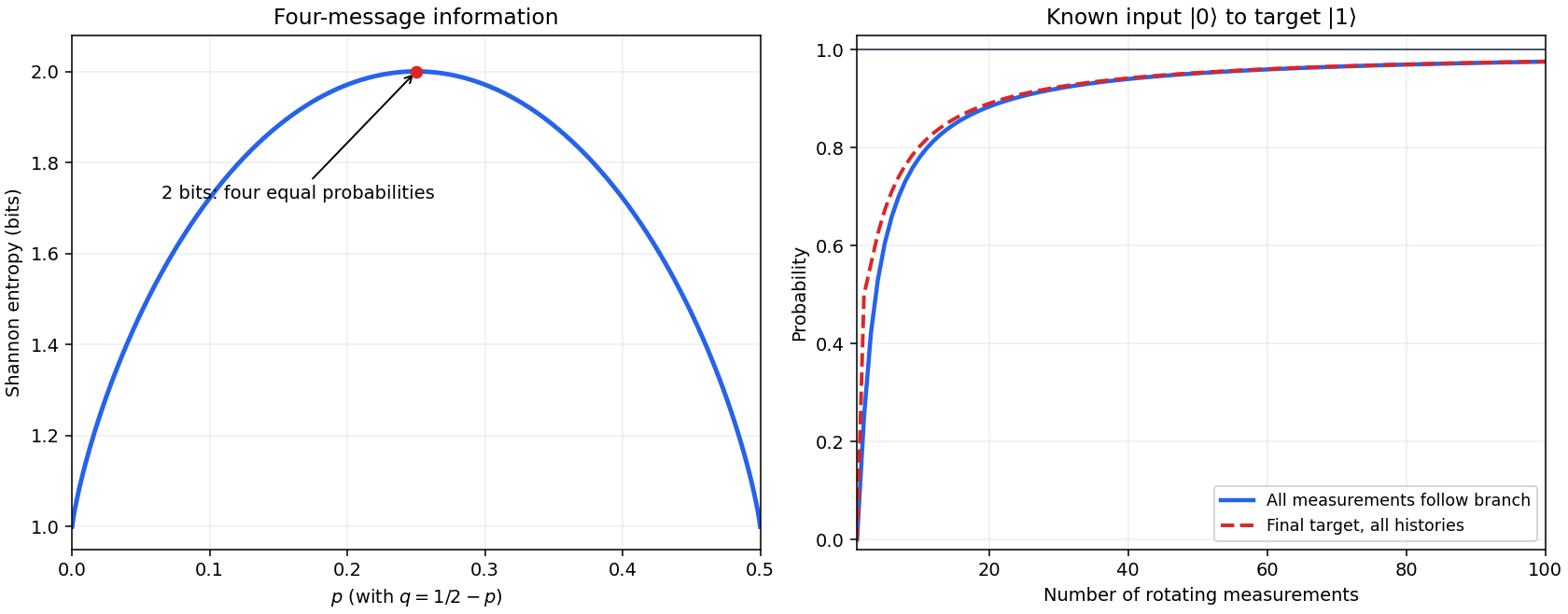
Message Shannon entropy and measurement-guided state transfer
. Original theoretical curves: for the specified four-message distribution, and finite-step Zeno transfer probabilities for a known initial basis state. The conditioned all-following probability and the unconditioned final-target probability differ at finite step count but both tend to one. Details.
In superdense coding, Alice and Bob initially share . Alice selects the same one-qubit Pauli gate according to her message and sends her single encoded qubit to Bob. He now has both halves and measures in the Bell basis. For the chosen assignment,which reaches two bits for the uniform distribution. A circuit implementation first converts the resource convention with , then applies and , and measures both in the computational basis. The four outcomes are distinct; relabeling them restores the selected message order.
Before Alice's transmission, Bob's reduced density operator is for every choice of her local operation. Thus distributing the message-independent entangled resource has transmitted no information about the subsequently chosen message. It is nevertheless a real physical resource: the two-bit rate counts the one additional transmitted qubit after entanglement has been shared, not a free initial distribution. The deterministic conditional probabilities above establish perfect correlation rather than merely matching output and input entropies.
Interpret the imposed measurement restriction as direct measurement of the encoded two-qubit Bell state in the computational basis, without a preceding entangling Bell decoder. For the uniform messages the conditional probabilities areEach outcome has probability , so bits, while bit. ThereforeThe outcome reveals even versus odd parity, but none of the plus/minus label. Each outcome is compatible with two equally probable messages.
Now insert an arbitrary single-qubit unitary operator on one wire immediately before measurement. Measuring that wire is equivalent to measuring along a Bloch vector , with the other wire still measured along . All four Bell states have zero local means, and , whereas for and for . HenceThe sign within each pair is still inaccessible, andIt stays one for a computational-axis measurement, but a Hadamard gate makes and reduces it to zero. Thus a single local gate can change the information, by reducing it, and cannot increase it above one bit.
There is an important scope qualification: if Bob is allowed the full two-qubit decoder from part b before his final computational measurement, those measurements already identify all four messages and give two bits. The one-bit result refers to restricting the Bell readout itself to product computational measurements. Merely specifying the final detector basis without restricting the decoder would not impose that one-bit limit.
Articles by others on the same topic
There are currently no matching articles.