Take and . In the resonant Jaynes-Cummings model, the interaction connects only and . Both have free energy , and their interaction matrix is . ThereforeExponentiating this two-state block and applying it to yieldsThe populations undergo Rabi oscillations at angular frequency . The common phase in this fixed- block does not affect its probabilities, but it must be retained when blocks with different photon numbers are superposed.
Let the initial field be the normalized coherent state , where . The atom is again initially excited. Linearity of the Schrödinger equation givesThe different photon numbers have different Rabi frequencies, so the state generally becomes entangled between atom and field. It cannot in general be replaced by one Rabi-oscillating atomic state multiplied by an unchanged coherent state.
Project the field onto the five-photon number state. The excited-atom contribution comes from the initial block, while the ground-atom contribution comes from the initial block. The unnormalized conditional atomic state isThus the five-count probability and normalized post-measurement state areThe relative free-evolution phase is physically retained; it is absent only in an explicitly rotating atomic frame. The conditional state is defined when . In particular, an initial vacuum cannot produce five photons in this one-atom model, so that conditioning event has probability zero when .
The conditional probability of the atomic ground state is the squared ground-state amplitude divided by the five-photon event probability:For , , giving the equivalent expressionIt applies only when the conditioning denominator is nonzero. The distinct and factors reflect the two different initial photon-number blocks.
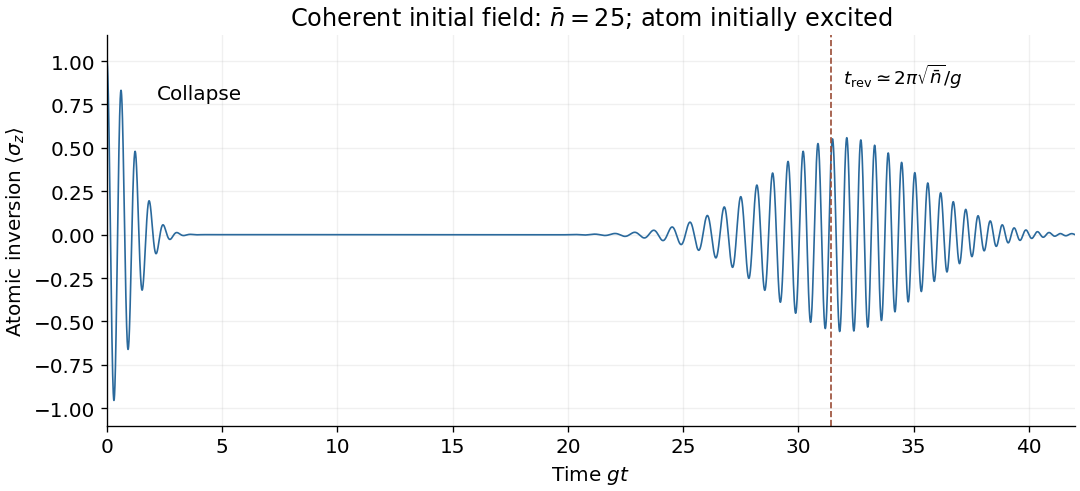
For , the Poisson distribution of photon number has width . Initially the atom therefore undergoes nearly classical Rabi oscillations at angular frequency approximately . However, the atomic inversion is a sum over slightly different frequencies:The components dephase, causing collapse of the visible Rabi oscillations on a time scale of order ; a Gaussian photon-number approximation gives an initial envelope approximately . Their discrete phases later rephase, giving revivals nearThe revival estimate follows by requiring the phase difference of neighbouring photon-number components to advance by . These Jaynes-Cummings collapse and revival effects arise from atom-field entanglement and photon-number discreteness. Large amplitude makes the initial classical description accurate over many Rabi periods, but does not eliminate quantum collapse and revival at all later times.

- It is an eigenstate of the annihilation operator, . Normally ordered field amplitudes therefore behave like a classical complex amplitude; normalized photon subtraction leaves the same state.
- Free harmonic evolution preserves its form, . The mean electric field follows a classical sinusoidal wave with an amplitude and phase set by .
- Its photon number has Poisson distribution, with and . Relative intensity fluctuations become small at large amplitude.
- Its optical quadratures and have minimum, balanced uncertainties, and . The fixed vacuum-scale fluctuation becomes small relative to the large phase-space displacement.
These properties identify a particular classical oscillation, rather than a state of definite photon number. Absolute quantum fluctuations remain even when their relative size is small.
Articles by others on the same topic
There are currently no matching articles.