For a positive integer , the identity givesThe stated nonnegative indexing includes as a special case: , whose squared norm is zero. Thus ; it cannot belong to a basis.
For distinct positive integers , the product-to-sum identity givesBoth cosine integrals vanish over , soIf one index is zero, the corresponding function is identically zero and the same answer follows immediately.
After discarding , the preceding inner products show that distinct sine functions are orthogonal; dividing each by makes them orthonormal. More precisely, their infinite expansions form an orthogonal basis of the odd part of in the Hilbert-space sense. This is not a claim that every arbitrary odd function is a finite linear combination of sines.
Take the inner product of with . Orthogonality givesTherefore the Fourier series of a periodic sawtooth, scaled to this interval, isIts periodic extension is piecewise smooth, so the Dirichlet convergence theorem for Fourier series gives pointwise convergence to inside the interval. At the jump endpoints of that periodic extension, the series instead converges to zero, the midpoint of the two one-sided limits.
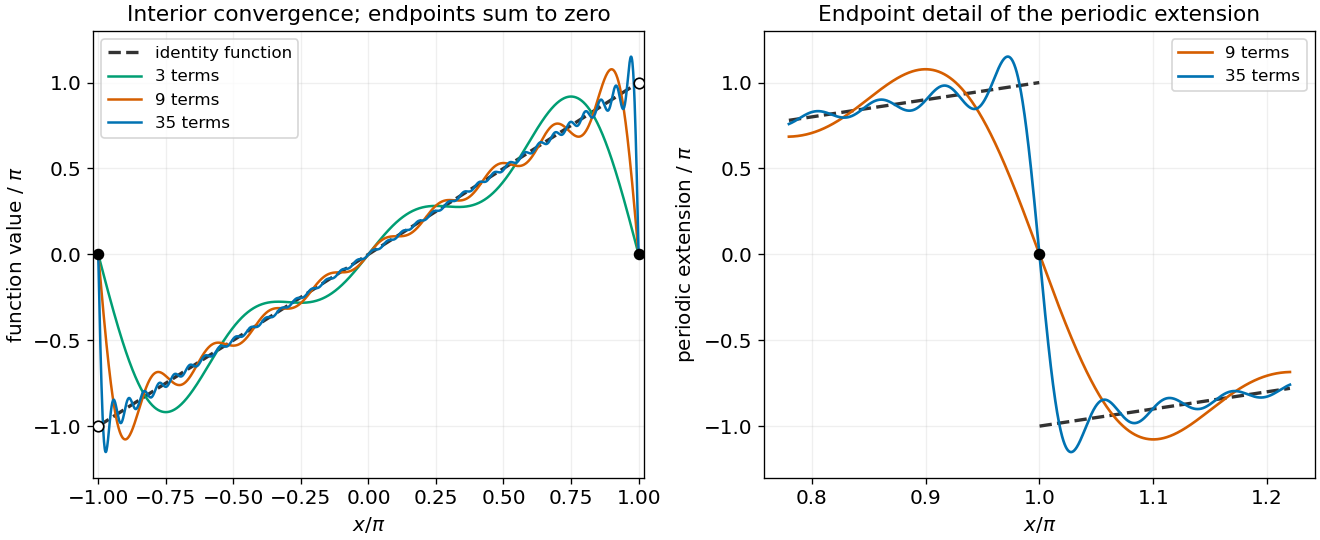
Fourier sine partial sums approximate the identity inside the interval, while their periodic extension has endpoint jumps
. Details. 
The function is an even function, while every sine basis function is an odd function. Their product is odd, so every sine coefficient is zero:The function itself is not zero, and therefore it cannot be represented by this sine basis. The basis spans the odd subspace, whereas the requested nonzero even function lies in its orthogonal complement. Equivalently, any pointwise limit of odd partial sums remains odd wherever both reflected points have limits.
Articles by others on the same topic
There are currently no matching articles.