Both expressions are the same scalar:This identity uses the ordinary transpose and remains true for complex entries. A Hermitian inner product uses a conjugate transpose instead and has conjugate symmetry, not this bilinear symmetry.
The coordinate is an independent eigen-direction, while the block is . Thuswhich gives . The eigenspaces areDivide the two diagonal vectors by to obtain an orthonormal eigenbasis. The eigenvalue one has multiplicity two; giving only the axis would omit an independent eigenvector.
Because is symmetric, translating givesThe linear term vanishes when . Solving gives . Since , the remaining constant isThis is completing the square for a quadratic form.
An orthogonal transformation to the eigenvectors preserves distance from the centre and writes the surface as . It is an ellipsoid with semi-axes . ThereforeThe original axis is one of the eigen-directions with eigenvalue one, and the centre has . Consequently , attained when the other centred coordinates vanish, so .
For , the centre and constant remain and . Its eigenvalues are , so rotated coordinates put the surface in the form . This is a one-sheet hyperboloid. Since , the nearest centre-to-surface distance is at least one, attained in the eigen-direction with eigenvalue three. The coordinate is unbounded, because arbitrarily large can be balanced by or . Thus the nearest distance is one, and there is no maximum value of .
For the printed nonsymmetric , use the symmetric part of a matrix:The skew-symmetric part contributes zero to this scalar. The same centre solves , and again . Sylvester's positive principal minors are , so this surface is an ellipsoid.
Let be the largest eigenvalue of . Its characteristic equation is , and the Rayleigh quotient givesFor the maximum , the support function of a centred ellipsoid gives the bound below. Equivalently, apply the Cauchy-Schwarz inequality in the -weighted inner product: . The inverse entry is , and equality is attained for a centred vector proportional to . Thus
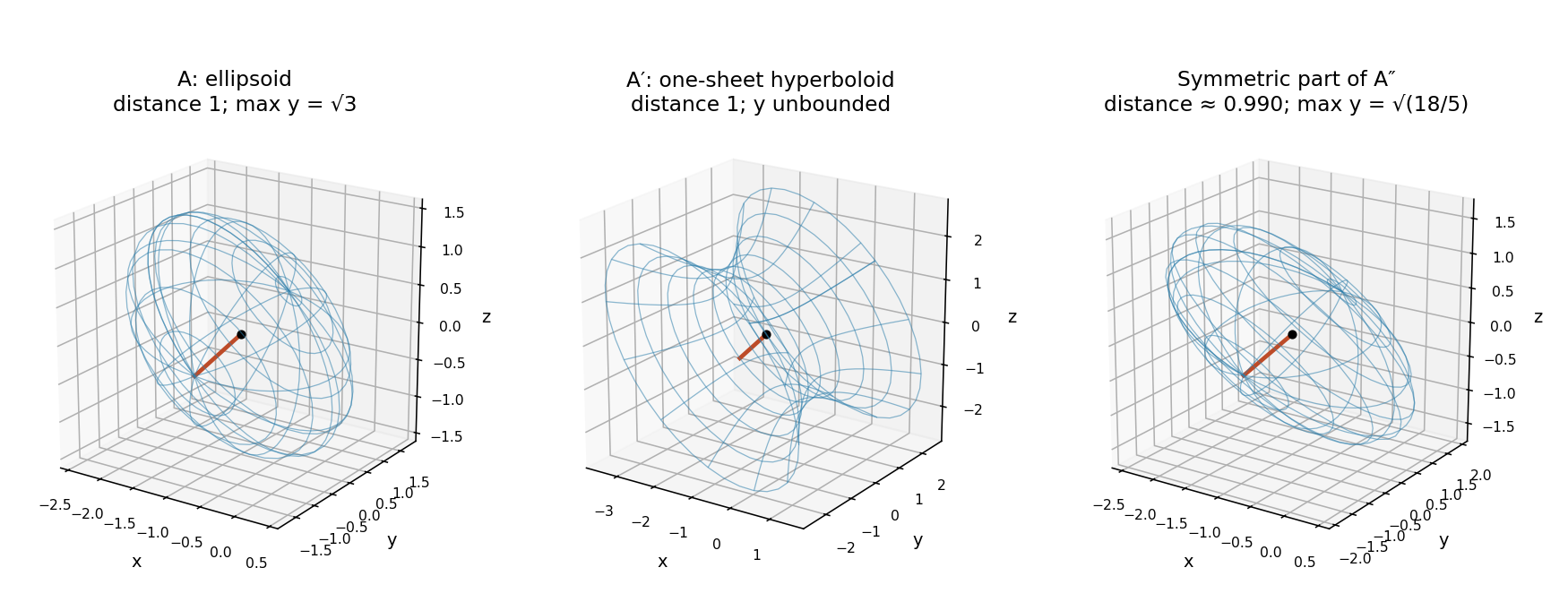

Using the eigenvalues of the raw nonsymmetric would be incorrect: it is its symmetric part that determines the surface and its Euclidean geometry.
Articles by others on the same topic
There are currently no matching articles.