Let the columns of the given unitary matrix be , with . Columnwise, for . Multiplication by and unitarity giveThe premise includes an orthonormal eigenbasis. It is not true that an arbitrary matrix admits such a basis; over it exists precisely for a normal matrix. The real symmetric inertia matrix in part (b) does satisfy the required condition.
In the quadratic form, the two equal off-diagonal contributions together supply the mixed term. Comparing coefficients givesFor a nontrivial physical moment of inertia scale take ; then this inertia tensor is positive definite.
The normalized vectors and give eigenvalues and . ThereforeThe columns are orthonormal, so and direct multiplication verifies . Signs of individual eigenvectors are free; the displayed signs also make .
The matrix has the standard rotation matrix form , with . ThusWith , the new first axis points along the original direction and is counterclockwise from the original first axis. Specifying this coordinate convention avoids confusing rotation of the axes with the inverse transformation of component columns.
Substituting and using the diagonalization givesFor and energy level one in the chosen units, its ellipse equation isThe major semiaxis has length along ; the minor semiaxis has length along . The full axis lengths are and . The original-coordinate curve is the same ellipse tilted by , elongated along ; an orthogonal coordinate change preserves lengths and does not change the ellipse itself.
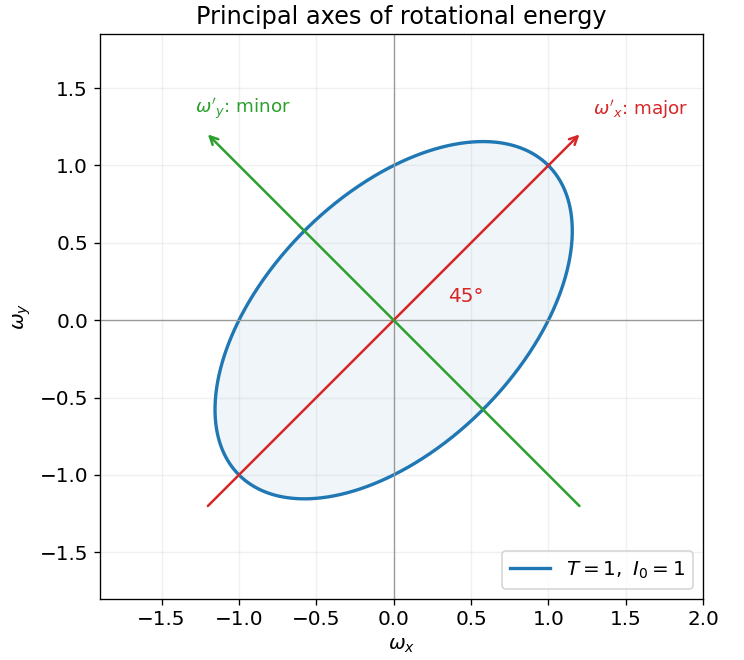
Principal axes of the rotational-energy ellipse
. Original plot at I0 equal to one and energy equal to one, showing the longer axis along the normalized (1,1) eigenvector and the shorter perpendicular axis. Details.
Articles by others on the same topic
There are currently no matching articles.