The original diagram has three horizontal spans , and . In the small-slope approximation the massless string segments are straight and their transverse force components are tension times slope. The horizontal tension components cancel to first order.
For the first bead, the left segment contributes and the middle segment contributes . For the second bead, the middle contribution is and the driven right segment contributes . Newton's second law therefore givesWith and , the coupled equations of motion areThe factor two in the driving term follows from the right span having length , while the middle span has length . Treating all three spans as equal would change both the coupling and the normal mode frequencies.
The natural normal modes belong to the homogeneous system with both end displacements fixed at zero. Seek , soThe characteristic polynomial is . The eigenvectors and therefore giveThe symmetric mode leaves the middle segment horizontal, while the antisymmetric mode bends it strongly and has the higher restoring stiffness. Defining and diagonalizes the driven equations too:This shows that the boundary drive excites both natural modes; neither natural resonance is removed by a zero drive projection.
Away from the natural resonances, seek a periodic particular solution . Let . The amplitude equations areTheir determinant is , giving the signed displacement amplitudesA negative sign denotes a phase reversal relative to the prescribed cosine; physical amplitude magnitudes are . In the quasistatic limit,These are the values of a straight string interpolating between endpoint displacements and at bead positions and along a total length .
Because damping is explicitly absent, this periodic response is not a unique attracting late-time state. Arbitrary homogeneous oscillations at and persist unless the initial conditions eliminate them. At either natural resonance, the drive produces secular growth rather than a finite bounded periodic response. Thus “steady state” here refers to the selected particular solution away from the poles.
At , , so the periodic amplitudes becomeThe second bead is stationary in this particular motion, although the endpoint oscillates. The first bead moves at twice the endpoint amplitude and in opposite phase. This is an antiresonance of the second-bead response, not a natural resonance of the complete two-bead system.
The force balance makes the cancellation explicit. At , the middle segment supplies transverse force , while the end segment supplies ; these cancel on the second bead. The first bead then oscillates between two effectively fixed neighbours with restoring coefficient , whose single-coordinate natural angular frequency is .
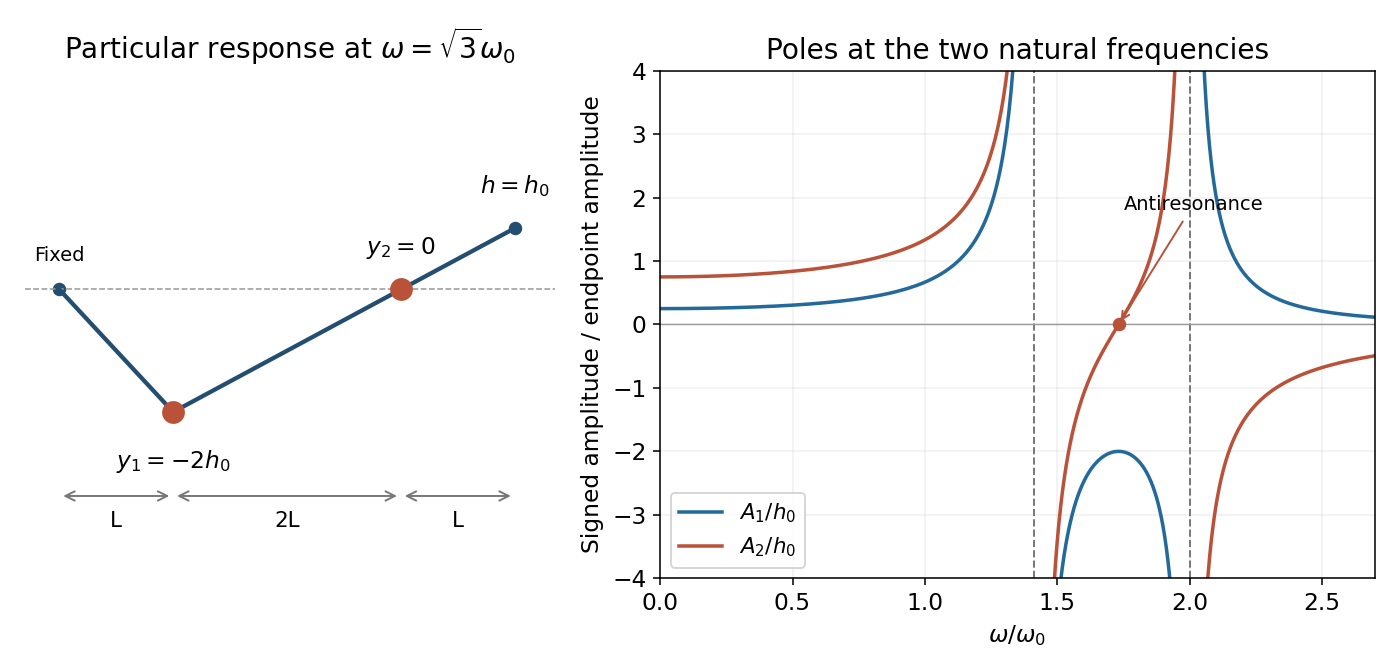
Periodic bead responses and the stationary second bead at antiresonance
. Details. 
As elsewhere in the undamped problem, this exact nodal motion presumes initial conditions selecting the periodic particular response. Additional free normal modes would move the second bead as well; they do not decay automatically.
Articles by others on the same topic
There are currently no matching articles.