The three nearly horizontal segments have lengths . To first order in small transverse slopes, the upward force on the first point mass is . The force on the second is . Applying Newton's second law to masses therefore givesThe approximation treats the string as massless, retains the imposed equilibrium tension and neglects gravity, as stipulated.
Let and seek a normal mode . Its eigenvalue equation isor , where . ThusThese are angular frequencies; the corresponding ordinary frequencies are .
For , the first eigenvector equation gives . For , it gives . ThereforeThe lower mode moves the masses in phase with equal displacements. In the higher mode they move in opposite directions, with the lighter mass's amplitude twice that of the heavier mass. Their eigenvectors satisfy mass-weighted orthogonality with respect to the physical mass matrix , although their ordinary Euclidean dot product is nonzero.
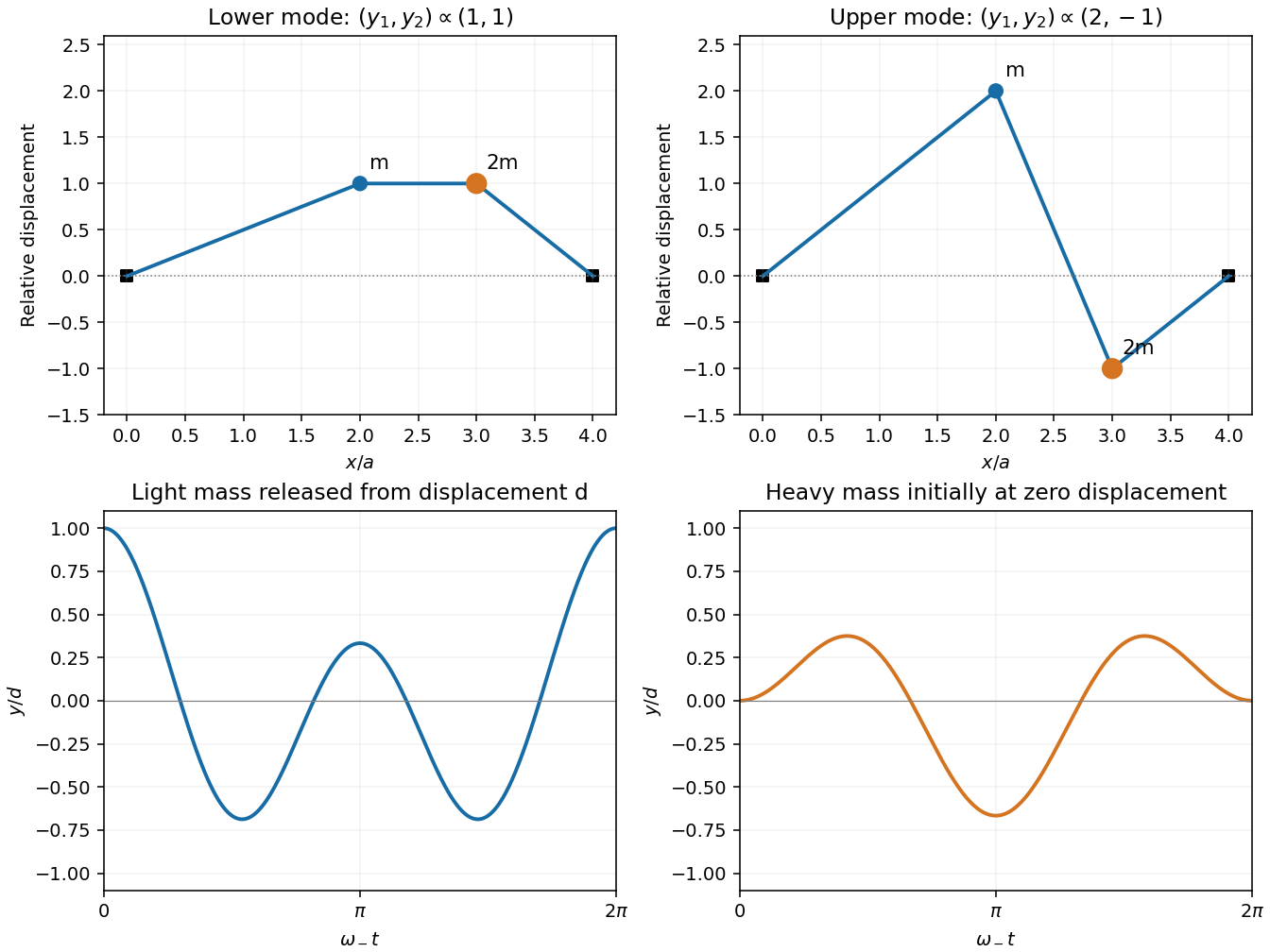

The independent normal modes span the two displacement coordinates. With arbitrary real constants , the general real solution isFour constants are required for two second-order ordinary differential equations, corresponding to two initial displacements and two initial velocities.
Release from rest gives . At , and , so . ConsequentlyThe frequency ratio is exactly two, so both motions repeat after . These are commensurate normal modes, rather than a pair of nearly equal frequencies producing slow beats.
Articles by others on the same topic
There are currently no matching articles.