Substituting into the wave equation on a string gives . Wherever both factors are nonzero,The left side depends only on and the right side only on , so both equal a separation constant . ThereforeThe resulting differential equations extend through zeros of or by continuity; division at a node is unnecessary.
The fixed-end boundary conditions require . For , the spatial solution is linear and both endpoints force it to vanish; for , the exponential solutions likewise cannot satisfy both conditions nontrivially. Write with . Then and , givingTheir angular frequencies are . Unlike the freely translating chain, this fixed string has no translational zero normal mode.
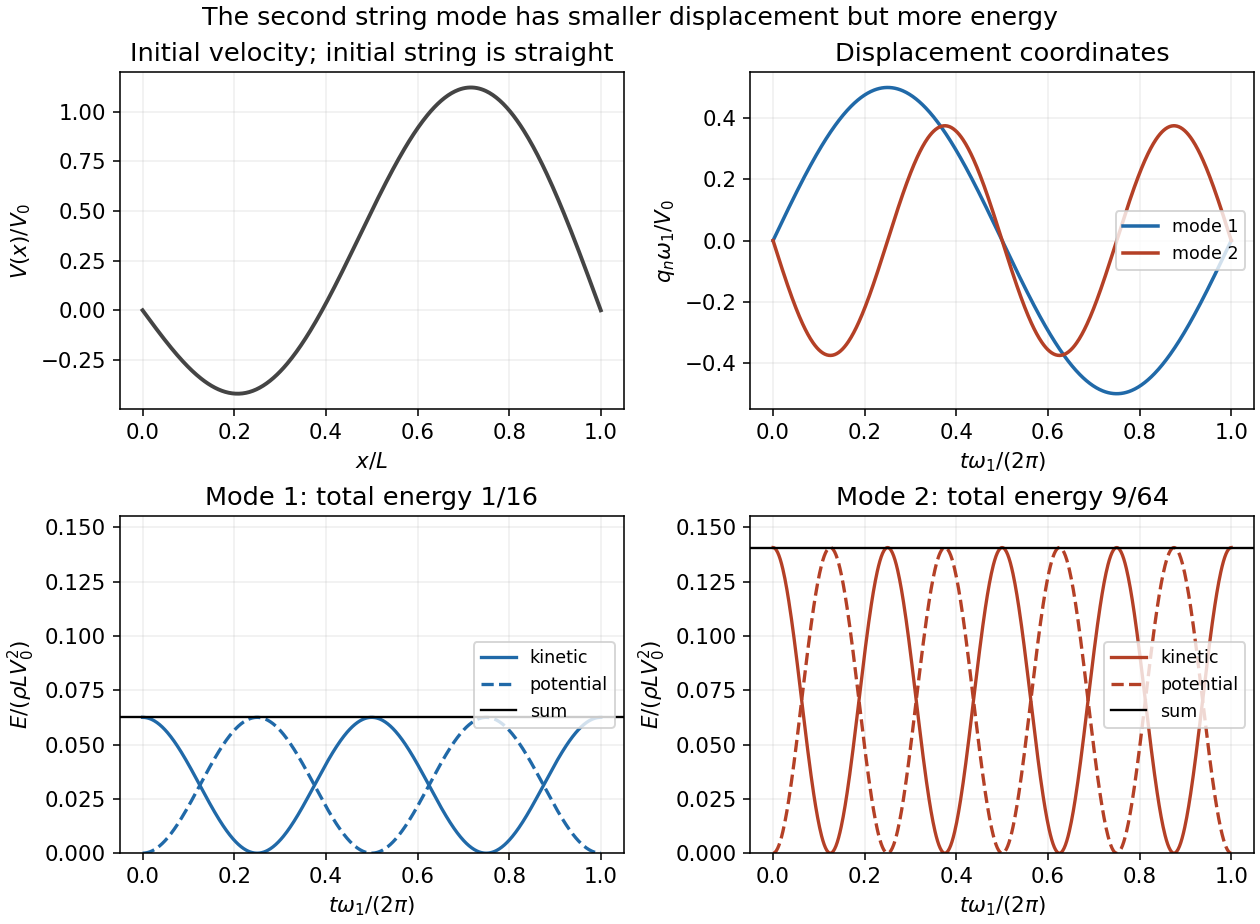
The zero initial displacement selects sine time factors. Put . The Fourier sine series of the initial velocity has coefficients , , with all other coefficients zero. Since differentiation in time multiplies a sine by its angular frequency,The normal mode coordinates are and . Their peak displacement amplitudes are and . Both the initial displacement and the initial velocity can be checked directly from this expression.
For either normal mode, let and write its contribution as . The product-to-sum identity givesThis standing wave is a superposition of two travelling waves of equal amplitude , moving oppositely with phase velocity . Their cancellation at enforces the fixed-end boundary conditions at every time.
For small transverse displacements, the string's kinetic energy and extra elastic potential energy areThe orthogonality of trigonometric functions removes cross terms between the two normal modes. For a mode , use and to obtainConsequently the modal energy distribution isThe second mode contributes more total energy at every time, despite its smaller displacement amplitude. The total energy is , with fractions and in the first and second modes. Each mode exchanges kinetic energy and potential energy, while its sum is conserved; the comparison is of these sums, not of instantaneous kinetic energies alone.

Articles by others on the same topic
There are currently no matching articles.