A normal mode is a motion of a linear oscillatory system in which every coordinate has the same angular frequency and a fixed relative amplitude and phase. For a conservative small-displacement system it has the formwhere is the mode shape, the stiffness matrix, and the mass matrix. Superposing normal modes gives the general small-oscillation motion when their eigenvectors form a complete basis.
Two common examples are standing transverse oscillations of a string fixed at both ends, and oscillations of coupled masses and springs. The string's mode shapes are sinusoidal along its length; the coupled system's mode shapes are fixed patterns of particle displacements. The following parts determine those patterns for the three-mass system in the source figure.
Let be longitudinal displacements from equilibrium, with positive direction to the right. The fixed walls have zero displacement. The first mass feels forces and ; the central mass feels and ; the last mass feels and . Hooke's law and Newton's second law therefore giveEquivalently,All four springs contribute: the wall springs supply one of the two diagonal terms in the first and third rows. This is a fixed-end chain, not a freely ended chain with a zero-frequency translation mode.
Put in solution. The normal mode equation is , with . Its characteristic polynomial isThe three eigenvalues are , , and . Solving the corresponding linear equations yieldsEach mode shape may be multiplied by any nonzero scalar. Their squared Euclidean norms are , respectively, so unit-normalized eigenvectors are . They are mutually orthogonal, as expected for the real symmetric stiffness matrix with equal masses.
The entries in the table are angular frequencies; the corresponding ordinary frequencies in cycles per unit time are . All three are positive because the fixed walls remove uniform translation as a free motion.
To specify “initial motion” unambiguously, choose each mode to pass through equilibrium at with proportional to its listed mode shape. The arrows in the figure then describe relative initial velocities:
- In mode 1, all three masses move in the same direction; the central mass has times either outer velocity.
- In mode 2, the two outer masses move with equal and opposite velocities, while the central mass remains stationary.
- In mode 3, the outer masses move together while the central mass moves oppositely with times their speed.
Reversing every arrow changes only the common phase. A quarter-cycle later these same ratios describe the extremal displacements, with zero instantaneous velocity.
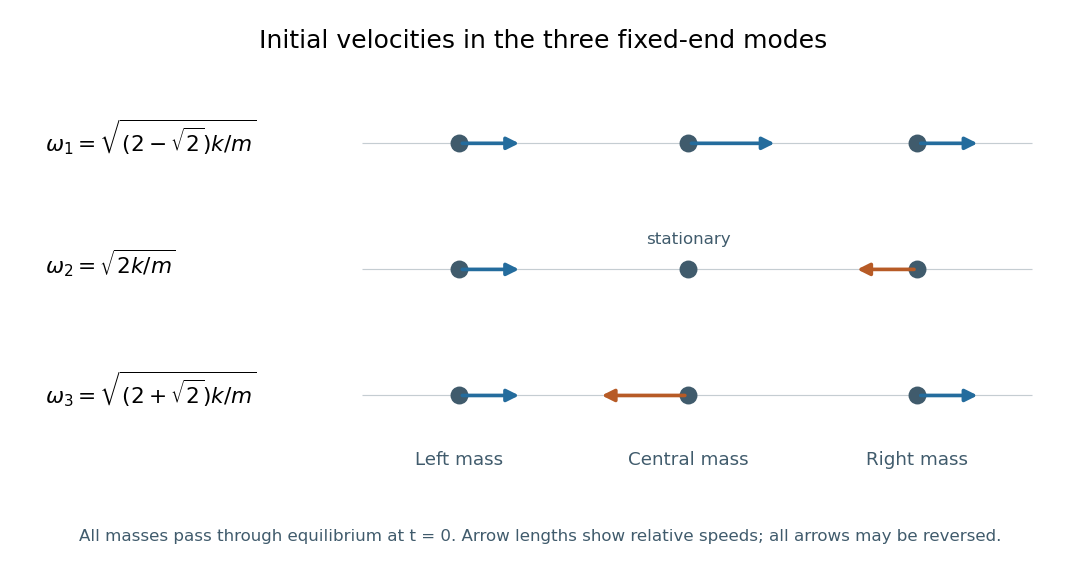
Relative initial velocities of the three fixed-end normal modes, starting as the masses pass through equilibrium.
Arrow lengths follow the mode shapes. The antisymmetric mode has equal and opposite outer velocities and zero central velocity; its angular frequency is unchanged by any positive change in central mass. Details.
Now replace the central mass by , leaving the outer masses equal to . The antisymmetric mode shape gives zero net force on the central mass, since . Each outer mass still obeys . ConsequentlyThis middle-mass-independent mode of a fixed three-mass spring chain is exact, not merely a large- approximation. The other two modes move the central mass and generally change. For example, their symmetric-sector frequencies satisfywhich explicitly depends on .
Articles by others on the same topic
There are currently no matching articles.