First solve the supplied equations as a linear system, with and . A normal mode obeysIts characteristic polynomial is . HenceBoth are positive, since the trace and determinant of are positive.
There is a physical discrepancy in the source. The horizontal-coordinate mass matrix of an unequal-mass double pendulum follows from the stated horizontal displacements, which giveThe Euler-Lagrange equations reproduce the supplied upper equation, but give , without its extra . The true normal modes of a double pendulum consequently have . The boxed answer and the remaining parts below concern the explicitly supplied linear system. The two models agree at , but not for a general mass ratio.
At , the supplied and physical systems agree. Their squared angular frequencies are . The upper row gives , soIn the slower normal mode, both masses move horizontally in phase and the lower has the larger amplitude. In the faster normal mode, the lower mass moves in the opposite direction, with magnitude . These are horizontal displacement ratios. The rod angles instead satisfy , because , ; confusing these ratios changes the sketch.
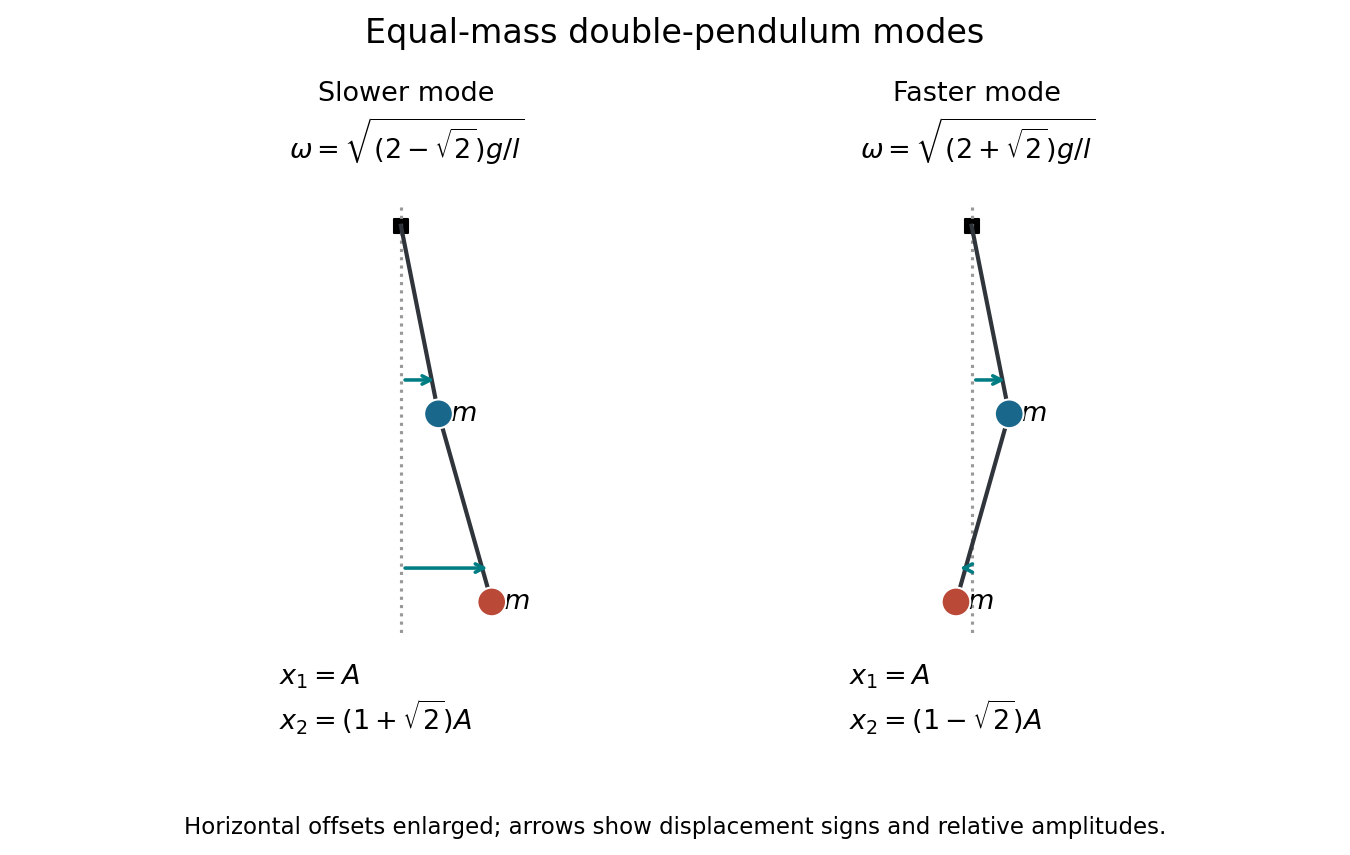
Equal-mass normal-mode snapshots with horizontal displacements enlarged for readability; arrow lengths show the relative displacement amplitudes
. Details. 
For the supplied system, the small- Taylor expansion gives , hence . Setting at this order yieldsThis is an approximation in the squared frequency. The exact positive solution of is , showing the size of the neglected correction. The physical unequal-mass double pendulum has a different small-mass limit, so the source's requested tuning does not follow for that model.
For the supplied equations, and . Thus the higher-frequency normal mode becomes an upper-mass oscillation at with a vanishing, opposite-sign lower horizontal displacement. At the supplied lower equation is and its other mode has zero frequency.
This limiting picture belongs to the given matrix. For the physical unequal-mass double pendulum, both normal mode angular frequencies tend to as the lower mass tends to zero; at exactly zero mass its independent equation needs a limiting test-body interpretation. The source's extra changes precisely this conclusion.
Articles by others on the same topic
There are currently no matching articles.