For equal lengths and mass ratio , the squared angular frequencies are , where is the upper mass, the lower mass, and . The equal-mass case admits particularly simple mode shapes.
Use the ideal model of the double pendulum, with both angles measured from the downward vertical. Around , the Taylor expansions and give the quadratic LagrangianHere both angles and their angular velocities are counted as small. Consequently the correction to is fourth order and does not enter . The Euler-Lagrange equations give . The mass matrix is not diagonal: an angular motion of the upper rod carries the lower mass too.[ref]
Classical Dynamics by David Tong. Classical Dynamics, chapter 2, §2.6.1, printed pp. 41–42, equations (2.130)–(2.132): equal-mass, equal-length linearized double pendulum
For a normal mode, put with fixed amplitude vector . The resulting generalized eigenvalue problem for small oscillations is . With , its characteristic equation isSolving this quadratic and using the second row, , givesThe lower-frequency normal mode has the rods in phase, with the lower angle times the upper one. The higher-frequency normal mode has opposite signs, corresponding to an oscillation phase difference of . These are ratios of absolute angles. The horizontal displacements are instead and ; their ratios are and respectively. Thus the lower mass moves horizontally opposite to the upper mass in the faster normal mode.
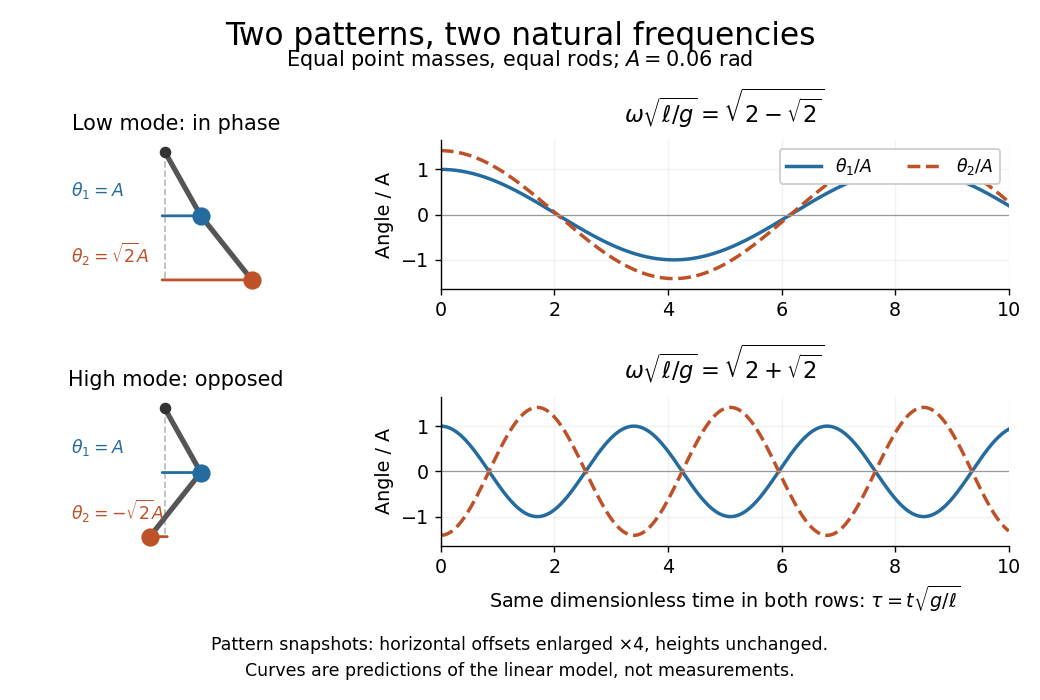

Both squared angular frequencies are positive. Their ratio satisfies , independently of , and . For a constructed model with and , the angular frequencies are approximately and , and the oscillation periods are and . Doubling both masses leaves these unchanged; multiplying both rod lengths by four doubles both oscillation periods.
The eigenvectors are not orthogonal in the ordinary dot product: . They satisfy mass-matrix orthogonality of normal modes, sinceWriting therefore removes the cross terms from both quadratic energies. The two normal coordinates satisfy . This is why the normal modes are useful: one coupled system becomes two independently evolving harmonic oscillators, and any small release can be decomposed into them. At larger angles, the discarded terms in the double pendulum equations of motion matter and this exact linear superposition no longer applies.
For equal point masses and upper/lower massless rods of length , angular coordinates from the downward vertical give mass matrix and stiffness matrix . The generalized eigenvalue problem reduces to , where . The slow mode has angular-amplitude ratio , and the fast mode has ratio .
For equal rod lengths , upper mass and lower mass , use horizontal displacements , at first order. The quadratic kinetic energy is , while the stiffness matrix isThe generalized eigenvalue problem for small oscillations is , not . In particular the lower Euler-Lagrange equation is , independent of the lower mass factor after division by that mass. This reproduces the normal modes of a double pendulum and distinguishes the mechanical mass matrix from its stiffness matrix.
An upper mass and lower mass joined by equal light strings of length have small-angle mass and stiffness matrices and . The squared frequencies are and , with angular eigenvectors and respectively. Equal-angle release decomposes with coefficients and . The angles are measured from vertical, not between strings.
Release the upper rod at radians while keeping the lower rod vertical, , with both angular velocities zero. The initial condition is the sum . The solution from linearization is thereforeAt release the lower angle vanishes by cancellation between the two normal modes. Their different angular frequencies then destroy that cancellation. Differentiating twice gives and , agreeing with the small-angle limit of the exact double pendulum equations of motion.
The quadratic mechanical energy at release is . Each normal mode contributes half, because . Equal coordinate amplitudes need not mean equal energies in general; here the modal inertias and squared angular frequencies happen to compensate. Releasing instead along or , with zero angular velocities, excites just one normal mode.
Articles by others on the same topic
There are currently no matching articles.