The question numbering follows the original paper. The domain and orientation assumptions are stated where needed; question 11 distinguishes the supplied equations from the unequal-mass pendulum described in its diagram.
The real logarithm restricts the approach to . The Taylor expansion givesThe positive first term dominates, since . Thus the requested extended limit is . There is no two-sided real limit across zero because the real logarithm is undefined for .
For , writeSince , the denominator factor tends to one, and . Therefore the limit is . The function is eventually negative, so it approaches zero from below. Oscillation of does not obstruct this limit, because it is bounded while grows.
Use logarithmic differentiation on the positive function: . The product rule and chain rule giveThe positive base permits this real definition on both components of the indicated domain. There is no need to treat a variable exponent as a constant.
For an exact differential , equality of mixed partial derivatives requires . The matching pair is , , sinceThe other pairings do not give the same partial derivatives on an open region. Integrating with respect to gives . Its derivative agrees with precisely when . HenceThis also proves existence, rather than relying only on the necessary mixed-partial derivative test.
Put and . At the expansion point the exponent is one and the gradient is . The first-order multivariable Taylor expansion isThe directional error of a first-order Taylor approximation is determined by the omitted terms, not just the equal first partial derivatives. The Hessian matrix at the expansion point is , soFor equal small steps along the coordinate axes, the leading error is along and along . The error grows faster along the axis, although the first-order change in the function is equal along the two axes.
Choose the normal pointing away from the origin, equivalently the outward normal of the first-octant tetrahedron. Parametrize the face by on . Its oriented area element isThus the surface integral isThe divergence theorem checks this result: , the tetrahedron's volume is , and each coordinate-plane face has zero flux. The opposite orientation gives ; a signed flux requires an orientation.
The triangular support can be written , . The density is nonnegative there, and the normalization of a probability distribution requiresHence . Multiplying the joint probability density by the required function cancels on the interior. Its expectation isThe singularity at lies at a support vertex of zero probability; the displayed integral establishes integrability. Assigning any value to the random function at that single vertex does not change the expectation.
The two planes bound , and the elliptical cross-section has . Under , , the absolute Jacobian determinant for is . ThereforeAs a check, the cross-sectional ellipse has area , while the part of the thickness proportional to integrates to zero by reflection. The mean thickness is therefore two.
For positive wavenumber, the condition gives on the positive-frequency branch. The group velocity and phase velocity are consequently related byThe required positive ratio gives . Isotropy makes these velocities parallel to the wave vector when this coefficient is positive. Identifying group velocity with energy transport assumes the usual lossless narrowband wave packet regime.
Since is constant, direct differentiation gives , , and . The stated right-hand side is therefore . Independently, index notation givesThus . A conservative vector field has zero curl, so the field is not conservative unless . For a closed planar circuit, its circulation is by Stokes theorem; the zero-vector exception is conservative with a constant potential.
For a sufficiently smooth vector field on an oriented surface with compatible boundary orientation, Stokes theorem statesApply it to in the plane. The closed line integral is the area integral of . Thus makes it vanish whenever a spanning surface lies within the smooth domain. In a simply connected domain this implies path independence: join one path from to to the reverse of another, and their difference is a zero closed line integral.
The domain qualification is essential. On the punctured plane, , satisfy , but the line integral around the unit circle is . A disk spanning that circle passes through the singularity. Hence the printed implication requires an appropriate domain assumption; zero curl alone is not a global path independence theorem.
Let and on the relevant intervals. The chain rule givesThus the one-form is explicitly an exact differential. Fixing its potential to vanish at determines it uniquely on the connected domain:Continuity of on the integration ranges suffices. For arbitrary smooth data defined throughout , that half-plane also supplies the simply connected domain in the previous argument.
For the specialization , the potential based at is defined in the positive quadrant; it cannot be continued through using this formula. Taking keeps both endpoints in that component. Their ratios are both , so the term cancels andNo condition on beyond existence on the traversed ratios enters this difference.
Write , so andSolving these simultaneously gives thirteen stationary points: the nine grid points with and the four points . There are no mixed extra cases, because and have no common root.
At a grid point the Hessian matrix has zero diagonal and off-diagonal entry , so its determinant is negative: all nine are saddle points. At the other four points the Hessian matrix is . Thus the equal-sign points are local maxima with value , and the opposite-sign points are local minima with value .
In the requested nonnegative quadrant, the stationary points are the four boundary saddle points and the interior local maximum . The zero contours are and . The gradient is perpendicular to regular contours and points toward increasing . A boundary point's classification above refers to the function on the whole plane; its behavior restricted to the quadrant can be one-sided. The interior local maximum is not a global maximum on the unbounded quadrant, since along .
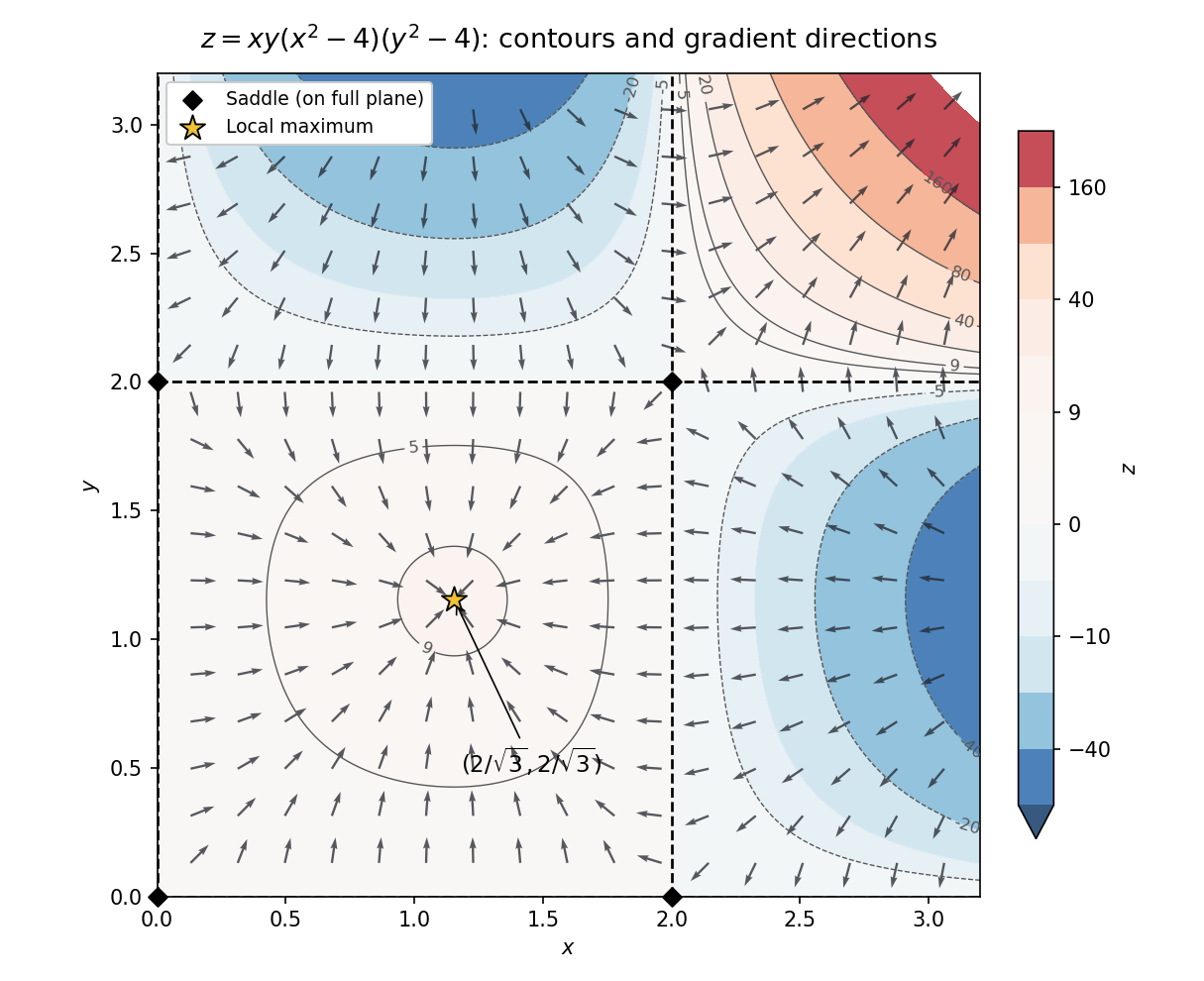
Contours, zeros, stationary points and gradient directions for the polynomial surface in the nonnegative quadrant
. Details. 
The divergence of is the LaplacianIts area integral over the square isFor the boundary flux, . On , , giving ; on it is , giving . The corresponding horizontal sides give and . The total is again , verifying the divergence theorem with outward normals. With a counterclockwise boundary, this is the same orientation as .
First solve the supplied equations as a linear system, with and . A normal mode obeysIts characteristic polynomial is . HenceBoth are positive, since the trace and determinant of are positive.
There is a physical discrepancy in the source. The horizontal-coordinate mass matrix of an unequal-mass double pendulum follows from the stated horizontal displacements, which giveThe Euler-Lagrange equations reproduce the supplied upper equation, but give , without its extra . The true normal modes of a double pendulum consequently have . The boxed answer and the remaining parts below concern the explicitly supplied linear system. The two models agree at , but not for a general mass ratio.
At , the supplied and physical systems agree. Their squared angular frequencies are . The upper row gives , soIn the slower normal mode, both masses move horizontally in phase and the lower has the larger amplitude. In the faster normal mode, the lower mass moves in the opposite direction, with magnitude . These are horizontal displacement ratios. The rod angles instead satisfy , because , ; confusing these ratios changes the sketch.
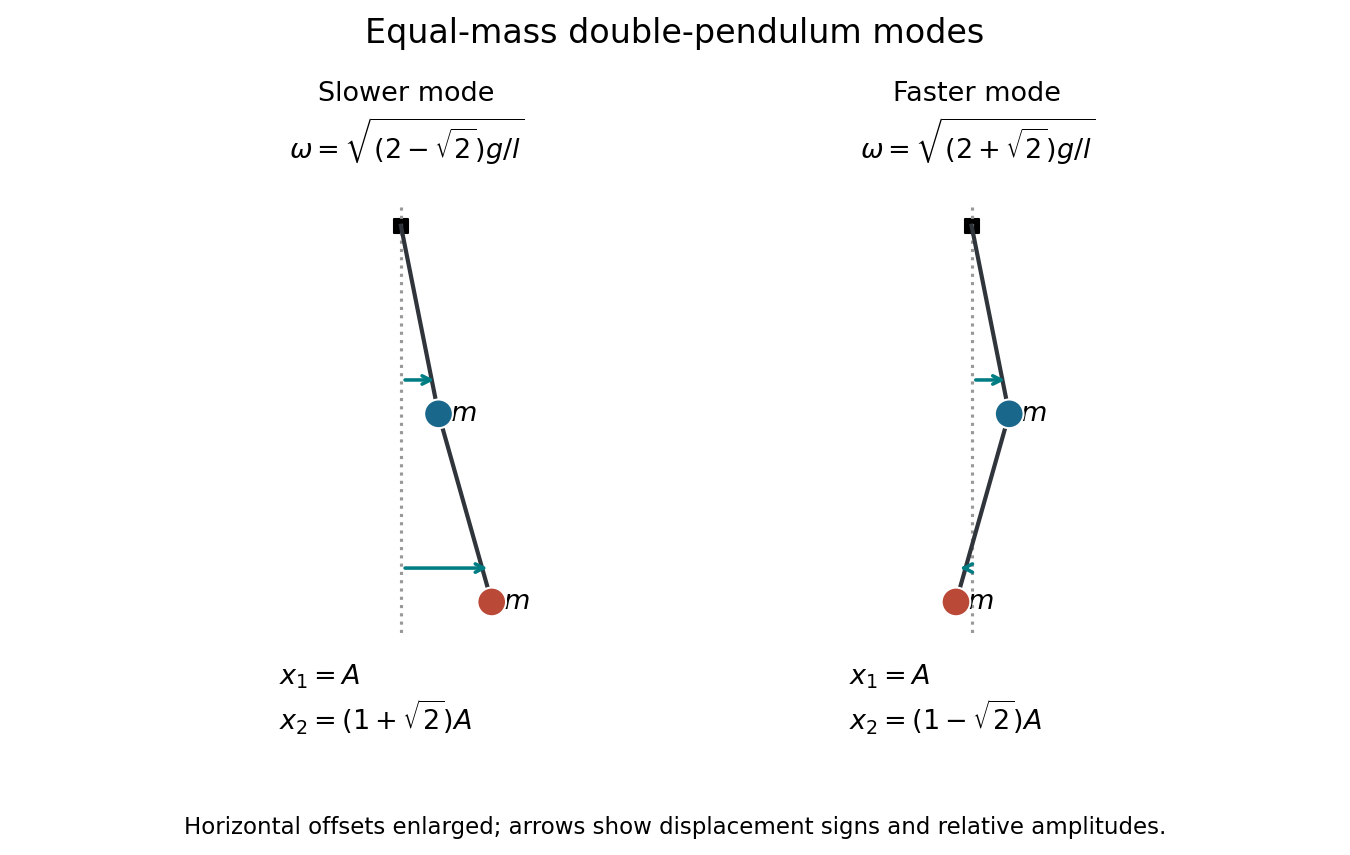
Equal-mass normal-mode snapshots with horizontal displacements enlarged for readability; arrow lengths show the relative displacement amplitudes
. Details. 
For the supplied system, the small- Taylor expansion gives , hence . Setting at this order yieldsThis is an approximation in the squared frequency. The exact positive solution of is , showing the size of the neglected correction. The physical unequal-mass double pendulum has a different small-mass limit, so the source's requested tuning does not follow for that model.
For the supplied equations, and . Thus the higher-frequency normal mode becomes an upper-mass oscillation at with a vanishing, opposite-sign lower horizontal displacement. At the supplied lower equation is and its other mode has zero frequency.
This limiting picture belongs to the given matrix. For the physical unequal-mass double pendulum, both normal mode angular frequencies tend to as the lower mass tends to zero; at exactly zero mass its independent equation needs a limiting test-body interpretation. The source's extra changes precisely this conclusion.
Use separation of variables, . A nontrivial separated solution satisfies . Fixed endpoints force , so , . ThereforeHere is the wave speed. Zero or negative gives no nonzero fixed-end spatial solution. Each time coefficient is a simple harmonic oscillator.
Expand the initial velocity in the Fourier sine basis, , where . Zero initial displacement removes the cosine-in-time coefficients. ThusThe trigonometric identity rewrites each summand asIt is therefore a superposition of travelling waves of speeds and , whose interference enforces the fixed endpoints. For general square-integrable initial velocity, the series is interpreted in the standard finite-energy sense.
The product-to-sum identity gives , and , with all other modal coefficients zero. If is the string's linear mass density, the initial potential energy vanishes and orthogonality gives the modal energy of a stringConsequently for . The fundamental mode carries the most energy, with fraction . Comparing displacement coefficients without their frequency factors would give the wrong energy test.
Substitute the three nonzero initial-velocity coefficients into the general Fourier sine series, with :Every term satisfies the wave equation and the endpoint conditions. Differentiating in time at zero recovers the three coefficients , providing a direct initial-data check.
Assume . Linear independence of the Fourier sine basis makes a flat string equivalent to vanishing of all three temporal coefficients. The fundamental requires , which automatically zeros the other two. Thus the earliest positive return isThe velocity need not have returned to its initial value at that time; full recurrence of the displacement-and-velocity data occurs at .
A nonzero pure fundamental profile would require . The common zeros have an integer multiple of , so the fundamental vanishes too. A pure second or third harmonic would already require the fundamental to vanish, again making the whole string flat. The string never has a nonzero pure sine profile. If , it remains identically zero and there is no earliest positive isolated return.
Articles by others on the same topic
There are currently no matching articles.