The heat capacity per unit horizontal area is : mass density times specific heat capacity times atmospheric depth. Thus is the rate of stored thermal energy per unit area. The solar constant is the incident radiative flux on a surface normal to sunlight; the ratio of the Earth's intercepting disk area to its spherical area is . The absorbed fraction is , where albedo is the reflected fraction. The outgoing radiative flux is , a Stefan–Boltzmann law with effective radiation factor incorporating the simplified greenhouse effect. Every term therefore has units of power per area.
The albedo curve decreases smoothly, passes through , and approaches at high temperature. At it is , close to when is large. Its derivative isAn ice-covered planet reflects more sunlight than exposed land or ocean. Warming removes reflective ice, lowers albedo, and increases absorbed radiative flux: this is ice-albedo feedback. The parameter controls the sharpness of this transition; the formula is an idealized global response, rather than a local melting law.
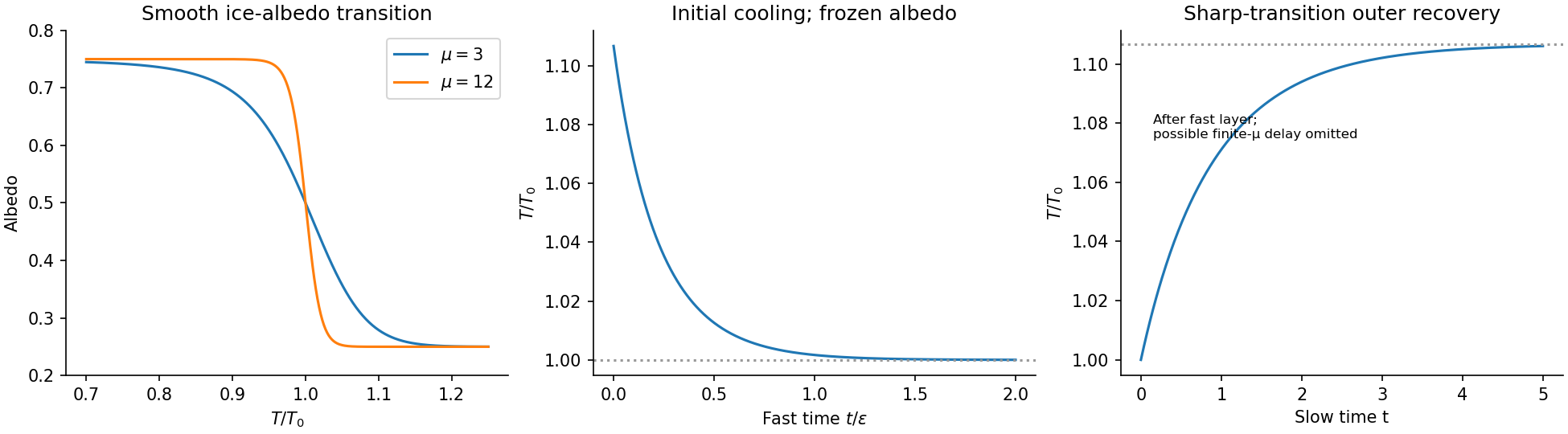
Temperature-dependent albedo and the separated fast cooling and slow recovery
. Details. 
Set . Since , the steady state energy balance is . Substitution givesThe two sides have slopes and at the origin. For , is strictly concave, its initial slope is , and it remains below . Consequently no positive root exists for , while for there is exactly one positive root . Oddness supplies the corresponding negative root. At the only root is still zero. Hence multiple steady temperatures occur precisely when .
The largest root corresponds monotonically to the largest positive absolute temperature:For large , the positive root tends to , so and . The negative branch has larger albedo and lower temperature.
Use dimensional quantities and set , . Dividing the energy balance by and the albedo equation by its time scale givesThus is the ratio of the atmospheric thermal response time to the much longer albedo response time. Converting kilometres to metres and years to seconds gives , , , andThe thermal time is about half a year, compared with a millennium for albedo adjustment. This is a singular perturbation: setting removes the independent initial condition for temperature.
Initially and , so . On the fast time , albedo changes by only andThus temperature rapidly falls towards . At the same time while , which seeds selection of the warm branch. Afterwards the approximate slow manifold is : decreasing albedo makes temperature rise slowly back towards . The preceding figure separates these two time scales; a single time axis would compress the initial fall into a nearly vertical segment.
In the sharp-transition regime, after selection of the warm branch . Solving the linear ordinary differential equation with the leading matched value givesThese are outer solutions: their initial temperature is , so the fast cooling layer is required to satisfy the actual initial temperature.
There is a useful qualification to the two-limit argument. For fixed finite , put on the slow manifold. Then , and is an unstable equilibrium with growth rate . The small positive seed from the fast layer can therefore produce a delay of order . The simple exponential approximation assumes that the sharp albedo transition is sufficiently fast to make this delay negligible on the displayed slow scale. It is not a uniform approximation for every fixed as .
Articles by others on the same topic
There are currently no matching articles.