Work over with a finite-dimensional semisimple Lie algebra . Choose a Cartan subalgebra , its root system , a positive system and its simple roots. Let be the Weyl group, generated by the corresponding root reflections, and put , the Weyl vector. The finite-dimensional irreducible highest-weight representation is indexed by a dominant integral weight .
If is the weight lattice, its group ring has formal symbols with multiplication . The formal character iswhere is a weight space. For a weight , define the Weyl alternant ; the sign is the determinant of on the real root span, equivalently the parity of its expression in simple reflections.
The Weyl character formula isThe second denominator is the Weyl denominator formula. The quotient can initially be taken in the fraction field of the group ring; the formula says it is the finite character on the left, so its apparent singularities are removable. The shifts by make strictly dominant.
Let and identify the real weight and Cartan spaces using a Weyl group-invariant positive inner product. For a regular , meaning for every root, specialize to . Then the value of the formal character at is , but both Weyl alternants in the Weyl character formula vanish there. We compute their leading terms instead of substituting into that zero-over-zero expression.
ExpandFor every root reflection , replacing by changes the sign of , by replacing with in the sum. Replacing by also changes its sign, by replacing with . Thus the polynomial vanishes whenever or lies on any reflecting hyperplane. It is divisible by in its first variables and by in its second variables. Distinct positive roots give distinct linear factors; each product has degree .
The polynomial has degree in each group of variables. Therefore for , and for it has the formwith a constant independent of both variables. At , the Weyl denominator formula givesConsequently . For strictly dominant , its leading coefficient is nonzero, and the ratio of the two Weyl alternants tends toThe coroot is , so the root-length factors cancel in each ratio. This proves the Weyl dimension formula by the lowest-degree alternant proof of the Weyl dimension formula, including the limiting step.
Apply the Weyl character formula with . In the Weyl denominator formula, replace every formal exponential by . This givesDividing by and cancelling each factor yieldsThe last expression is a compact way of writing the same character; individual half-root exponentials may need a larger formal lattice, but their full product lies in the group ring of the weight lattice. Expanding the first expression, a subset contributes the weight . Different subsets with the same sum give that weight's multiplicity. In particular , consistent with the Weyl dimension formula. This is the case of the character of a Weyl-vector multiple.
The complex Special orthogonal Lie algebra consists of endomorphisms preserving a nondegenerate symmetric bilinear form infinitesimally:In an orthonormal basis this is , with the commutator bracket and dimension . Its compact real form is obtained by taking real skew-symmetric matrices. For diagonal root calculations it is more convenient to use an isotropic basis with , including .
A maximal torus of the complex special orthogonal group isIts Lie algebra is the Cartan subalgebraIn the compact real form the corresponding torus consists of independent rotations in two orthogonal coordinate planes, fixing the remaining direction. Define for , and , .
Writing for the matrix unit in the isotropic basis, lies in and satisfiesThus the nonzero root spaces are one-dimensional and the root-space decomposition isExplicit generators for four positive root spaces areThe transposes of these matrices generate the negative root spaces. Each transpose still satisfies the bilinear-form condition and reverses the displayed diagonal weight. These eight root vectors and the two independent Cartan matrices exhaust the dimension ten; a matrix commuting with every is diagonal and the form condition makes it lie in . This also proves that the torus has maximal dimension.
Give the real root span an inner product with orthonormal. The B2 root system consists of four short roots on the coordinate axes and four long roots on the diagonals. Choose the long-first simple rootsThe positive roots are , and . The corresponding simple reflections areThey generate every signed permutation of the two coordinates. Thus the Weyl group has order eight and is the symmetry group of a square; every element sends to or , with independent signs.
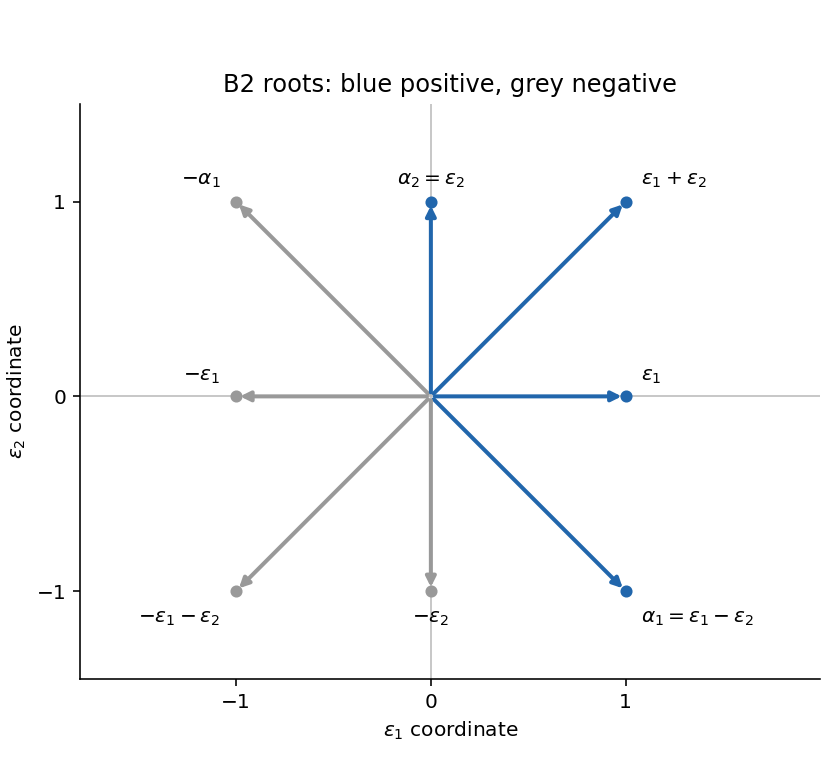

Since form an integral basis of , the root lattice is . The simple coroots are and . Therefore the weight lattice isSolving gives the fundamental weightsThe cone of dominant weights isIndeed and are exactly the two simple-coroot pairings. This describes representations of the Lie algebra, or of its simply connected Spin group; half-integral weights are allowed. For representations descending to itself, the weight must lie in , equivalently must be even.
Every finite-dimensional irreducible Lie algebra representation has highest weight for unique integers . The Weyl vector isso . In the Weyl dimension formula, the factors for the four positive roots, ordered as , are respectivelyHenceIn particular the two fundamental representations have dimensions five and four. The highest root is , so the Adjoint representation has dimension ten. These also fix the dimensions of the crystals below. Our numbering places the long root first; interchanging a B2/C2 numbering without interchanging the associated fundamental-weight labels would give the wrong dimension formula.
Use directed color- edges for the Kashiwara operator , so every edge subtracts from the weight. The defining crystal of the defining odd-orthogonal representation isThe defining module has highest weight and precisely these five weights, all of multiplicity one. The color-two string through zero has length two, since . The other indicated strings have length one. Restriction to each simple-root sl2 Lie algebra and the root-string property of a crystal justify the edges; no other weight difference is the relevant simple root.
For the B2 spin crystal , denote the four weights by their sign pairs. Its graph isThe fundamental weight is a minuscule weight: its pairings with all positive coroots are zero or one. Its Weyl orbit has four weights, and the dimension formula gives four, so each occurs once and there are no additional weights. All simple-root strings have length one. Subtracting or where another weight is present gives exactly this graph.
For the B2 adjoint crystal, write for the vertex of root weight , and use two distinct zero-weight vertices . There are eight root vertices and two zero vertices because the zero-weight space is the two-dimensional Cartan subalgebra. The complete lists of colored strings areEvery arrow in a given row has that row's color; the reverse arrows are the raising operators, and all unlisted lowering operations vanish. In particular the two zero vertices must not be merged.
For a constructive justification, let with the invariant symmetric form from part(a). The mapis an equivariant isomorphism , identifying the highest weight as . Compute its crystal as the highest-weight component starting at in , with labels for the defining chain. The crystal tensor-product rule iswhere counts available raising steps and counts lowering steps in the color- string. It generates the following ten vertices:Applying the displayed rule to these labels gives precisely the listed strings, proving the entire diagram rather than only its weight multiplicities. Tensor labels here are crystal vertices in the combinatorial limit, not an assertion that a bare ordinary tensor such as lies in .
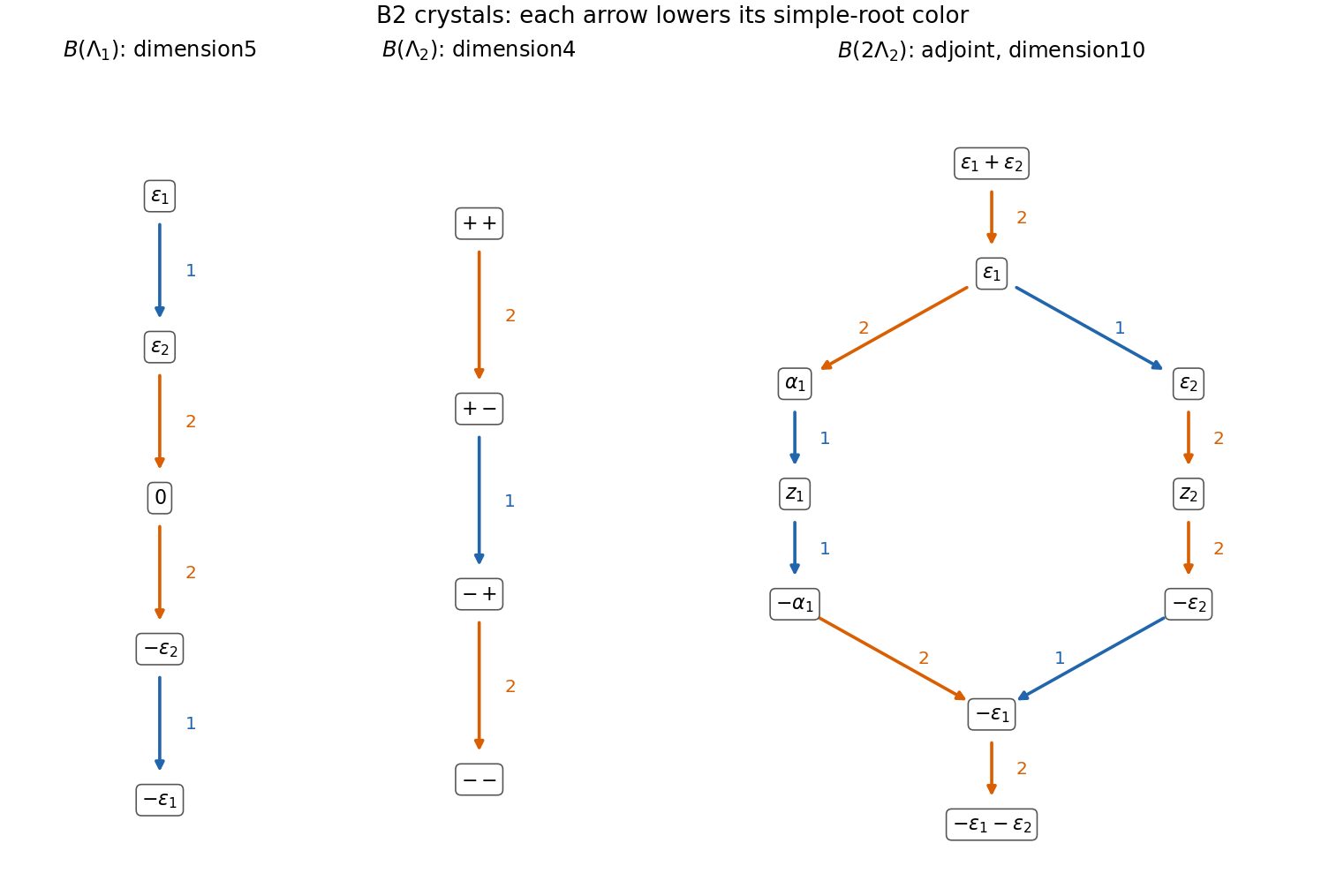
The two B2 fundamental crystals and the ten-vertex adjoint crystal, with distinct zero-weight vertices
. Details. 
Take the diagonal Cartan subalgebra of and let select its th diagonal entry, so on it. Use simple roots , . The fundamental weights are and . The defining representation has highest vector and the dual has highest vector . ThusTheir crystal basis diagrams are and , with weights and respectively. Use the same crystal tensor-product rule as in2(d): lowering acts on the first factor when ; otherwise on the second. Raising uses the first factor when , so it reverses each lowering arrow. An edge is absent if the selected factor operation is zero.
For , abbreviate by . The complete color-one edge list is , , ; the complete color-two list is , , . There are two connected components:For example because , whereas because equality selects the second factor and . This explains which ordered tensor labels lie in each component. At the representation level, the two components are the six-dimensional symmetric square and the three-dimensional exterior square:
For , abbreviate by . The complete color-one edge list is , , ; the complete color-two list is , , . The isolated vertex is . Thus the two highest vertices are of weight , and of weight zero. Lowering from the former visits all eight other vertices. ConsequentlyThis also follows concretely from : the first term is the Adjoint representation, with highest weight the highest root, and the second is the trivial Lie algebra representation. The ordinary invariant vector is , not the bare tensor suggested by the singleton's crystal label. The explicit edge lists and the diagrams exhibit all eighteen tensor vertices and justify the four highest weights.
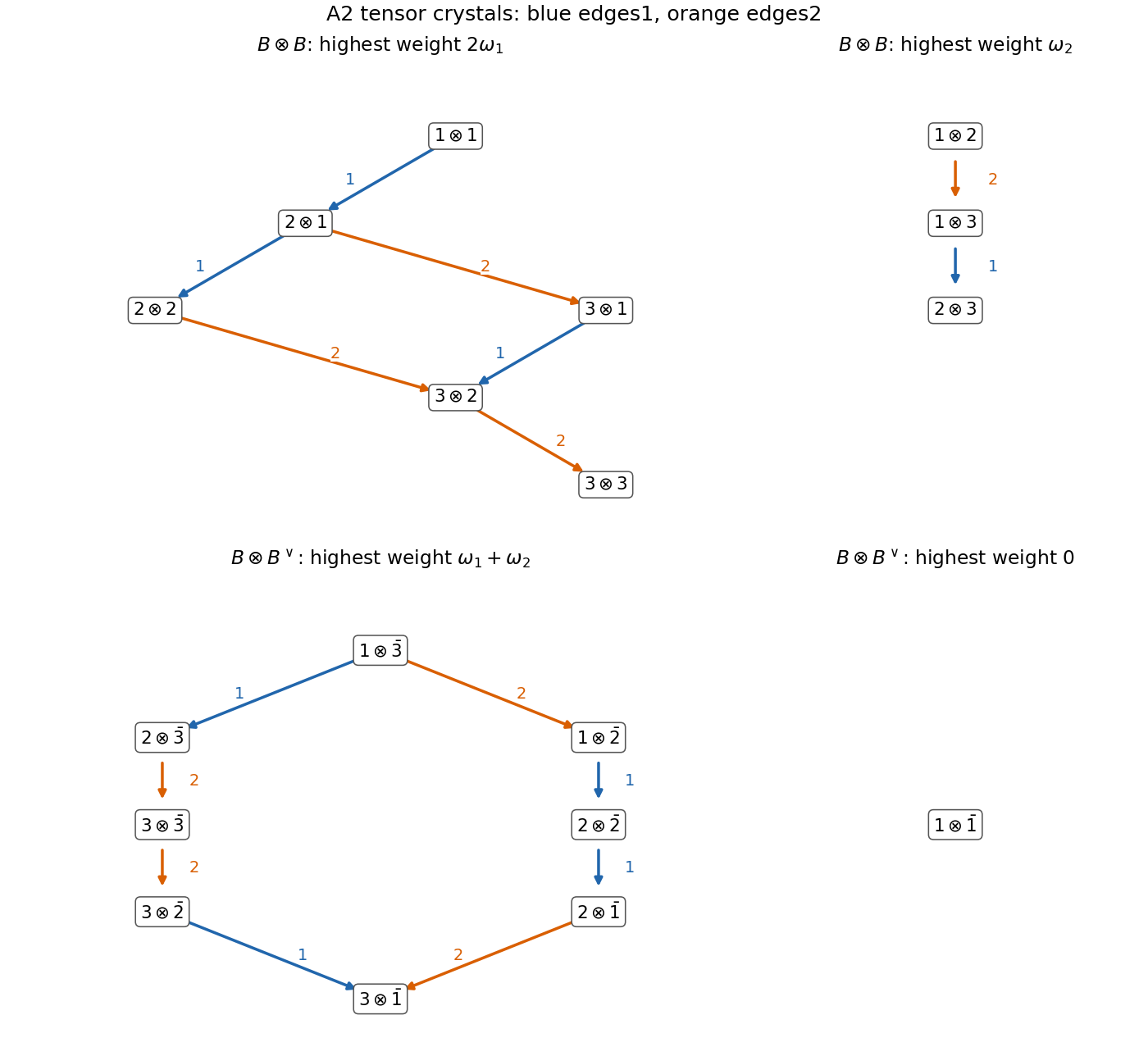
All components of the defining A2 tensor square and defining tensor dual crystals, with every lowering edge labeled by its simple-root color
. Details. 
Assume . Let be the -dimensional irreducible sl2 Lie algebra representation. Choose a weight basis with weights ; this lists the usual irreducible weight string in increasing order. Its exterior power has basis for , so its formal character isThe last sum is the Gaussian binomial coefficient . To verify the product identity, splitting the subsets according to whether they contain givesThe product satisfies the same recurrence, after putting both terms over their common denominator. Thus induction identifies it with the subset sum, proving it is a polynomial with nonnegative integer coefficients.
The quantum integer convention in the PDF hasMultiplying these factors in the factorial quotient givesThis establishes the required representation-theoretic interpretation.
By the Weyl complete reducibility theorem, write , where are nonnegative integers. The classification of finite-dimensional sl2 representations givesEvery exterior-power weight has parity and lies between and . Therefore only with occur. For with that parity, the coefficient of isThe coefficients consequently increase toward the middle of the occupied weight string and decrease afterward. If , then . HenceThis is the unimodality of Gaussian binomial coefficients, proved through parity unimodality of an sl2 character. It includes , when the character is one.
There is a normalization qualification in the printed wording. The symmetric quantum-binomial quotient is a Laurent polynomial in , with exponents spaced by two; the unimodality just proved is for that occupied parity, or equivalently for the ordinary polynomial after setting and removing the monomial shift. If one instead includes every integer exponent of , the literal coefficient claim is false: has coefficients . The representation-theoretic conclusion is unimodality on the parity string, and ordinary unimodality of the Gaussian polynomial.
Articles by others on the same topic
There are currently no matching articles.