Use the Unscaled Papkovich–Neuber representationwith harmonic vector and scalar potentials. For a torque-driven sphere chooseIts components are harmonic for , and both and vanish. HenceThe last equality follows from the no-slip boundary condition at . To check that is indeed the applied couple, the traction on the sphere, with directed into the fluid, is . Its hydrodynamic torque isHere . The applied couple balances this resisting torque. The resulting field is the rotlet of a rotating sphere in Stokes flow.
For the Lorentz reciprocal theorem for Stokes flow, let point out of the fluid domain and take the same viscosity in both flows. With , the theorem isIt follows by taking the divergence of the boundary integrand: incompressibility removes pressure-work terms, the two Newtonian strain contractions are equal, and the remaining stress divergences give the displayed body-force terms. This convention matters: on the inner boundary of an exterior domain, .
Apply the reciprocal identity with flow1 the actual body-force-driven flow and flow2 the rotlet auxiliary field. Its body force is zero. The large-sphere boundary terms vanish under the usual decay and convergence assumptions for this unbounded body-force problem.
On the sphere, the actual rigid velocity is . The auxiliary force is zero and its torque with the outward fluid normal is . The actual torque with that normal is the negative of the hydrodynamic torque on the sphere, hence zero for a torque-free sphere. Consequently the surface side of the reciprocal identity is just . The volume side isSince the auxiliary couple is arbitrary,An unknown translation contributes nothing because the auxiliary rotlet has zero net force. This is body-force-driven rotation of a torque-free sphere.
Subtract the ambient velocity and stress, writing . This perturbation decays at infinity and on the sphere has velocity . The ambient flow is regular through the ball and has no body force. Its net torque on the imaginary spherical surface is zero: the divergence theorem converts the torque to the volume integral of the stress divergence plus its antisymmetric part, both zero. Thus the perturbation has zero torque too.
Reciprocity with the auxiliary rotlet givesUsing yieldsOn this sphere , so the vector divergence theorem gives . Taking the curl of the homogeneous Stokes equation makes harmonic. Its ball average is its central value: the derivative of each spherical mean is proportional to the volume integral of its Laplacian, hence zero, and its small-radius limit is its value at the center. ThereforeThis proves Faxén rotation law directly from the reciprocal theorem, including why no finite-radius Laplacian correction is needed for a body-force-free ambient flow. Regularity of the ambient field throughout the sphere's prospective interior is part of this argument.
Let . The first sphere's leading velocity field is . Taking its curl givesThe second sphere is torque-free, soIts own force-free and torque-free motion emits no Stokeslet or rotlet; further reflections are smaller at large separation. In particular it spins in the opposite direction for a primary rotation perpendicular to the line of centers, and in the same direction with twice that magnitude for a parallel rotation.
Now isolate the additional interaction caused by the applied force . Its leading Stokeslet produces at the first center the incident velocity . The Stokes drag law makes the increment of the force required to hold that sphere fixedThe sign opposes the incident velocity. This holding force acts on the fluid and generates a reflected Stokeslet. A Stokeslet of force has vorticity . Evaluating half that vorticity at givesThus its magnitude is , as required. This is forced-sphere rotation reflected from a held sphere. Longitudinal forcing has zero leading spin by symmetry. Finite-size multipoles and the couple correction needed to preserve the first sphere's prescribed spin are smaller than this force-monopole reflection by order .
The material derivative follows surfactant carried by the moving interface. Tangential surface divergence changes the local surface area and hence dilutes or concentrates insoluble material. Normal motion changes area through the curvature: an expanding sphere has positive and its concentration decreases. The last term is surface diffusion, which smooths concentration gradients. There is no exchange with the bulk; this is conservation of insoluble surfactant on a moving interface.
The interfacial speed is of order . Diffusion dominates redistribution when the surface Péclet number satisfiesThen , and advection of is a second-order effect. Write . Since , the projected divergence of the first term is , whereas the second has divergence ; its gradient contracted with is zero. Hence .
The leading steady transport equation is . Trace-freeness and the supplied surface Laplacian identity give . Fixing the conserved total surfactant removes the uniform null mode and yieldsThis is quadrupolar surfactant distribution on a spherical interface; its spherical mean is zero because .
With outside, inside, and the normal directed out of the bubble, the interfacial stress balance with variable surface tension isNow , so . Multiplying the curvature by the tension and retaining linear terms givesThe undeformed isotropic pressure jump is kept with its normal; the perturbation terms are evaluated on the reference sphere. Products of deformation and concentration perturbations are beyond the approximation.
The imposed tensor is symmetric and traceless, so is a harmonic scalar of degree two. Its decaying partner is ; the corresponding harmonic vector uses . Linearity and rotational symmetry give precisely these tensorial modes, with the growing scalar chosen to reproduce the imposed strain. Thus in the unscaled convention one can takeThe coefficients multiply distinct decaying modes. No other angular harmonic is forced at this order.
No penetration in the steady state gives . The given tangential surface velocity implies . The tangential stress balance, with , gives , or . ThereforeThe nonuniform normal stress is unaffected by the uniform inviscid interior pressure. Its balance isSubstitution and rearrangement giveAs , : the concentration-induced Marangoni stress suppresses tangential surface motion, making the exterior boundary behave like an immobile surface despite the inviscid interior. The deformation coefficient tends to ; the clean limit is . Both small surface Péclet number and small deformation, of order , are required. This is Marangoni immobilization of a bubble in straining flow.
Measure pressure relative to its hydrostatic value and let be the lower-side excess pressure minus the upper-side excess pressure. The long unobstructed parts of the tube act as Poiseuille resistances in series. Their lengths add to at leading order because ; entrance and exterior resistances are smaller for . ConsequentlyHere is downward laboratory-frame volume flux.
Take upwards in the particle frame and let measure distance from the particle surface to the tube wall. In this frame the particle is stationary and the wall moves upwards at speed . In the thin, slowly varying gap, pressure is uniform across and the leading axial Stokes equation is . No slip givesThe gap's upward relative flux is constant, while conservation of displaced volume gives . Thus , and integration from bottom to top yieldsCurvature corrections to the gap circumference are relative order . Rapid end regions do not contribute to the leading singular neck resistance.
For the force use a cylindrical fluid control volume containing the particle, with full-area end caps just beyond it and the particle surface as an inner boundary. The upward pressure force on the caps is . The outer wall exerts axial traction on the fluid, whereas the particle's traction on the fluid integrates to minus its upward hydrodynamic resistance . The zero-inertia momentum balance is thereforeThe velocity profile gives , provingUsing the outer-wall traction is essential; directly using the particle-side shear and a flat-end pressure force would omit the pressure on the sloping particle surface. This is control-volume drag formula for a sphere in a tube.
The four dimensionless relations areSolving them givesWithin the preceding lubrication and tube-resistance approximations, the force isSince , . Dropping the smaller additive terms in the numerator yields the requested leading formulaThe Cauchy-Schwarz inequality gives , so the retained term is positive. The term multiplied by must be retained: it can compete with even though the unmultiplied lower integrals cannot.
For a sphere of radius , the neck has at leading order. With , the integrals reduce to . For these last integrals are , giving the full two-sided integrals. PutThe printed sphere integrals are half these values: they correspond to integrating over one side of the neck rather than the stated interval spanning both sides. The substitution above establishes the radius-deficit normalization of sphere-tube lubrication integrals. Using the two-sided values, the force becomesso the three answers areThese are the corrected sphere-tube drag regimes with a radius-deficit gap. If the supplied half-integrals are treated as stipulated data instead, the same algebra gives , and in the three regimes. Thus the first and third numerical drag coefficients double when the geometrically correct integrals are used; the regime boundaries and dominant flow patterns are unchanged.
In the first regime, , , and . Almost no displaced fluid escapes through the long tube; it bypasses upwards through the thin annulus. The large pressure-driven bypass resistance sets the drag, with shear smaller.
In the second regime, , , andAlmost all displaced volume travels through the unobstructed tube, whose pressure resistance dominates the force. Both terms in this small gap flux are worth displaying: their crossover at changes the balance between pressure-driven and wall-driven gap transport but does not create a fourth leading force regime.
In the third regime, , , and . Tube throughflow still carries almost all the displaced volume, but the dominant resistance is local annular lubrication rather than the net tube pressure drop. The relative gap flux is now of order , so wall-driven and pressure-driven components both matter locally. The formulas describe hydrodynamic resistance after subtracting hydrostatic buoyancy; terminal settling would balance it against the particle's excess weight.
The Darcy law here is , with hydrostatic contributions absorbed into if present. Since is uniform and the fluid is incompressible, gives in the porous matrix.
Pressure is uniform across the thin crack at leading order. No-slip lubrication theory gives its flux per unit depth . Conservation in a short crack segment says , while Darcy flow gives . ThereforeThe other interfacial condition is pressure continuity, . The far pressure gradient is ; outside the slit both pressure and normal Darcy flux are continuous. The leading tapered-crack flux vanishes at its endpoints. The assumptions and justify transverse pressure uniformity and neglect of porous-wall slip on scale . Close to the sharp tips the reduced model is an outer approximation, not a uniformly resolved tip solution. This is lubrication boundary condition for a crack in a Darcy medium.
These are planar elliptic coordinates. The curve is the slit , traced on its upper and lower sides. The curve is the ellipse with semiaxes and . For fixed noncardinal , the coordinate curve is the appropriate branch of . The cardinal angles give the two exterior horizontal rays and the upper/lower vertical rays. The requested original sketch is:
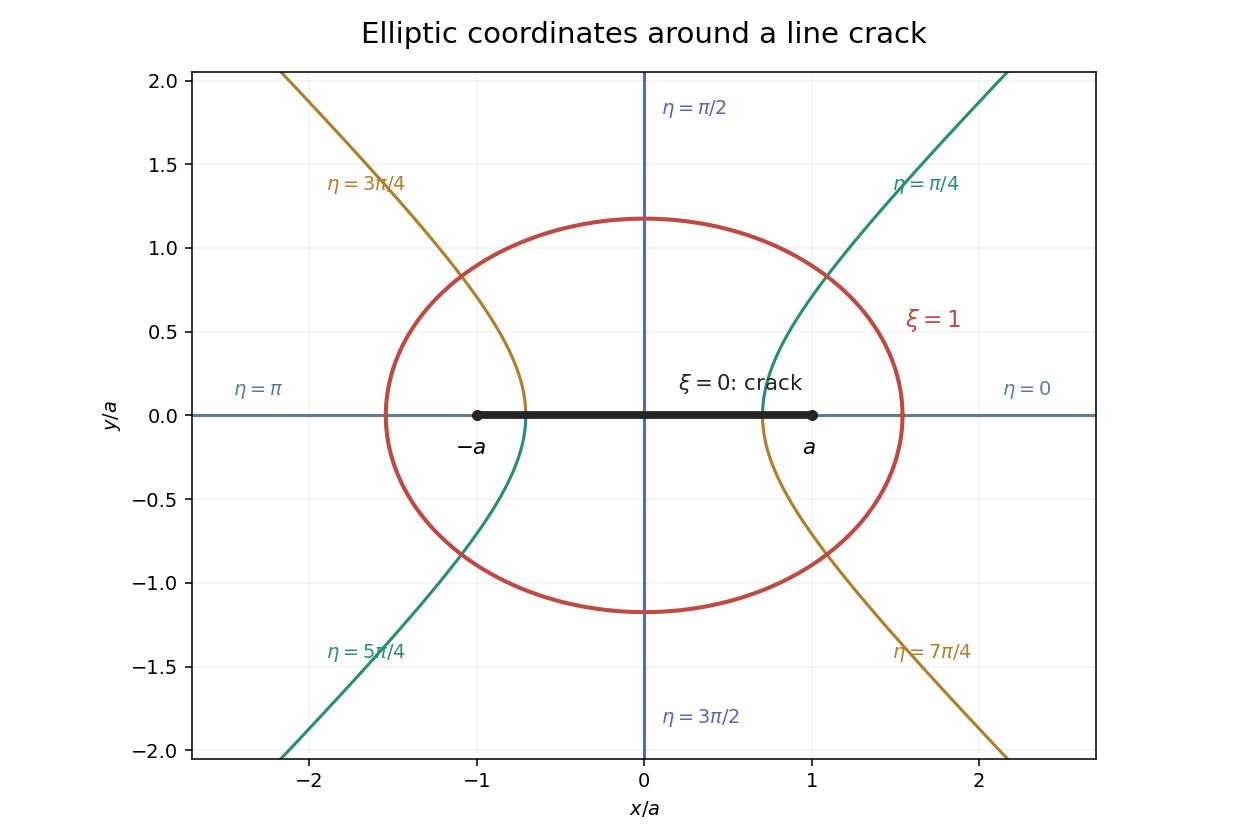

On the upper face , the supplied derivatives reduce to and . The same point on the lower face has angle , so its has the opposite sign. ThusInsert this and the tangential derivative into the crack condition and multiply by to obtainPressure continuity becomes . The uniform-flow background is . Its derivatives immediately giveThe harmonic equation is because the metric multiplier is nonzero outside the slit.
For the specified profile, on the upper face. Its coefficient in the tangential operator is constant, so the imposed cosine mode separates. With , write . Harmonicity gives , the interfacial condition gives , and the far field fixes the growing coefficient to . ThereforeReflection symmetry makes the two face derivatives equal. Other homogeneous cosine modes decaying as would require at the slit, impossible for and . The constant pressure gauge is immaterial. This justifies the separated crack pressure in elliptic coordinates, not only a candidate satisfying selected conditions.
At the midpoint and . HenceFor , and the crack barely perturbs the imposed Darcy pressure gradient. For , and the slit is nearly equipotential: its high axial conductance collects flow from the surrounding matrix rather than sustaining a substantial pressure gradient. The parameter compares crack conductance with matrix conductance . In fact , so the tip flux is zero in this outer model.
Subtracting the exact uniform background gives . Since and at infinity,The printed far-field coefficient is too large by a factor of two. The factor is forced by the stated coordinate map. An independent check is the large- solution , whose expansion has precisely . This is the elliptic crack pressure dipole.
The phrase “suitably chosen curve” matters for the pressure-only dissipation integral. Put and use a rectangle with end faces and transverse extent , taking . The horizontal faces have . The two end-face integrals of totalThis is a fixed-throughflow normalization: the integrated velocity perturbation on an infinite end face is zero, since it is proportional to . Work on the transverse faces vanishes as . Thus the requested line functional givesA bare circular cutoff would give instead; it does not enforce this same throughflow normalization, so its pressure-only term cannot be substituted into the fixed-throughflow dissipation comparison. Keeping the control surface explicit resolves that ambiguity. This is fixed-throughflow dissipation reduction of a conductive crack.
Let . The noninteracting average dissipation per area is . Equating this with givesOnly the first-order density term is controlled by the noninteraction assumption; the rational form is not an all-orders result. It increases permeability along the aligned cracks and saturates as their conductance becomes large. This is dilute permeability enhancement by aligned cracks.
Articles by others on the same topic
There are currently no matching articles.