Let and denote longitudinal length and time scales, and let be a typical streamwise velocity. The shallow water approximation requires , slow changes in the channel geometry , and small longitudinal slopes. The vertical velocity is then of order ; its acceleration must be small compared with the restoring acceleration, for example in a reduced-gravity layer. The leading pressure is hydrostatic pressure, and cross-sectional horizontal velocity is approximated by . High Reynolds number permits negligible interior viscous terms but does not itself guarantee the geometric or hydrostatic assumptions. We also require and in the wetted interior. The dimensionless need not be small: it measures the cross-section's opening angle, while the smallness condition concerns streamwise variation.
The cross-sectional area and volume transport areFor an impermeable bed and no fluid entrainment, volume conservation givesor, equivalently,The geometrical source term expresses the depth change needed when a moving layer encounters a wider or narrower triangular section.
Write . The Saint-Venant dry-front condition describes a liquid advancing over a dry bed, or into an ambient whose inertia is negligible, as when . The edge has ; its velocity is obtained by continuing the appropriate shallow water Riemann invariant to zero depth. There is no independent universal finite-depth head Froude number. In the triangular geometry a release of a resting layer gives , whereas a rectangular release gives .
The Benjamin deep-ambient front condition includes the inertia of an ambient that must turn around a finite-depth gravity current head. In the ideal deep-ambient Boussinesq approximation, is close to one andHere is the current depth just behind its head, its speed relative to the far ambient, and the ideal head Froude number. The ambient is much deeper than ; a finite upper-layer depth changes the closure. The lower density must exceed the ambient density for a bottom current. A non-Boussinesq head requires an appropriate density-ratio correction rather than using at every ratio. The Saint-Venant and Benjamin models therefore describe different front physics, even though both use the same long-wave equations in the interior.
Constant density in each layer and negligible ambient acceleration far from the front giveThis primitive momentum conservation equation remains valid with slowly varying . In conservative form it iswhere the right side is the longitudinal component of the hydrostatic pressure force on the sloping sidewalls. Omitting that term while retaining variable would give the wrong acceleration.
Together with volume conservation, the principal coefficient matrix in isIts real eigenvalues and characteristic curves areThese are downstream and upstream gravity waves relative to the moving fluid. The factor is geometric: the hydraulic depth is . Both waves move downstream in a sufficiently fast current, whereas one can carry information upstream in a slower current.
For , differentiate and combine the two equations. The Riemann invariants areFor variable they instead obeywhich also checks that the invariant claim depends on a prismatic channel.
Put . The undisturbed reservoir has and Riemann invariants . The right-going characteristic curves supply the invariant throughout the release. The spreading disturbance is the other family, whose speed is . In its rarefaction wave let . ThenAt the reservoir edge , so the back of the rarefaction wave travels at . At the dry edge the Saint-Venant dry-front condition givesThus the fan occupies , while remains undisturbed. Its full length grows at ; there is no finite-depth uniform shelf between the fan and the dry front. The optional interior depth is .
The fan's minus-family characteristic curves are rays . For the plus family in the fan, ; integration gives , with constants selected at entry from the reservoir. These curved paths transport the constant plus Riemann invariant.
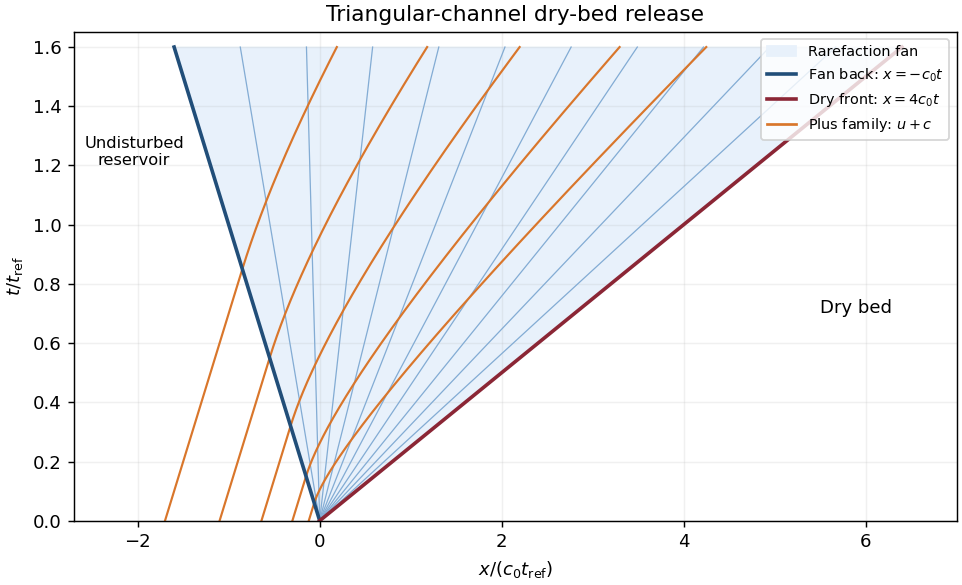
Triangular-channel dry-bed release with its rarefaction rays and right-going characteristics
. Details. 
Use a gravity-current box model: approximate the current by uniform depth and length , with constant reduced gravity, no deposition and no fluid entrainment. The triangular cross-sectional area is , so the fixed released volume isThe Benjamin deep-ambient front condition closes the integral model:For a finite initial length , direct integration givesThe ideal point-release limit takes and has , . Its divergent initial depth is outside the shallow water approximation, so a real finite reservoir regularizes the early stage. This is the finite-volume triangular-channel current integral law; it does not assert a spatially uniform exact solution of the local equations.
Let be the downward fluid suction speed and the downward particle settling velocity relative to that fluid. Set and . The carrier volume conservation and particle-volume balances per unit channel width areThe particle sink includes suction as well as relative settling: the particles follow the well-mixed withdrawn fluid, in addition to settling through it. Subtracting yields . Thus for , as long as ,For the continuous limit is and . In particular suction alone does not change the well-mixed particle fraction: implies .
Withdrawn fluid carries its local horizontal momentum, so the momentum flux and hydrostatic pressure force obeyExpand this and use . The suction momentum terms cancel in the primitive acceleration equation, leavingThese are the governing equations for a particle-laden current with suction. Substituting and the concentration equation gives the convenient depth equationThe steady carrier flux is exhausted at the formal length when . Positive cannot continue beyond it. Near that limit a chosen depth branch, mixing or shallow-layer assumptions may fail, so this is the mass-budget extent, not a guarantee that every arbitrary inlet state has a regular shallow continuation to it. When , settling makes the driving reduced gravity exponentially small but does not remove carrier fluid; this ideal steady model has no finite mass-budget runout.
At , the particle budget gives , so is constant. The primitive momentum conservation equation integrates toIntroduce , and . The exact relation on the subcritical flow branch isExpanding uniformly for givesThe depth increases slightly because horizontal kinetic energy decreases as fluid is removed. In fact the depth equation has on this branch, andThus the small-Froude number approximation becomes better downstream, including as the flux vanishes. At leading order .
With and , and , where . No carrier momentum is withdrawn; hence the integrated momentum flux is exactly constant:On an initially small-Froude number branch, the pressure term dominates. At leading orderA slightly more accurate large-distance amplitude is , so . The Froude number satisfies and remains small. The growing depth can eventually violate confinement or the shallow water assumption; this does not make the asymptotic momentum calculation inconsistent within its intended regime.
On an initially large-Froude number branch, horizontal momentum flux dominates instead. The leading depth is constant, , while the decaying reduced gravity makes the Froude number still larger. To resolve the small change, put and :soThe depth decreases slightly and tends exactly to . Its Froude number grows like . Both approximations agree with the exact depth equation : the subcritical flow deepens, while the supercritical flow thins.
Articles by others on the same topic
There are currently no matching articles.