Write and . The primary streamfunction mode describes a single roll spanning the box, while the first magnetic mode describes the distortion of the vertical field by that roll. The second magnetic mode is independent of height and has twice the horizontal wavenumber, as generated by interaction of the first two modes. TakeThese satisfy all the stated boundary conditions: the sine factors vanish on the vertical walls, and its Laplacian vanish on every wall, and vanishes at the horizontal walls.
Let . Since , . The magnetic Jacobians areandProjecting onto the three retained Fourier modes and discarding the generated third horizontal harmonic yields, in the original time,Here , so the second magnetic mode has the same linear diffusion rate as the first.
Choose and normalize the amplitudes byFor example the coefficient of in is , and that of in is . The linear momentum coefficients become and . ThereforeThis is three-mode porous magnetoconvection. Because the nonlinear magnetic advection generates a discarded harmonic, it is a Galerkin approximation, not an exact three-dimensional invariant subspace of the partial differential equations.
At the no-convection equilibrium , one eigenvalue is and the other two come fromTheir trace and determinant areA zero eigenvalue occurs at . If , the other two eigenvalues are negative, and the stationary bifurcation is the pitchfork analyzed in part (c). For the transverse eigenvalue is positive instead.
An imaginary pair occurs at , provided , becauseThe trace crosses zero with derivative . The cubic coupling is nondegenerate here: at criticality, putting reduces the oscillatory variables toFor , the forced second harmonic of has sine coefficient . Averaging the derivative of consequently gives . Thus the Hopf bifurcation is nondegenerate and supercritical.
The two thresholds meet atHere the planar block is nonzero but has trace and determinant zero, while the third eigenvalue remains negative. It is a reflection-symmetric double-zero, codimension-two point; the ordinary simple-eigenvalue reduction of part (c) is not valid there.
Fix and . The noncritical eigenvalues at are and . Include the constant parameter as an additional centre variable. Symmetry permits expansionswhere the omitted terms in the reduced equation have order . At , begins at cubic order, so begins at fourth order. The equation therefore gives .
The invariance equation for must retain . From the first equation,Equating coefficients in givesHenceand the required reduced equation isBoth coefficients are positive. Thus the bifurcation is a subcritical pitchfork: the no-convection state is stable for and unstable for . The small nonzero branches lie on the stable-origin side,and are unstable, since the derivative of the reduced vector field there is . Their two transverse directions remain stable, making them saddle equilibrium equilibria in the three-dimensional model. Setting without the invariance correction would incorrectly omit the common factor . This is the cubic centre-manifold reduction of porous magnetoconvection.
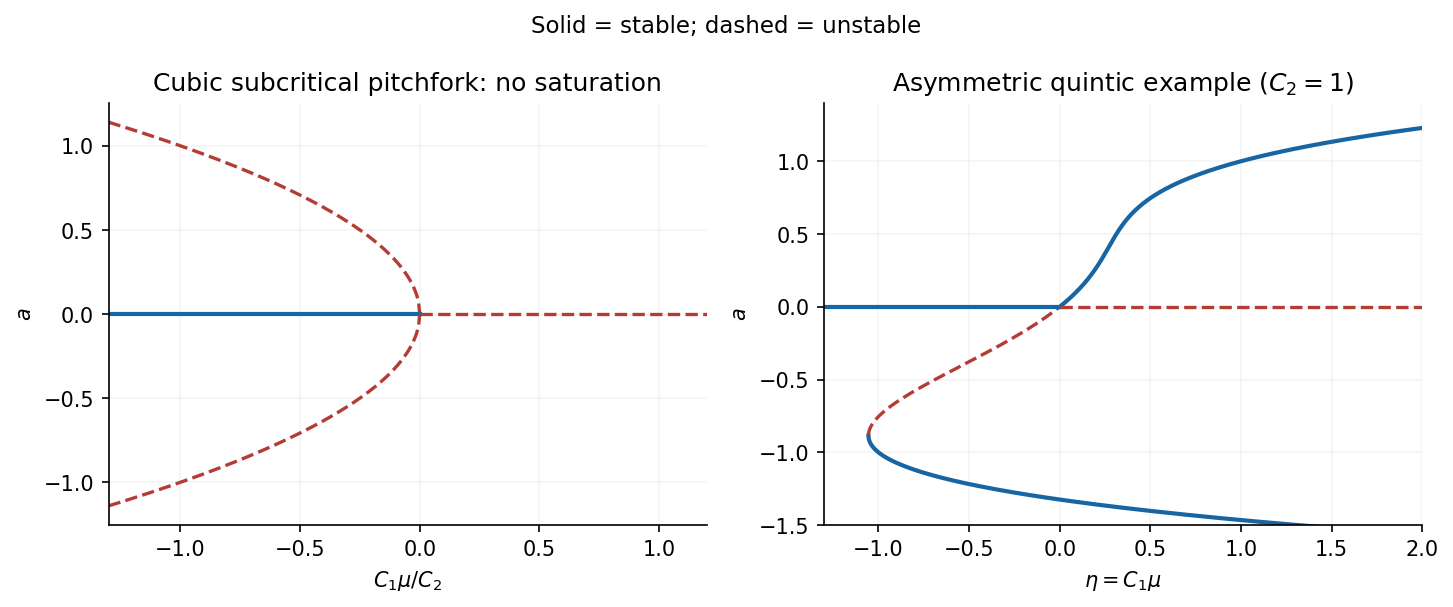

For , the cubic equation has the same sign as everywhere away from zero: small positive or negative disturbances grow without saturation, and the cubic truncation even predicts finite-time blow-up. An amplitude of convection cannot grow indefinitely under that local approximation. The conclusion is that additional nonlinear physics and higher-order terms are needed, not that the small-amplitude reduction is valid at arbitrarily large amplitude.
For the modified equation put and . It can be writtenThe quintic term points inward for sufficiently large , so all forward solutions are bounded and approach equilibria in this scalar problem. The quadratic term breaks symmetry. Besides , the equilibrium diagram isThis stability criterion follows from on the equilibrium curve, where . Near zero the new branch is , crossing the trivial branch transcritically. It is unstable for small negative and stable for small positive ; the trivial branch has the opposite stability.
The negative-amplitude part of has exactly one minimum. Above its negative fold value but below zero, a stable finite-amplitude negative state coexists with the stable origin, separated by an unstable negative equilibrium. This gives hysteresis and finite-amplitude triggering of convection. For positive the origin is unstable and stable nonzero states provide saturation. Additional positive-amplitude folds depend on : has two positive roots for , a double root at and none for , so further multistability can occur. The right-hand figure illustrates , without those extra positive folds; it does not assume that every possible gives that same detailed diagram. These are the qualitative changes in quintic saturation of a symmetry-broken pitchfork.
Articles by others on the same topic
There are currently no matching articles.