Use units and the Minkowski metric , so . The canonical momentum of the real scalar field is , and the Hamiltonian operator isCanonical quantization of a real scalar field promotes and to operator-valued distributions satisfying the equal-time canonical commutation relationProducts and operator commutators can first be interpreted after spatial smearing. An additive vacuum constant in does not affect the following equations. In the Heisenberg picture, . Applying the canonical commutation relation to the quadratic Hamiltonian operator, and integrating the gradient term by parts, givesThus the Klein-Gordon equation is an operator equation. The spatial Fourier transform reduces it to , with . Its two frequency branches, together with the Hermitian adjoint condition , give the mode expansion of a free fieldThe measure is Lorentz invariant; its normalization fixes that of the creation and annihilation operators rather than imposing any extra physical assumption.
For invariant-normalized scalar mode extraction, take the Klein-Gordon inner product of with the field. The positive-frequency contribution has coefficient and spatial integral . The negative-frequency contribution has coefficient and spatial integral , so it vanishes because . ConsequentlyTaking the Hermitian adjoint, with the order of the scalar factors immaterial, yieldsEquivalently and . At a common time their operator commutator therefore isThe same calculation gives : the surviving factor is an energy difference supported at opposite spatial momenta. These are the bosonic canonical commutation relations in relativistic normalization of a one-particle state.
Choose the Fock vacuum by and . Only the annihilator-creator product contributes to the Wightman function, givingUsing time ordering and the reverse product for , the Feynman propagator, with the convention in this calculation, isIn particular the denominator in the spatial measure is in both terms.
To verify the four-dimensional Fourier transform representation, let and integrate the energy variable first:The Feynman i-epsilon prescription puts the positive-energy pole at and the negative-energy pole at . For , the contour integral closes in the lower half-plane with clockwise orientation. The residue theorem multiplies the residue by , giving . For , it closes counterclockwise above: multiplying the residue by gives . Thus . After inserting the spatial exponential, reversing in the negative-time term gives exactly the time ordering expression above. HenceThis equality is understood as a distribution limit; the same prescription gives .
Use the Minkowski metric . Multiplying the block gamma matrices and using the Pauli matrix multiplication law givesThus these matrices satisfy the Clifford algebra relation . Since partial derivatives commute, the antisymmetric part of drops out of its contraction with . Multiplying the Dirac equation on the left by givesTherefore every component of the Dirac spinor obeys the Klein-Gordon equation with mass .
For Lorentz covariance, take and , with constant and . The chain rule gives . The given intertwining relation then impliesThis proves invariance of the Dirac equation under the joint coordinate and spinor transformation.
The infinitesimal identity follows directly from the spinor Lorentz generator commutator. To derive it, first move through a two-matrix product using the Clifford algebra:Subtract the expression with and interchanged and multiply by . ThusWriting gives , and henceThe last step uses , including the metric signs in raising the first index.
For parity symmetry in quantum field theory, set . The time derivative of is unchanged and each spatial derivative changes sign. Also commutes with itself and anticommutes with every . ConsequentlyThis verifies the specified parity symmetry in quantum field theory action explicitly.
For charge conjugation, put , so . In the Dirac representation of the gamma matrices, are real and is imaginary. The Clifford algebra therefore gives for all four indices. Complex conjugation of the Dirac equation, followed by multiplication by , yieldsThis is the antilinear charge-conjugation intertwiner property. No electromagnetic background is being held fixed in this free-field calculation.
Apply the specified parity symmetry in quantum field theory action before charge conjugation. Since is real and ,Thus the induced parity action on the charge-conjugate spinor has the opposite sign. In particular, if a spinor has intrinsic parity , its charge conjugate has intrinsic parity . Equivalently, at rest the positive-frequency Dirac spinors occupy the upper two components and have eigenvalue , whereas the negative-frequency Dirac spinors occupy the lower two components and have eigenvalue . The corresponding particle and antiparticle creation operators inherit these opposite signs under the specified parity convention. Hence electrons and positrons have opposite intrinsic parities; conventionally one assigns to the electron and to the positron. The common real overall parity sign may be reversed without changing this relative sign, as in opposite intrinsic parities of a Dirac particle and antiparticle.
All three fields have mass . In the interaction picture the quantum fields evolve with the free Hamiltonian operator, so their equations areThe interactions evolve the states instead. For the appropriate mode expansion of a free field isIndependent species have commuting creation and annihilation operators. The full set of canonical commutation relations isThese follow from the separate equal-time canonical commutation relations for the three real scalar fields. For comparison, in the Heisenberg picture the full Euler-Lagrange field equations contain interactions: , , and . These are distinct from the free equations used in the interaction picture.
There are no derivative couplings, so the interaction Hamiltonian is . The interaction picture evolution operator obeysIterating its integral equation gives the Dyson seriesThe ordered integration region is equivalent to the unrestricted region with time ordering and the factor . Taking the scattering limit , , with the usual adiabatic prescription for perturbation theory, therefore yields the S-matrixAll fields inside this expression are interaction picture fields.
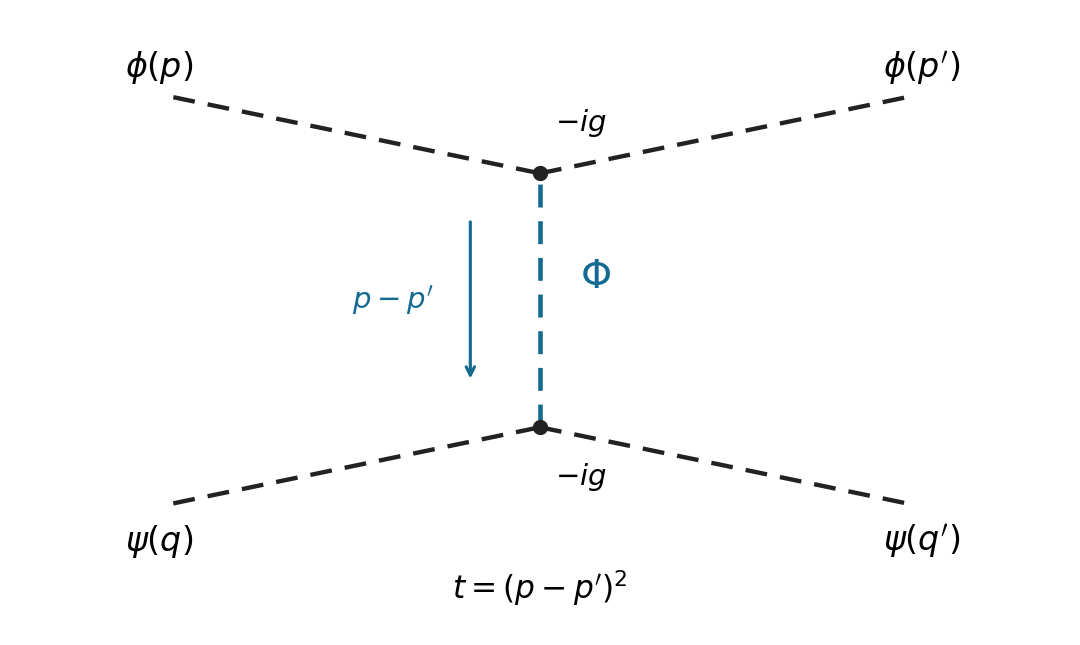
Use relativistic normalization of a one-particle state and take , . Define the connected scattering amplitude by . The identity contribution describes no scattering; the term linear in cannot connect these four external particles. At quadratic order, the connected term in the Dyson series isBy Wick theorem, a connected Wick contraction must attach the two external legs to at one vertex, the two external legs to at the other, and contract the remaining two fields. The two assignments of species to cancel the Dyson factor . At either vertex, the assignments of its identical fields to the incoming and outgoing particle cancel the interaction factor . Equivalently, the coefficient is multiplied by , giving . Therefore, writing ,Insert the Feynman propagator . The two vertex integrals impose and . With the Mandelstam invariant , this givesThis is distinguishable scalar scattering by a shared mediator with mediator mass . In physical elastic kinematics , so the denominator has no pole for . There is only the displayed -channel tree-level Feynman diagram: an - or -channel would require an absent mixed vertex. Each vertex contributes and the exchanged contributes , agreeing with the direct Wick contraction calculation.

Use throughout. Vary the Maxwell action with respect to the electromagnetic four-potential. Antisymmetry of the electromagnetic field tensor gives . After integration by parts, the Euler-Lagrange field equation isA gauge transformation leaves unchanged because partial derivatives commute. It therefore leaves the Maxwell action and observable electromagnetic fields unchanged: different potentials represent the same physical field. This redundancy matters for canonical quantization: before gauge fixing, the momentum conjugate to vanishes and the four potential components cannot be treated as four independent physical oscillators.
Choose the Lorenz gauge , attainable by solving with suitable boundary data. The Euler-Lagrange field equation then reduces toResidual Lorenz gauge symmetry consists of transformations with . The gauge condition and this residual redundancy ultimately leave two transverse polarizations of a free photon.
For the specified kinetic density , one has . Its Euler-Lagrange field equation is therefore . This density is the Feynman-gauge Maxwell kinetic density after a boundary-term subtraction, sinceThe divergence follows by expanding both sides and commuting the second derivatives. Thus the wave equation follows from a Feynman gauge action; the additional physical-state condition will implement the Lorenz gauge. One must not impose inside the original action before varying it.
Take the covariant components as canonical coordinates. The canonical momentum computed from isThe equal-time canonical Poisson brackets are , with coordinate-coordinate and momentum-momentum brackets zero. Applying canonical quantization givesIn particular . The negative temporal sign is the source of the indefinite state-space norm in covariant photon quantization.
The spatial Fourier transform of the wave equation gives an oscillator of frequency for each component. The Hermitian adjoint condition on the electromagnetic four-potential then yields the mode expansion of a free fieldThese are massless on shell modes. Consistently with the preceding equal-time canonical commutation relation,The normalization is the same as for the scalar modes, with replacing the species identity matrix.
Gupta-Bleuler quantization starts with the Fock vacuum annihilated by every and imposes only the annihilation, or positive-frequency part of a quantum field, of the Lorenz gauge condition:Imposing the entire Hermitian field divergence as a strong operator identity would be incompatible with the four-component canonical commutation relation. The weaker condition suffices: between two physical states its positive-frequency part vanishes on the ket, and its negative-frequency part vanishes on the bra. Hence .
For a one-photon state , commuting the constraint through the creator givesThus the allowed photon polarization vectors satisfy . Their state inner product, with the common momentum-normalization factor suppressed, is . Momentum eigenstates are delta-normalized; the same statements hold with finite norms for normalizable wave packets.
Rotate the spatial axes so that . The constraint is , so the complete allowed family isThe first vector is the allowed longitudinal gauge polarization, proportional to the null four-momentum . Its state has zero norm because ; it is also orthogonal to every constrained state because . A purely spatial vector alone is not an allowed physical polarization: its time component must accompany it to satisfy the constraint. The other two vectors are transverse polarizations, perpendicular to , with positive unit norms. For the displayed family,The timelike negative-norm excitation has been excluded by the constraint, and the remaining form is positive semidefinite. The Gupta-Bleuler null-state quotient identifies and , removing the null direction. It leaves exactly two transverse physical photon polarizations with a positive inner product; their bosonic Fock space is the physical photon state space.
Finally use Feynman slash notation, , and impose four-momentum conservation . The external Dirac spinors obeySet and . Replacing by in the first term of the electron-positron annihilation into two photons amplitude, the rightmost contracted vertex obeysSince the Clifford algebra implies , that term becomesFor the second term, four-momentum conservation gives . The contracted vertex is now adjacent to the outgoing positron spinor on the left, soConsequentlyThe two terms cancel, proving the two-photon fermion Ward identityExchanging the two photon labels proves the same result for . By linearity the amplitude is invariant under on either external photon leg. Therefore the null longitudinal gauge polarization has zero production amplitude: physical scattering produces only the two transverse photon polarizations. This cancellation also shows why both photon orderings in the tree-level Feynman diagrams are essential; either term alone fails the Ward identity.
Articles by others on the same topic
There are currently no matching articles.