A chain complex consists of abelian groups and homomorphisms with . Its groups of chain cycles and chain boundaries are and ; the identity ensures . Its homology groups areFor a nonnegative complex, take for .
The singular chain group is the free abelian group on continuous maps , called singular simplices. With the inclusion of the face opposite vertex , defineDeleting any two vertices in the two possible orders gives the same face with opposite signs, proving . This defines the singular chain complex and its singular homology. A continuous map induces the chain map ; it commutes with the boundary because composition commutes with restriction to faces.
To prove homotopy invariance of homology, let have endpoints . Triangulate by the simplices with ordered verticesLet be their affine parameterizations. The singular prism operator isOn taking boundaries, shared internal faces of consecutive prism simplices cancel. The top and bottom faces give , and the remaining faces are with their induced signs. ThusFor a chain cycle , is a chain boundary, so on homology. If is a homotopy equivalence, its homotopy inverse therefore induces an inverse to , proving that singular homology depends only on homotopy type.
Use the standard CW complex for an orientable genus-three surface: one vertex, six edges , and a two-cell whose attaching word is . The cellular homology theorem identifies this cellular calculation with singular homology. The boundary of every edge is zero, and each edge's total exponent in the attaching word is zero, so the two-cell boundary is zero. HenceChoose to be the nonseparating curve represented by , and choose as a small circle bounding a disc in a surface patch. Then is a nonzero primitive homology class, whereas the inclusion of induces zero on . If a homotopy equivalence carried onto , its restriction would factor through and kill , contradicting injectivity on first homology. This is the homology obstruction to carrying surface curves onto one another.
There is nevertheless such a continuous map. Map the edge homeomorphically onto and all other edges to its base point. The two-cell attaching word then has winding number zero in , hence is null-homotopic and the map extends to . Compose with a homeomorphism and the inclusion of in the surface. This gives . Thus an arbitrary map can carry the first curve onto the second, but a homotopy equivalence cannot.
For an unambiguous drawing, realize as the double of a manifold formed from a disc with three holes. Its two copies are glued along all four boundary circles. The red curve below follows an arc from the outer boundary to the first hole on the front copy and returns along the matching arc on the back copy; it is a nonseparating curve. The blue circle is entirely in a disc patch on the front copy and is contractible.
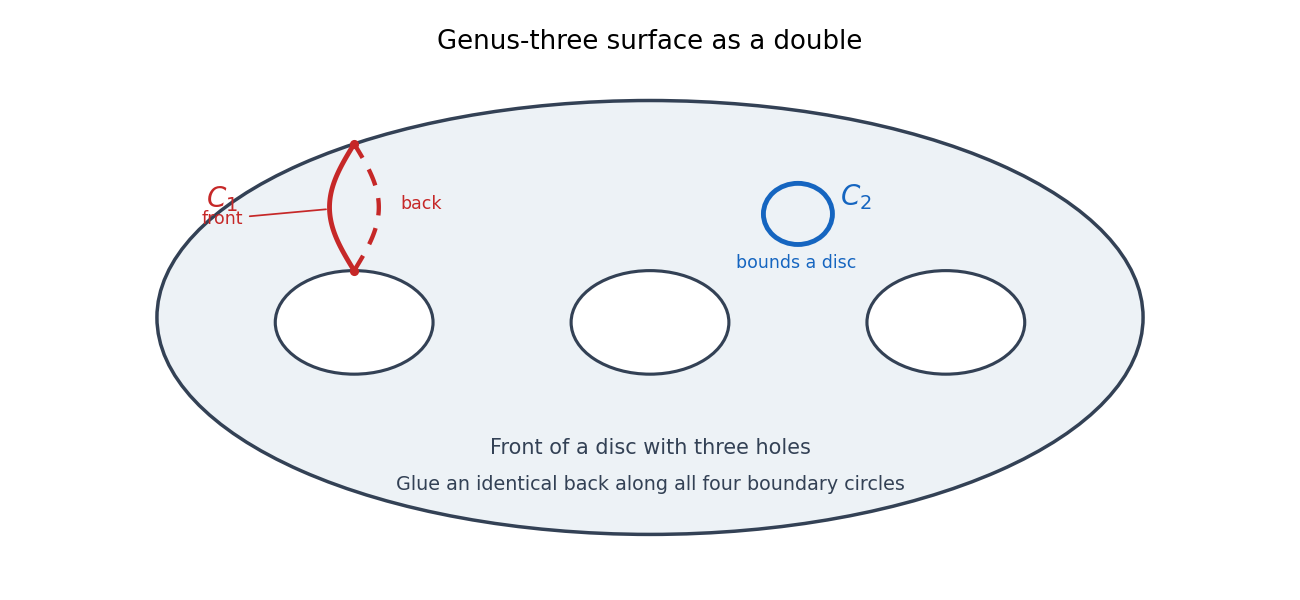
Nonseparating and contractible circles on the genus-three surface, drawn as a doubled three-holed disc
. Details. 
A CW complex is built by attaching q-dimensional discs to the -skeleton along maps of their boundary spheres, with the closure-finite and weak-topology conditions. Write for its q-skeleton and . The cellular chain group isThe cellular boundary is the composite of the connecting map and the relative quotient map:Consecutive maps in the relevant exact sequences compose to zero, so these maps make a cellular chain complex. Equivalently, a boundary coefficient is the degree of the attaching sphere followed by collapse onto the sphere of a selected lower cell. Its cellular homology is . The relative groups of successive skeleta vanish off their cell dimension; their exact sequences identify this homology with singular homology, the cellular homology theorem.
For , the sphere has a zero-cell and a k-cell with zero boundary. The Complex projective space has one cell in each dimension and no odd cells, so all cellular boundaries vanish. ConsequentlyAt , the sphere consists of two points and ; at , projective space is a point.
Put and . Its product CW complex has cells in dimensions . For , these positive dimensions are distinct and never consecutive, so all cellular boundaries vanish. ThusIts -skeleton is . Collapsing it gives the quotientIt induces an isomorphism on top homology, with degree after choosing the quotient orientation. Let be the Hopf fibration and set , the Hopf projection of a product smash quotient.
On reduced homology, the collapse kills the two lower-dimensional classes, and the remaining top class maps to zero because projective space has no odd-dimensional homology. Therefore in every reduced degree. On homotopy groups, for , with summands induced by the two factor inclusions. Both inclusions are collapsed by , so and hence vanish on both summands. The domain is simply connected and connected, which also handles the lower groups.
It remains to prove that is not null-homotopic. The Hopf fibration has fibre and has the homotopy lifting property for the CW domain : a homotopy downstairs and a lift of its initial map have a lift with that specified initial value. If were homotopic to a constant, lift this homotopy starting at . The ending map would land in the single fibre . Every map is null-homotopic, since the simply connected domain permits its lift to the contractible universal cover . Thus would be null-homotopic in , contradicting its nonzero top homology map. Hence
An orientation of a topological n-manifold without boundary is a choice of generator of each local homology group , compatible in coordinate neighbourhoods. Equivalently, local orientations of coordinate discs are chosen so their overlap changes have degree . This trivializes the orientation local system.
Here the printed denotes compactly supported cohomology, which we write . We prove the cyclicity assertion without assuming Poincare duality. By the compactly supported cohomology of Euclidean space, an open n-disc has one copy of in degree and zero in all other degrees. The compact-support Mayer–Vietoris sequence for open sets containsUse the finite good cover allowed in the paper. Induction on the number of discs shows that any union of its discs has zero compact-support cohomology above degree : at each step the intersection with the new disc is itself a union of fewer discs with a good cover, so the displayed sequence and its higher-degree terms apply.
The same induction presents by a generator for each cover disc, with overlap relations , where is its orientation transition sign. Indeed of the intersection is generated by its overlap discs; extension by zero sends each generator to the two disc generators with these signs. Passing through the compact-support Mayer–Vietoris sequence imposes exactly those relations. This is top compactly supported cohomology from orientation signs.
Since is connected, the overlap graph is connected: a disconnection would split the union into two disjoint nonempty open subsets. A spanning tree expresses every generator as or , so is cyclic. Additional overlap relations can only impose . If is oriented, use its compatible local orientations; every relation becomes , and the presentation is exactly one free generator. ThusIn fact a nonorientable connected manifold has an orientation-reversing loop in this transition graph and gives . In dimension zero the connected manifold is a point and the assertion is immediate.
For a closed oriented n-manifold, Poincare duality says that its fundamental class gives isomorphisms by cap productFor an oriented manifold that is not necessarily compact, the corresponding ordinary-homology statement is , using the locally finite fundamental class. The version without compact supports on cohomology pairs with locally finite homology instead. Orientability and the absence of boundary are essential to these untwisted formulas; for a manifold with boundary one needs Poincare-Lefschetz duality, and for a nonorientable manifold one uses the orientation local system.
For the following cases, forces connectedness. The universal coefficient theorem for cohomology givessince the Ext term from vanishes. Combining with duality yields the third homology of a closed oriented four-manifold constraint .
This sequence cannot occur. Poincare duality and the universal coefficient theorem for cohomology implyThus a nonzero rank-two third homology group is incompatible with the proposed first homology group.
This sequence does occur, for the oriented connected sumThe Künneth theorem gives one copy of in dimensions for each factor product and zero in dimension two. Removing a disc from each summand and gluing their boundary three-spheres, the Mayer–Vietoris sequence makes the homology in dimensions one through three the direct sum of that of the two summands. The two orientations join to one top fundamental class, so , , and .
This sequence cannot occur. The same duality and coefficient calculation gives when . More generally the third homology of a closed oriented four-manifold is torsion-free, whereas the proposed nonzero third group is torsion. Either observation rules it out.
For an oriented real vector bundle of rank , the Thom isomorphism theorem gives a unique Thom class restricting to the chosen generator in each fibre, and isomorphismsEquivalently use the pair , identifying with the zero section. After forgetting relative supports, pull the Thom class back along the zero section to define the Euler class:In this expression the relative class is first mapped to absolute cohomology.
A compact embedded submanifold equipped with a coorientation has an oriented normal bundle of rank . A tubular neighborhood and excision identify its Thom class with a class . Its image in is the cohomology class of a cooriented submanifold . In particular it restricts to zero on . If the ambient manifold is oriented, orient by the normal-first convention. The class is its Poincare dual, characterized byfor the appropriate complementary degree. This is the stated integration identity in cohomological notation.
First prove the Lefschetz fixed-point theorem for an oriented closed n-manifold . Orient its diagonal by the identification , and choose the normal orientation so this agrees with the normal-first convention in the product. This produces the integral class . To compute the part that contributes to the trace, tensor with : the trace on a finitely generated integral cohomology group means its trace on the free quotient, equivalently on rational cohomology; torsion contributes nothing.
Choose a basis of and its Poincare duality pairing dual basis , normalized by . The rational image of the cohomology class of the diagonal isIndeed, pairing this expression against with degrees picks out the p-summands. The cross-product multiplication contributes and moving past contributes . Together with their product is . The result is , exactly the diagonal's defining identity. The rational Künneth theorem and nondegeneracy of the duality pairing determine the class. An integral torsion component, if present, is not determined by this rational expression and does not affect any evaluation below.
For the graph map , write . Pulling back the expression and evaluating gives the graph-diagonal formula for the Lefschetz number:If has no fixed point, its graph lies in . The relative Thom class restricts to zero there, so and . The contrapositive proves the required fixed-point assertion, without requiring smoothness of or transversality of its graph.
The printed hypothesis does not require to be orientable. For a nonorientable , the diagonal's normal bundle is , so an ordinary integral coorientation cannot be assumed. We extend the proved theorem as follows, rather than apply the untwisted diagonal computation incorrectly. We first construct a smooth embedding in Euclidean space using finitely many charts and smooth functions supported in those charts, with at least one at every point. The map , with zero extensions, is injective: a positive first coordinate identifies a chart in which its remaining coordinates recover . Its differential is injective as well, since and force in a chart with . Compactness makes this injective immersion a homeomorphism onto its image. This finite-chart Euclidean embedding of a compact smooth manifold, enlarged by zero coordinates if necessary, has positive codimension. A compact tubular disc neighbourhood is an oriented N-manifold with boundary, inheriting its orientation from the ambient Euclidean space. Its double of a manifold is closed and oriented. Projection of each copy of to agrees on their common boundary, giving ; inclusion into the first copy gives with .
Set . A fixed point of must lie in , and then is exactly the image of a fixed point of . Moreover , and cyclicity of trace for maps between finite-dimensional rational cohomology groups givesin each degree, because . Thus . The oriented theorem for now gives a fixed point of , hence of , whenever . This oriented manifold retract for the Lefschetz theorem proves the full printed result. The double construction also works componentwise if necessary.
For a sphere self-map, the Lefschetz number is . At degree zero this is , so the Lefschetz fixed-point theorem supplies with .
Let be the antipodal map, , of degree . The composite also has degree zero, hence Lefschetz number one, so it has a fixed point . The equation is . ConsequentlyThe two points are distinct, since a unit vector is never its own negative.
Use the standard integral cohomology ring , . Any self-homeomorphism sends to or , and hence sends to . Its Lefschetz number is therefore , which is either or . By the Lefschetz fixed-point theorem, every such homeomorphism has a fixed point.
Now is simply connected: its CW structure has no one-cells and only two- and four-cells. If it covered a connected space with degree , it would be the universal cover. The usual covering space hypotheses hold for the base because it is locally homeomorphic to this manifold. Its deck transformation group would act transitively on every fibre and have elements. A nonidentity deck transformation has no fixed point: uniqueness of lifts makes one fixing a point the identity everywhere on the connected cover. This contradicts the preceding calculation. ThusThus the complex projective plane has no nontrivial covering quotient.
Over the Grassmannian , the complex tautological bundle on a Grassmannian isIts fibre at is the k-plane itself. A neighbourhood of a fixed plane consists of graphs of linear maps ; gives a local trivialization. The inclusions of coordinate spaces give the infinite Grassmannian and its tautological rank-k bundle .
Use the customary compact Hausdorff base convention for the classification of complex vector bundles by a Grassmannian; equivalently the argument uses finite subordinate partitions of unity. Give a rank-k complex vector bundle a continuous fiber metric given by Hermitian inner products. Choose a finite trivializing cover with local orthonormal coordinates , and a subordinate partition of unity with support contained in . Defineextending each component by zero off its support. This is continuous and satisfies , so it is a fibrewise embedding. The image planes vary continuously: in local frames, their orthogonal projection matrix is . Thus they define a map , and identifies with . This proves that every bundle is a tautological pullback vector bundle, by the finite-dimensional embedding of a complex vector bundle.
We next prove the two independence assertions that turn this construction into a bijection. First, homotopic maps have isomorphic pullback vector bundles. Pulling back along a homotopy gives a bundle over compact Hausdorff ; embed that bundle in a finite trivial vector bundle by the construction just given. Its image has a continuous family of rank-k orthogonal projection matrices . Compactness gives a subdivision withRestriction of to the image at is injective: if it killed , then , impossible by the strict norm bound unless . Equal ranks make it an isomorphism, with continuous local inverses. Composing these bundle maps identifies the endpoint vector bundles. The fact that close orthogonal projections identify their image bundles therefore makes the pullback assignment well-defined on homotopy classes.
Conversely, suppose two classifying maps give isomorphic vector bundles. The infinite Grassmannian has its standard weak CW topology; the compact-subset property of CW complexes puts the compact images of the two maps in finite stages. Their tautological pullback vector bundles therefore give two finite-dimensional embeddings and of the same bundle, after using the vector bundle isomorphism. In orthogonal coordinate blocks interpolate byAt least one coefficient is nonzero, so every is injective and its image planes give a continuous Grassmannian homotopy. One endpoint uses the first block and the other the second block. Moving the latter coordinate copy to the standard one is a fixed unitary change of coordinates, connected to the identity by a path in the unitary group. Such a path exists by diagonalizing the unitary matrix and continuously varying its eigenvalue phases. Hence the original two maps are homotopic in the infinite Grassmannian. This also proves independence of all embedding and metric choices. Together the two directions establishFor arbitrary non-Hausdorff compact spaces without the required numerability, that usual bundle-classification statement needs additional hypotheses; the construction above specifies precisely the conventional setting being used.
Write . For the assumed fiber bundle with contractible total space, the long exact sequence of homotopy groups of a fibration has segmentFor this gives group isomorphisms. For , the relevant pointed-set part and connectedness of give , corresponding to the single component . Thus the claimed formula includes its endpoint:Finally the determinant gives a fiber bundle . Since , its exact sequence yields . The given identification and the degree calculation therefore giveThe equality of free and based homotopy classes uses the simple connectedness just proved. HenceThe classification of rank-two complex vector bundles over the four-sphere is a bijection of isomorphism classes, labelled by the integer clutching function homotopy class after choosing a generator. It is not an assertion that Whitney sum gives a group operation on bundles of fixed rank two.
Articles by others on the same topic
There are currently no matching articles.