For a nonrotating inviscid Boussinesq fluid, start from , andThe resting background has and . Write , and . Keeping first-order terms givesThe PDF has a genuine sign error: its momentum equation uses a minus sign before despite defining . A lighter parcel has and accelerates upward, so the plus sign is necessary. Retaining both printed signs would yield negative squared wave frequency and exponential growth in a supposedly stable fluid; no oscillatory stable-wave dispersion relation follows from that inconsistent system. Alternatively one can define a downward density variable , but then its density equation must have .
For the consistent system, take a plane internal gravity wave proportional to , with . Incompressibility gives . Project the momentum equation perpendicular to the wavevector, eliminating pressure: . Combining with givesOn a smooth signed-frequency branch, the phase velocity and group velocity areTheir scalar product is zero. Equivalently, the dispersion relation is homogeneous of degree zero in , so Euler homogeneous function theorem gives . The phase velocity moves crests normal to their phase lines; the group velocity moves wave packets and energy along those lines. Their perpendicularity explains why following individual crests does not reveal the direction of energy propagation.
Assume , , constant , negligible rotation, dissipation and reflection from infinity, small and , and no wave overturning. The terrain is stationary, so laboratory frequency is zero and intrinsic frequency is . Propagation requires . PutThe kinematic boundary condition at the linearized bed is . The upward radiation condition selects the positive branch because . ThusThe internal-wave polarization and every other perturbation follow from this vertical velocity and the linear equations.
In the frame moving with the fluid, , the phase is , andThe intrinsic energy ray slopes upward and upstream, , along a constant-phase line of an internal gravity wave. At fixed intrinsic frequency the spatial wave equation is hyperbolic, with the two characteristic curve line slopes ; the radiation condition selects the upward ray of the appropriate horizontal propagation branch.
In the terrain frame, phase lines remain fixed and the pattern phase velocity is zero. A transported packet hasIts energy path slopes upward and downstream, , and need not coincide with a stationary phase line. One should not add to the chosen normal intrinsic phase velocity and call that the normal ground-frame phase velocity: tangential motion along a phase line is arbitrary; zero laboratory frequency makes the entire crest pattern stationary. The sketch distinguishes stationary crests, intrinsic characteristics and transported energy.
If , is imaginary and the bounded field is an evanescent wave; at the vertical group velocity vanishes and an ordinary upward radiation interpretation degenerates.
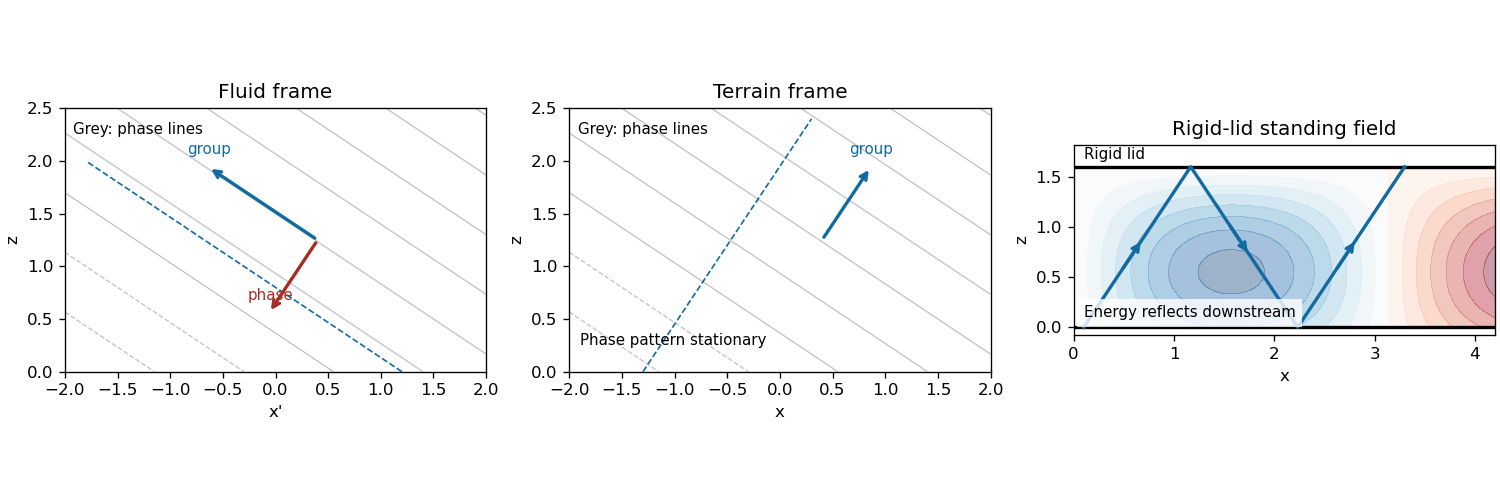
Phase lines and energy rays of topographic internal waves in fluid and terrain frames, with rigid-lid reflection
. Details. 
Let be the complex vertical velocity amplitude in . It satisfies , with and . Away from resonance, solve these two boundary conditions:The resulting field is a standing vertical superposition of equal-amplitude upward and downward internal gravity waves. Write . The rigid lid gives , and the bed givesThe upward vertical-velocity amplitude is . For real positive , its phase relative to the bed-height coefficient is if and if , modulo . Relative to the imposed bed-velocity coefficient , the phase is instead in the positive-sine case, with an additional when the sine changes sign. The complex coefficient gives the answer without convention ambiguity. The upward displacement coefficient, if desired, is , since for the stationary wave.
A reflecting lid reverses the vertical energy direction while retaining horizontal wavenumber and laboratory frequency. In the terrain frame the incident and reflected energy rays therefore travel downstream while zigzagging between the boundaries. The velocity field has nodes at the lid and a vertically standing pattern; the sketch marks this ray geometry, rather than falsely drawing the reflected ray as a specular optical ray.
The intrinsic group velocity makes an angle with vertical satisfying . Consequently the denominator vanishes whenThese are the rigid-lid resonance of stationary topographic internal waves. At such a nonzero vertical mode the homogeneous rigid-lid eigenfunction is also zero at the bed, so it cannot satisfy the nonzero prescribed bed velocity; a bounded stationary inviscid forced solution does not exist. Time-dependent forcing produces secular modal growth until dissipation or nonlinearity intervenes. The formal , limit is not this resonance: is finite. Propagating resonance also requires ; an evanescent field has no real standing-wave resonances of this kind.
Articles by others on the same topic
There are currently no matching articles.