Use tangent vectors, rather than the affine tangent plane, to differentiate. Every skew-symmetric matrix gives a curve in the special orthogonal group. Its first derivative under is . The trace pairing annihilates every skew-symmetric matrix precisely when is symmetric: choosing with only entries tests each off-diagonal antisymmetric entry. Thus criticality is equivalent to being symmetric.
Since is orthogonal, , so at a critical point . Consequently commutes with . The diagonal entries are distinct, and the equation gives for . Hence and are diagonal. Orthogonality and the determinant constraint give exactlyConversely each such makes symmetric, so this list is complete.
To calculate the Hessian matrix, use local coordinates with ; the matrix exponential is a local coordinate map near zero. Its quadratic term givesbecause . There are no mixed quadratic terms. For , , so has the sign of and is never zero. Every listed critical point is therefore nondegenerate, with Morse indexThis is the trace height on the special orthogonal group calculation; the rotations in the hint select the individual coordinates .
For , the signs have indices respectively. A Morse function on a compact closed manifold has Euler characteristic equal to the alternating number of critical points, by its Morse handle-attachment theorem and resulting finite CW complex. Hence
The usual compact closed-manifold hypothesis is needed for the first assertion, or a proper bounded-below Morse exhaustion in an appropriate noncompact version. As literally printed without any such condition, on is a Morse function with no critical points, while . We prove the intended closed-manifold statement, which applies to the surface product later in the question.
By the Morse handle-attachment theorem, crossing an index- critical point attaches an -handle, and no topological change occurs between critical levels. Retraction to the core disks of handles gives a CW complex model with cells in dimension . Its cellular chain complex has . Tensor with , which computes the ranks of integral homology. Since homology is a quotient of a vector subspace of , . This argument has not used the Morse inequalities.
The strong Morse inequalities and top-dimensional equality areTheir weak form is . To see the algebra behind the strong form, put in the Morse chain complex, with . The kernel-image dimensions give , so the alternating difference at is exactly . Conversely, given the strong inequalities, denote those alternating differences by , with . Then , proving that they imply every weak inequality.
They are not equivalent as numerical restrictions. For the Betti numbers of , the formal counts satisfy all weak inequalities and the Euler equality, but at give . They therefore cannot be the counts of a Morse function on ; the strong inequalities detect that additional obstruction.
If all the strong inequalities are equalities, all vanish and . An integer boundary matrix with rational rank zero is the zero matrix. Thus the integral complex itself has zero differential, not merely its rationalization. Consequentlyand higher homology vanishes. In particular there is no homology torsion. This is an integral consequence of a Perfect Morse function, rather than just an assertion about ranks.
For , the integral homology is free with Betti numbers . The Künneth theorem therefore has no torsion terms, and the product's Poincaré polynomial isSumming the weak inequalities yields the lower boundChoose a surface Morse function with one minimum, saddles and one maximum. It can be built from one closed disk, the standard one-handles, and a closing closed disk, using the local forms , , and at the handle centres. Regular collars interpolate between the handles without new critical points. Now set . Its critical points are the ordered pairs of those of , and its Hessian matrix is a block direct sum; the indices add. This product of Morse functions has exactly critical points and realizes every displayed Betti count. Small bumps constant near the critical pairs can separate their values without altering the Hessians or creating new critical points.
The same minimum does not apply to arbitrary smooth functions. Here is an explicit finite-critical-point counterexample, avoiding any assumption that degeneracy leaves the Morse lower bound intact. On , takeIt is well defined because shifting either coordinate by reverses two of its factors. Its derivatives are and . If either or vanishes, both derivatives vanish only at . Otherwise and must be multiples of , giving exactly and in addition to the origin. At the first point the Hessian is , positive definite; at the second it is its negative. They are a minimum and maximum. The origin is an isolated degenerate monkey saddle, with leading term . Thus this three-critical-point function on a torus has exactly three critical points.
For , perform connected-sum gluing of functions between this torus and a perfect Morse surface of genus : delete a small neighbourhood of the torus maximum and of the other surface's minimum, and join their regular boundary circles by a monotone cylinder. Collar coordinates ensure nonzero differential throughout the neck, so precisely those two critical points are lost and none are added. The result on has critical points, retaining the degenerate point. For , simply use . Calling this smooth function and the earlier perfect Morse function , the smooth product hascritical points. This explicitly proves the negative answer to the unrestricted smooth-minimum question; it does not assert that this smaller illustrative count is sharp.
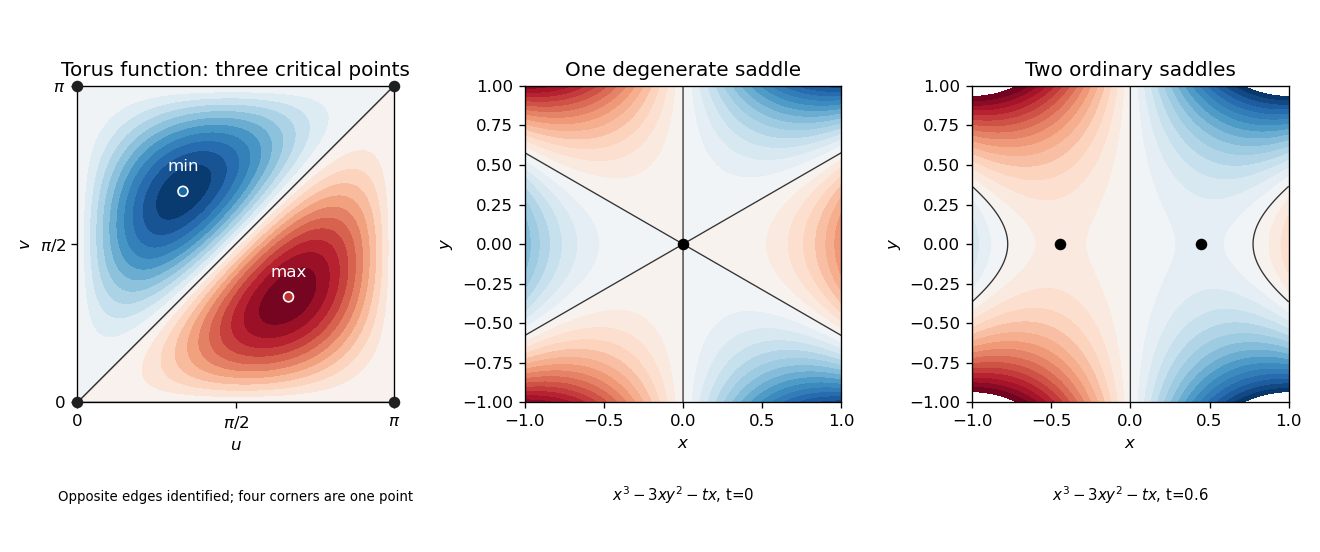
The explicit three-critical-point torus function and the local merger of two Morse saddles into one degenerate saddle
. Details. 
For a framed embedding , index- surgery on a smooth manifold removes the interior of that region and replaces it by . Their common boundary is , along which the framing specifies the gluing. This is a surgery. Its trace is an -dimensional cobordism obtained by attaching the handle to along the outgoing boundary.
In the present surface case, and . The operation removes an annulus around the embedded curve and caps its two boundary circles by closed disks. Since , the curve cannot separate the oriented torus: a separating curve is the oriented boundary of one of the complementary subsurfaces and is therefore null-homologous. Thus it is a nonseparating curve, and the cut-open surface is connected with two boundary components. Its Euler characteristic is zero, since both the removed annulus and the gluing circles have Euler characteristic zero. Capping adds two, so the resulting oriented closed connected surface has . By the allowed surface classification it is a sphere. ThereforeEquivalently the classification shows that is a cylinder. The argument is conditional on the asserted embedding existing; it does not assign a surgery manifold to a nonexistent embedded curve.
Choose an arc in this connected cylinder joining its two boundary circles and close it by an arc crossing the removed annulus. After smoothing the joints, its closed curve meets transversely exactly once. If , then their algebraic intersection number of curves on an oriented surface isThis proves that is a primitive homology class and forces .
Conversely, if , the mapis an immersion with the required homology class. If its values at coincide, then and are integers; Bézout's identity gives . It is therefore injective and, by compactness, an embedded circle. An explicit annular thickening isThe determinant of its coordinate derivatives is . If two image points coincide, solving for the difference in the normal coordinate shows that is an integer multiple of . The strict choice of forces that integer to be zero, so and then modulo one. This supplies the actual required embedding, not just a homology class. Hence
Choose real constants and define the smooth homogeneous quotientIt is unchanged by nonzero rescaling, so it is well defined on Real projective space. On the unit sphere its differential vanishes on the tangent space precisely when is proportional to , where . The entries are distinct, so the only critical projective lines are . In the affine chart , write for . ThenIts Hessian at zero is diagonal with entries . Exactly are negative, and none vanish. Thus this is a Morse function with one critical point of index for every .
Choose the quotient of the round metric on the unit sphere. The downward gradient flow has sphere equation and projective solutionNormalization to the unit sphere supplies the common positive factor. As , the smallest index with nonzero coordinate dominates; as , the largest dominates. ConsequentlyThese are its unstable manifolds and stable manifolds. If , the tangent directions in allow coordinates , and those in allow , modulo the common projective line. Together they span the full tangent space at every intersection. If the intersection is empty. Thus the flow is a Morse-Smale gradient flow, with no generic perturbation needed.
Orient each unstable manifold using its affine coordinates. The Morse-Smale complex has ; its differential counts oriented unparametrized connecting trajectories of index difference one. A trajectory from to has only coordinates nonzero, and there are exactly two, distinguished by the sign of . Each sign branch is a single orbit modulo time translation.
To calculate their signs rather than merely count two, use the characteristic closed disk of the unstable cell: the closed upper hemisphere of with , followed by projection onto . Its interior is , and its boundary map is the antipodal double cover . After collapsing , its degree on the -cell is the sum of the degrees of the two sheets. Comparing the sheets by the antipodal map on gives relative orientation : it is induced by on , whose determinant is . Thus the two trajectory signs add to , up to the choice of generator orientations. The projective quadratic Morse complex is thereforeIn particular , as required for the connected one-dimensional skeleton. The signed trajectory count agrees with this attaching-map incidence calculation, so it computes integral rather than only mod-two homology.
For , taking kernels modulo images givesFor example, an odd interior-degree generator has zero outgoing differential but twice itself is the image from the next degree; an even positive-degree differential is injective. At the top there is no incoming differential, leaving a copy of exactly when is odd. For the space is one point and only remains. This recovers the cellular homology of real projective space by explicitly constructing its Morse-Smale complex and signs.
The smooth h-cobordism theorem states: if is a compact smooth h-cobordism, , and its connected boundary manifolds are simply connected, then there is a diffeomorphism restricting to the prescribed identification on . In particular and are diffeomorphic. Being an h-cobordism means that both inclusions are homotopy equivalences; their fundamental groups then also identify with that of .
The homotopy-equivalence condition is necessary for a trivial cobordism: each end of a cylinder is a deformation retract, by for the incoming end and for the outgoing end. Its relative homology with respect to either end is consequently zero. Compactness is also necessary for a product with a closed compact end. The dimensional bound and simple connectivity are not necessary for an individual cobordism to be a product. The cylinder is a simply connected trivial cobordism of dimension three; and, in the theorem's dimension range, is a six-dimensional trivial cobordism with fundamental group . These prove the two non-necessity assertions explicitly, while the inclusion argument proves necessity of the h-condition.
For the remaining claims, use a cobordism Morse function: its two regular boundary levels are zero and one, and all critical points are interior. An arbitrary function with unrelated boundary values would not have the relative handle-count property. The relative Morse chain complex for has one generator per critical point, in its Morse index. ThusA trivial cobordism has zero relative homology, hence zero relative Euler characteristic. Modulo two the displayed sum is the number of critical points. An odd number makes it odd, and therefore nonzero. This proves an odd-critical-point cobordism is not trivial.
With precisely two critical points of indices , a trivial cobordism requires the two-generator relative complex to be acyclic over . Equal indices leave a rank-two homology group; a gap of more than one leaves both generators with zero possible differential. Therefore is necessary. The remaining two-term complex isChoose a transverse gradient-like vector field. A nonzero differential requires the index- point to be above the index- point; otherwise no descending connecting trajectories exist. In a common regular level between them, the belt sphere has dimension , and the attaching sphere has dimension , where . Their dimensions add to , the level's dimension, so their transverse intersection consists of points. Each intersection is one descending trajectory from to , modulo time translation. Orient the attaching sphere and use an orientation of a vector space on the handle core to coorient the belt sphere; the resulting signed count is the cellular boundary coefficientThe two homology groups are the kernel and cokernel of multiplication by . They vanish precisely when is a unit of . Consequentlyare necessary. This proves the two-critical-point obstruction to a trivial cobordism; it makes an algebraic incidence statement and does not assume that an algebraic count of one automatically supplies geometric handle cancellation.
For an explicit nontrivial cobordism from to itself, attach two zero-framed two-handles to the outgoing end of along the standard Hopf link. Its two components are unknots with linking number one. This realizes two successive surgeries, as suggested by the hint. The outgoing boundary is again , and this can be checked geometrically: the Hopf-link exterior is , and each component's zero-framing longitude is the other's meridian. Filling along these two slopes glues two solid tori with meridians intersecting once, the standard genus-one Heegaard decomposition of . Thus zero surgery on the Hopf link does return the three-sphere, not just an unspecified homology sphere.
The trace has only the two added index-two handles. Its relative cellular complex has and all other groups zero, soIt cannot be a product cylinder. Equivalently this trace is with two disjoint open four-balls removed: the usual handle presentation of has one zero-handle, the two zero-framed Hopf-linked two-handles, and one four-handle. Removing the bottom and top balls exposes the two three-sphere ends. The relative-homology calculation alone already proves the requested cobordism is nontrivial.
Articles by others on the same topic
There are currently no matching articles.