Chemical equilibrium for implies , because equilibrium photons have zero chemical potential. Dividing the three nonrelativistic Maxwell-Boltzmann number densities therefore givesThe Hydrogen binding energy is in natural units. For ground-state hydrogen, with hyperfine splittings unresolved, and , so the degeneracy ratio is one. Equivalently one can omit nuclear-spin degeneracy consistently from both the proton and atom. Excited hydrogen levels are exponentially suppressed at recombination temperatures. Also , so its effect in the prefactor is negligible. ThusThe sign of the exponential follows from the smaller rest mass of the bound atom: cooling favours neutral hydrogen once translational entropy no longer compensates the binding energy.
Ignoring helium, charge neutrality gives , while baryon conservation gives . Defining the hydrogen ionization fraction yields and . Substituting in the abundance relation givesUse and to obtain the Saha equation:If the positive right side is denoted by , the physical root isThis form avoids subtracting nearly equal numbers when is small, and makes the limits transparent: for , whereas for . It is an equilibrium prediction; a kinetic cosmological recombination treatment is needed after reactions cease to keep up with expansion.
There are about photons per baryon. Even when the typical photon energy is below the Hydrogen binding energy, the high-energy tail can provide abundant ionizing photons. The nonrelativistic electron's translational phase space also favours the ionized state. Quantitatively, the Saha equation contains both suppressing factors and . Recombination needs their tiny product to be overcome by , so must be several tens, not of order one.
For an illustrative , the supplied baryon-to-photon relation gives . With , direct evaluation givesThus the equilibrium ionization fraction reaches a few per cent just below , while at it is essentially unity. The exact temperature depends weakly on the baryon abundance and on the fraction used to define cosmological recombination. This is small baryon abundance delays hydrogen recombination. Recombination, photon decoupling and residual electron freeze-out are related but distinct: the last two involve rates and cannot be determined by chemical equilibrium alone.
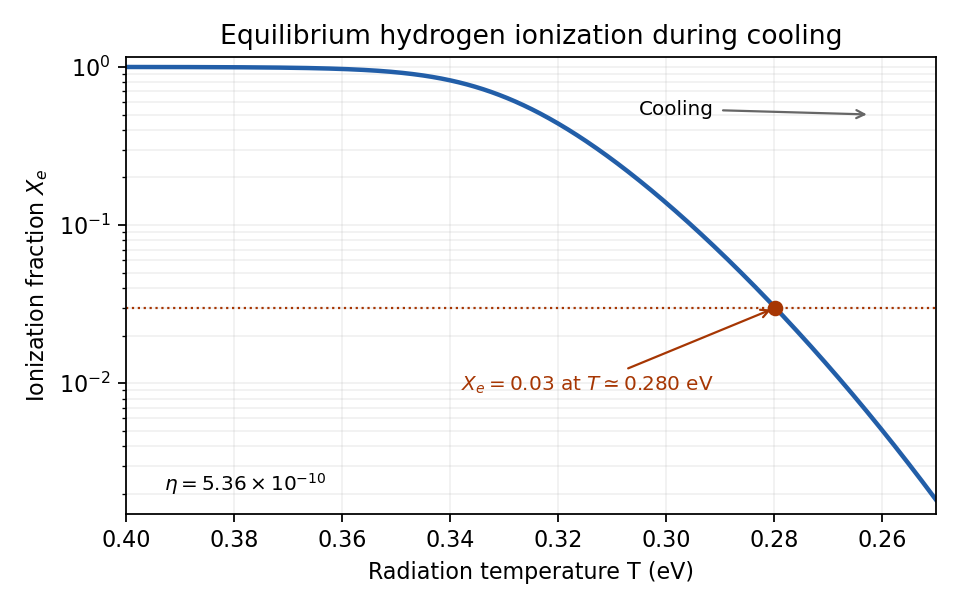
Hydrogen-only Saha ionization fraction during cooling, with the three-per-cent crossing near 0.28 electronvolts for baryon-to-photon ratio 5.36 times ten to the minus ten
. Details. 
Use the flat matter-only Einstein-de Sitter approximation for the distance-redshift relation, neglecting radiation corrections at cosmological recombination. Let be the cosmological recombination redshift. Adiabatic photon cooling gives . The Hubble rate is , so the comoving radial distance to last scattering isThe angular diameter distance is . A proper Hubble radius therefore subtends the small angleThis is the angular Hubble-radius scale in an Einstein-de Sitter universe; the present Hubble constant cancels.
Taking and the literal printed gives and radians, or degrees. As noted above, that present CMB energy is too large by ten. With the corrected , andwhich gives the familiar order-one-degree scale within the assumed cosmology. Using to mark a few-per-cent ionization fraction changes this only modestly. These numbers refer to the Hubble-radius scale, not its diameter. In a matter-only universe the particle-horizon radius is and would give twice the angle; the acoustic sound horizon is a different length again.
Articles by others on the same topic
There are currently no matching articles.