For a finite-dimensional Lie algebra, the Killing form is defined using the Adjoint representation on the algebra itself, rather than the given Lie algebra representation :The Jacobi identity gives . Using the cyclic property of the trace,The same trace identity makes the Killing form symmetric. For a basis , the lowered structure constants of a Lie algebra are . Antisymmetry of the Lie bracket gives , while invariance gives . The two adjacent transpositions generate every permutation, proving the antisymmetry of Killing-lowered structure constants: is totally antisymmetric, even if the Killing form is degenerate.
A semisimple Lie algebra has no nonzero solvable ideal; equivalently, its solvable radical is zero, or, in characteristic zero, its Killing form is nondegenerate. A real compact Lie algebra is the algebra of some compact Lie group, equivalently an algebra admitting a positive-definite invariant bilinear form on a Lie algebra. For a real semisimple Lie algebra the compactness criterion from the Killing form says precisely that is negative-definite. A compact algebra with a nonzero abelian center has a degenerate Killing form, so the semisimplicity qualification matters.
For a semisimple Lie algebra, let denote the inverse matrix of . Its Casimir operator in isThis contraction is independent of the chosen basis. To prove centrality directly, put . Invariance gives , hence . The Lie algebra representation property and the product rule for a commutator now giveIndeed, the coefficient of in this expression is . Thus for every . No irreducibility of is required.
The matrix units obey . Consequently the general linear Lie algebra hasFor its Killing form, write and , so that . Left multiplication acts identically on each of the columns, and right multiplication identically on each of the rows. Thus . The diagonal coefficient of on is , giving ; the other mixed trace is identical. This proves the Killing form of the general linear Lie algebra:The scalar matrices form a nonzero central abelian ideal, so is not semisimple for any . More explicitly, the radical of the Killing form is , since vanishing against every forces by nondegeneracy of the trace pairing. For , take . Then , whereas a positive-definite invariant inner product would make every adjoint map skew and hence give . Therefore is not compact when . For the allowed exceptional value , the abstract abelian algebra is a compact Lie algebra, being isomorphic to the algebra of ; the particular matrix group is nevertheless noncompact. This distinguishes compactness of an algebra from that of a chosen group realizing it.
For the final algebra, the printed basis specifies strictly upper triangular matrices. If and , the first term in can be nonzero only when , and then is strictly upper triangular; the second can be nonzero only when , and then is strictly upper triangular. Bilinearity proves closure under the Lie bracket. To compute its own Killing form, grade by the positive integer . Bracketing with any basis element increases that degree whenever the result is nonzero. In a basis ordered by degree, all adjoint maps are strictly triangular, as are their products. Every such product has zero trace, so the Killing form of a nilpotent Lie algebra vanishes here. Therefore the subspace denoted by a prime in the PDF isThis is the defined radical of the Killing form, not the derived algebra; for both and this radical are zero.
A highest-weight vector is a nonzero vector satisfying and ; its eigenvalue is the highest weight. Existence does not require the Lie algebra representation to be antihermitian. Since is a nonzero finite-dimensional complex vector space, has an eigenvector with some eigenvalue . The commutator with shows that each nonzero has eigenvalue . Infinitely many such vectors would have distinct eigenvalues and be linearly independent, which is impossible. The last nonzero vector in this raising chain is therefore a highest-weight vector .
Put . The ladder operator relations give . The raising coefficient follows by expanding the commutator of with a power of :The factor is essential: these ladder operators have , rather than the convention with . The same finite-dimensionality argument gives a last nonzero lowered vector , with . Applying to yieldsso . All are nonzero and have distinct eigenvalues. Their span is invariant under and therefore under the original three generators. Irreducibility of the Lie algebra representation makes this span equal to . HenceIn particular, the initial construction produces the largest eigenvalue of , since its full spectrum is now . This establishes the highest weight without assuming beforehand that all eigenvalues are real or that is diagonalizable.
For the additional antihermitian Lie algebra representation, the given definitions imply and . Thus distinct eigenvalues give orthogonal weight vectors. With , write . The adjoint relation and the raising coefficient giveMultiplying this recursion proves the normalized highest-weight lowering formula in the present normalization:Every factorial argument is an integer, even for half-integral . The displayed states have unit norm, mutually distinct eigenvalues, and span , so they form an orthonormal basis. Their phase convention also fixes the positive ladder amplitudeswith the endpoint actions interpreted as zero. These amplitudes will determine the Clebsch-Gordan coefficients.
The Clebsch-Gordan decomposition for SU2 iswhere increases by one and every summand occurs once. The tensor product of Lie algebra representations is antihermitian for the product inner product, so an invariant subspace has an invariant orthogonal complement; this gives complete reducibility. To see the particular summands, suppose . The product weight diagram has one state of weight , two of weight , and increasing multiplicities down to the plateau determined by . Subtracting the weight string of leaves a single highest state of weight . Repeating highest-weight character subtraction yields exactly the displayed sequence, down to . Its dimensions exhaust the tensor product becauseThe case is identical with the factors exchanged.
Let be the Clebsch-Gordan coefficients. Since the total is , orthogonality of its eigenspaces gives the selection rule unless . Normalize the coupled states by lowering from a unit highest-weight vector, as in part (i); a common phase for an entire summand is immaterial. ThenTake the inner product with . On the other hand, the total ladder operator is , and . Its action on the product bra is thereforeEquating the two evaluations and multiplying by proves both signs of the ladder recurrence for Clebsch-Gordan coefficients:Terms with an index outside its allowed weight range are zero. Merely specifying eigenvectors of would allow unrelated phases for different ; the coherent positive-ladder convention above is what makes these recurrences hold with the displayed positive square roots.
Covariance of the fundamental gauge covariant derivative requires for every column . Expanding the left side and cancelling gives . Therefore the necessary and sufficient Yang-Mills gauge transformation isIn operator notation . Expanding its commutator on an arbitrary column shows : the second derivatives cancel, as do the terms containing a single derivative of . Conjugating this identity proves the gauge field strength transformationThus the gauge field strength transforms homogeneously even though the potential has an inhomogeneous derivative term.
For the adjoint scalar field, write and . Differentiating the inverse matrix givesThe extra terms cancel, proving for the adjoint covariant derivative. Its curvature is obtained by another direct expansion:where the Jacobi identity combines the last two terms.
For the equations of motion take compactly supported variations, and assume , as required by the Lagrangian coefficient. Invariance of the Killing form impliesIndeed, the two connection terms sum to . This is the gauge-covariant integration by parts identity. The needed variations areAntisymmetry of the gauge field strength combines its two variation terms. Applying gauge-covariant integration by parts to the action givesHere fixes the sign of the scalar current. Since the Killing form is nondegenerate on a semisimple Lie algebra, independent variations give the coupled Yang-Mills equations and scalar equationEquivalently, . These signs use the stated Minkowski metric, with upper spatial derivatives .
It remains to verify every equation for the static Bogomolny equations. The hypotheses imply and , so the temporal gauge equation is automatically zero. The gauge-theory Bianchi identityfollows, for example, from the Jacobi identity for the fundamental gauge covariant derivatives, using their commutator . Define . Contracting the gauge-theory Bianchi identity with gives . The Bogomolny equations say , so implies . In the static configuration , verifying the scalar equation.
For the spatial gauge equation, use and . The Bogomolny equations, the curvature commutator proved above, and the contraction of two Levi-Civita symbols givesince . This is exactly . Thus the static first-order Bogomolny system satisfies all four gauge equations and the scalar equation, with no extra ansatz or boundary assumption needed for this local implication. This is the mechanism by which Bogomolny monopole equations imply Yang-Mills-Higgs equations.
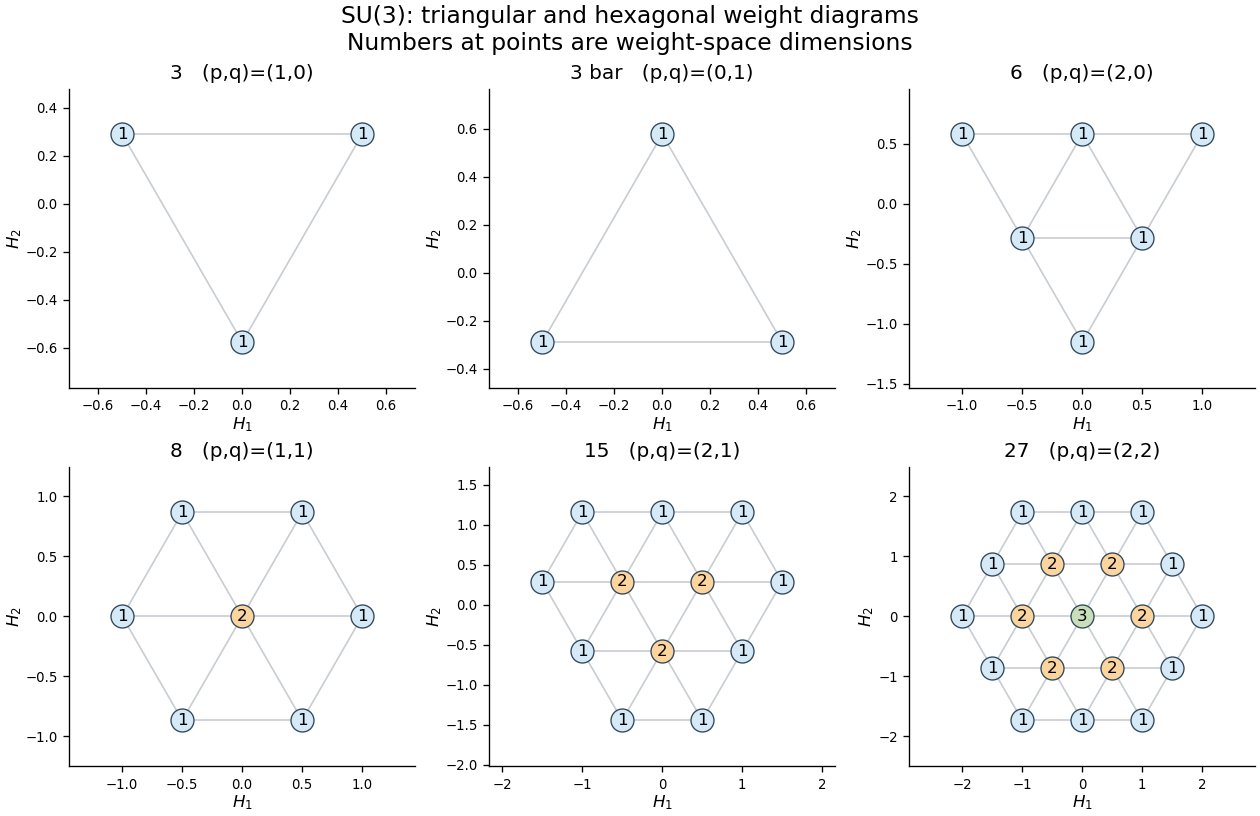
The SU(3) Lie algebra is the compact real algebra of traceless skew-Hermitian matrices; its complexification is , a special linear Lie algebra. In an antihermitian Lie algebra representation, the two commuting Cartan operators are Hermitian matrices, and the root operators satisfy . Thus the spectral theorem gives an orthogonal weight-space decompositionA weight diagram plots the pairs , recording the weight multiplicity at each position. One point need not represent only one state. The commutators with give the roots of a root systemThe raising operators move a nonzero weight vector by and the lowering operators move it by . These six root directions form the A2 root system. Each root and its negative generate an SU(2) representation ladder; in particular the pairs with Cartan operators and constrain the two simple-root strings.
Choose a linear functional positive on the three positive roots. A maximal weight for this ordering is killed by every raising operator. In an Irreducible Lie algebra representation it generates the entire representation by lowering, and its weight space has dimension one. The two SU(2) representation strings show that its Dynkin labels are nonnegative integers:Conversely, each such pair specifies exactly one finite-dimensional irreducible highest-weight representation. Write it as . The fundamental weights in these Cartesian coordinates are and , soThe dimension follows from the three positive-root factors in the Weyl dimension formula: , , and . The complex conjugate representation is , with every weight negated. The SU(3) highest-weight coordinates here use as Dynkin labels, not as the plotted Cartesian coordinates.
The weight diagram is invariant under the Weyl group, generated by reflections perpendicular to the two simple roots; its convex hull is the orbit polygon of the highest weight. For it is a point, the trivial representation. If exactly one of is zero, the polygon is an equilateral triangle, with opposite orientations for and . Its edge has root steps. If , it is a hexagon with alternating edge lengths root steps; it is regular precisely when . The diagram contains the lattice points in that polygon belonging to the coset root lattice. A point in a different weight lattice coset is not a weight merely because it lies inside the polygon.
The shell multiplicities in an SU(3) weight diagram can be stated geometrically. The outer boundary has weight multiplicity one. Removing it leaves the orbit polygon for on the same lattice coset, with every surviving multiplicity reduced by one. Repeating increases the actual weight multiplicity by one at each inward layer until the smaller label reaches zero. The remaining triangular region then has constant multiplicity ; when it is just the central point. A triangular weight diagram has multiplicity one everywhere. Thus , the adjoint representation of SU(3), has six root weights of multiplicity one and two independent zero-weight states; has an outer shell of multiplicity one and an inner triangle of multiplicity two; has twelve outer states, six positions of multiplicity two, and a central position of multiplicity three. The total is . The dominant weight multiplicity formula for sl3 is an algebraic expression of the same rule.

For a tensor product of Lie algebra representations, the Cartan operators add. Consequently its tensor-product weight diagram has weights and multiplicitiesGeometrically, place a copy of the second weight diagram at every weight of the first, multiplying and adding coincident multiplicities. Because the representation is antihermitian, invariant subspaces have invariant orthogonal complements. To decompose the product, select a maximal remaining dominant weight, identify its irreducible highest-weight representation, subtract that representation's whole diagram with its weight multiplicities, and repeat. This highest-weight character subtraction must exhaust every weight, not merely the corners. Unlike the Clebsch-Gordan decomposition for SU2, an SU(3) product may contain repeated copies of an irreducible representation.
The two three-dimensional Fundamental representations of sl3 are and . In , the largest weight is , giving the six-dimensional triangle ; subtracting it leaves the reversed three-dimensional triangle . The first summand consists of symmetric tensors and the second of antisymmetric tensors. In , the weight sums give the six roots once and weight zero three times. Subtracting the octet, whose zero weight has multiplicity two, leaves a singlet. Hence the octet and singlet in a fundamental SU3 tensor product and the two-quark product areThe first dimensions are , and the second are . Next has highest weight , giving . Subtraction leaves one . Together with , this proves the tensor cube of the defining SU(3) representation:The decuplet is fully symmetric in the three factors, the singlet fully antisymmetric, and the two octets have mixed permutation symmetry.
For the quark model, the relevant approximate flavour symmetry rotates the three light quarks in the fundamental . The up quark, down quark, and strange quark basis states have the weight diagram of the defining SU(3) representation. In physical coordinates define isospin and flavor hypercharge . ThenThe last row follows from the Gell-Mann--Nishijima formula , in units of the positive elementary electric charge. The antiquarks transform in and have the negatives of these additive quantum numbers. Each quark has baryon number ; the strange quark has strangeness , while have . Thus , distinguishing flavor hypercharge from electroweak hypercharge. The Weyl group geometry is equilateral in ; using rescales the vertical coordinate.
A conventional meson has valence content , so its flavour symmetry gives a meson octet and a singlet. For the light pseudoscalar mesons, the octet contains the pions at with isospin , the kaons at , their antiparticles at , and the Eta octet state. The central weight multiplicity two is realized byThe orthogonal eta singlet state is . The eta and eta prime mesons are mixtures of , rather than exact octet and singlet mass eigenstates; this gives the pseudoscalar meson nonet. A different spin coupling of the same flavour product gives the vector mesons, again an octet and singlet, including the , , and neutral mixtures. The lowest orbital states have and respectively.
A conventional baryon has three valence quarks, so the tensor-cube decomposition supplies the flavour possibilities. The observed lowest baryon octet has spin and positive parity. Its isospin rows are : the nucleons , the three Sigma baryons, the Lambda baryon, and the two Xi baryons. The central states and have the same weight but different total isospin; this is the physical meaning of the octet's central multiplicity two. The spin-, positive-parity baryon decuplet is the triangle with rowsThe Delta baryons form its top row, and the Omega baryon is the bottom state. All ten weights have multiplicity one. Their electric charges follow directly from the Gell-Mann--Nishijima formula; for example has , so , and has , so .
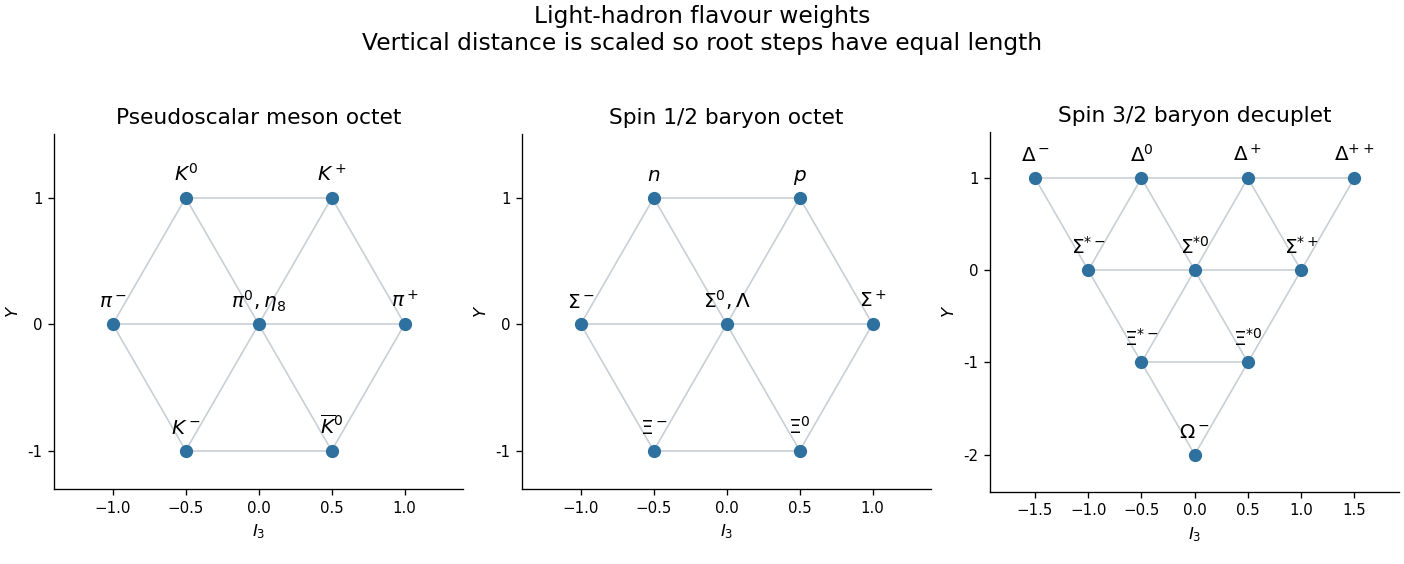
Light pseudoscalar meson octet, spin-one-half baryon octet, and spin-three-halves baryon decuplet in isospin and flavour-hypercharge coordinates
. Details. 
The two algebraic octets do not mean that two independent ground-state octets must occur. A three-quark colour singlet has a completely antisymmetric colour wavefunction. For a symmetric spatial ground state, the Pauli exclusion principle therefore requires a symmetric combined spin-flavour wavefunction. The symmetric flavour decuplet pairs with symmetric spin ; mixed flavour octets pair with mixed spin in one symmetric combination. Equivalently, the symmetric spin-flavour SU6 representation hasThe three-quark flavour singlet is the antisymmetric combination. For a spatially symmetric ground state it would require an antisymmetric spin state of three spin- particles, but . The Pauli constraint on three-quark flavour multiplets thus excludes it from this ground-state sector; orbital excitation permits other multiplets.
Finally, this flavour symmetry is approximate: the unequal light-quark masses, especially the larger strange-quark mass, and electromagnetic interactions split masses within the multiplets and permit octet-singlet mixing. The weight diagrams classify flavour states, rather than asserting exact equality of their masses. Colour SU(3) is a separate gauge action on each flavour and supplies the colour-singlet constraint; it is not the approximate flavour action used in the eightfold way. The light conventional mesons organize into flavour octets and singlets, while the spatial ground-state three-quark baryons form one spin- octet and one spin- decuplet.
Articles by others on the same topic
There are currently no matching articles.